
The OECD has noted the lack of success thus far of the KiwiBuild initiative and is urging the Government to focus more on low-income renters.
As part of its latest survey of New Zealand, the OECD has looked at the housing affordabilty issue here.
Andrew Barker, New Zealand Desk, OECD Economics Department, says the government has taken a more active role in the delivery of new housing supply through KiwiBuild. But...
"Despite taking on considerable risk through underwriting or purchasing new homes, KiwiBuild is yet to deliver a substantial increase in affordable housing."
The Government is currently working on a "reset" of the Kiwibuild policy, which it has now been talking about since January.
"The reset currently underway is a good opportunity to re-focus the programme towards mitigating risks that developers are not well placed to manage, such as aggregating fragmented land holdings," Barker says.
"Better targeting of government programmes (including KiwiBuild) through focussing more on low-income renters would enhance overall well-being."
Barker says social housing supply is low by international comparison and there are poor outcomes for at-risk groups, including overcrowding, low quality housing and high homelessness.
"Further expansion of social housing in areas where there are shortages has the potential to deliver improvements across a number of well-being dimensions, including health, education and life satisfaction."
While the Government has been tightlipped about what the seemingly much-delayed "reset" will entail, Housing and Urban Development Phil Twyford has indeed hinted that low income renters might be more of a target.
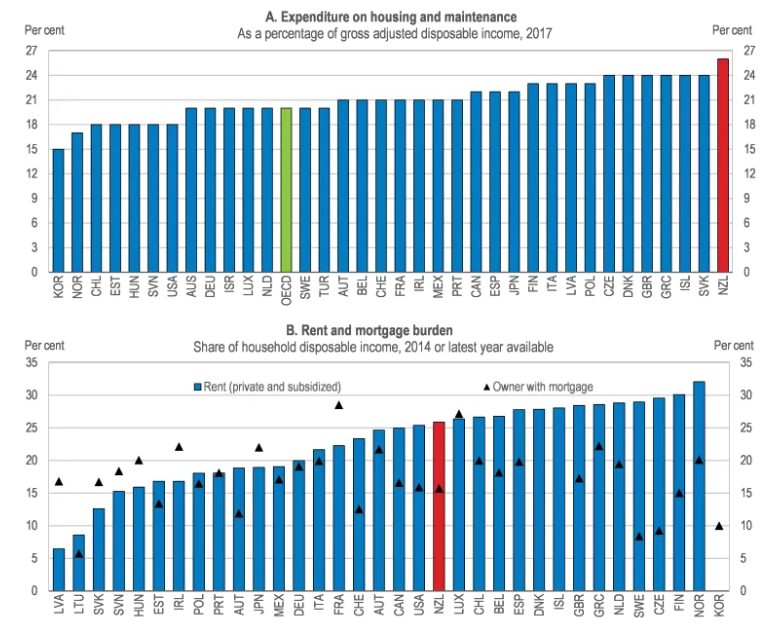
The OECD's Barker says over the past two decades, New Zealand has experienced one of the largest house price increases among OECD countries, pushing up housing expenditure as a share of income to very high levels.
"Affordability for first-time buyers and renters has suffered, particularly in Auckland.
"This is a problem for well-being as it reduces household finances available for other uses, can harm health through various forms of deprivation such as poor nutrition, and adversely affects labour market inclusion. There are also negative distributional consequences, as increasing property prices benefit owners at the expense of renters."
Barker says "weak supply responsiveness" in the face of strong housing demand has been responsible for the escalation in prices.
"Rapid population growth due to net inward migration has combined with record-low interest rates to push up demand.
"Restrictive and complex land-use planning, infrastructure shortages and insufficient growth in construction-sector capacity has impeded new housing. The result has been persistent growth in the number of people per dwelling in Auckland, and in the rest of the country too over the past five years."
Solutions should therefore focus on removing barriers to new housing supply.
"The government has taken a number of promising steps through the establishment of an urban development authority and the Urban Growth Agenda, further implementation of which will be key to achieving its ambitious goals. Strict regulatory containment policies should be replaced with rules that facilitate densification, while infrastructure funding and financing tools available to local governments need to be expanded," Barker says.
The OECD has also made a number of recommendations on NZ's migration policies. These include:
• Require employers to be accredited before they can recruit migrant labour.
• Revise job checks to ensure that migrant labour is only recruited where there are genuine shortages.
• Align the immigration, education and welfare systems to encourage training and employment of New Zealanders.
• Make it easier for migrants on employer-assisted temporary work visas to modify their visa so that they can more easily change their employer.
• Complement Regional Skills Matching Programmes by mentoring and bridge programmes.
We welcome your comments below. If you are not already registered, please register to comment
Remember we welcome robust, respectful and insightful debate. We don't welcome abusive or defamatory comments and will de-register those repeatedly making such comments. Our current comment policy is here.