
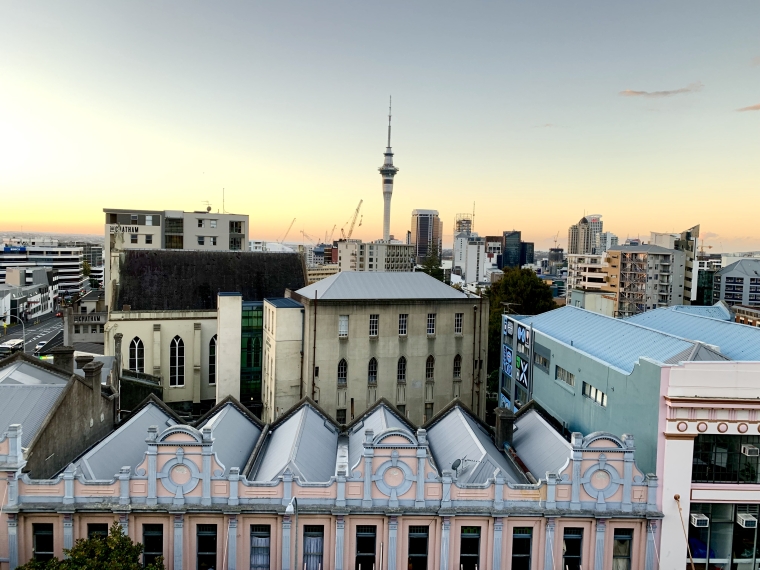
The Auckland Council is seeking the public’s feedback on its future vision for the city's Central Business District (CBD).
The council’s original City Centre Masterplan (CCMP) and Waterfront Plan were adopted in 2012, but it says it’s now time for an update.
It says the two plans will be combined and will provide a blueprint for future development in the central city and allow the council to look at opportunities for future growth.
CBD's growing populous
An Auckland Council discussion document released as part of the public consultation process says the central city’s resident population has increased from 24,000 to over 55,000 since 2012, while the number of daily workers has jumped from 90,000 to more than 120,000.
“Every day over 200,000 people visit the city centre. An estimated 20 per cent of Auckland’s gross domestic product is now generated from the city centre alone.
“Auckland continues to grow at an unprecedented rate. Right now, there is $73 billion of commercial construction across the region and more than 150 major development projects either in progress or in the pipeline. We need to continue the transformation of the city centre so we can provide a cultural and economic heart for Auckland. This will help it become a great place to live, work and play. The City Centre Masterplan refresh provides the blueprint for this transformation.”
The report includes a number of key objectives, such as making the city centre more accessible through increased public transport and a target to reduce the number of cars entering the CBD during the morning peak period by at least 20%.
Central to such plans is the completion of the City Rail Link (CRL) which is expected to be finished in 2024. It will include two new underground railway stations and is expected to double rail city’s rail capacity, with an additional 12,000 people able to travel per hour.
The report says bus congestion, even with a new fleet of double-decker buses, remains an issue as the city’s roads simply cannot handle the volume of people trying to get into town and home during morning and evening peaks.
“This has led to the government proposing development of a light rail system transit linking the suburbs to the city centre and to the airport, in large part to relieve the pressure on the road network.
“Light rail transit between the city centre and Māngere (CC2M), along with a future rapid transit connection to the northwest, will together move many thousands of people per hour along a mostly pedestrianised Queen Street. CRL and light rail will structurally transform city centre access by more than doubling public transport capacity.”
It also includes plans to increase access for walking and cycling and improvements to the downtown ferry terminals. While the reports also says the council needs to make the city centre more liveable for the growing numbers of people who live in and around the CBD.
Economic development
While the economic growth and business activity in the city centre is also highlighted in the masterplan report.
“The city centre is undergoing a radical economic transformation at a scale and pace not envisaged at the time of CCMP 2012. In late 2018, Auckland was acknowledged as having more cranes on its skyline than any city in the United States. It is a sign of ongoing confidence in Auckland’s economy and the appeal of the city centre as a place to invest and live.
“New employment clusters have emerged in the Wynyard Quarter and Downtown with Albert Street emerging as a potentially important commercial office spine associated with CRL. The anticipated drift of commercial office space from Uptown/Aotea Quarter has occurred as signalled in CCMP 2012. Vacated, older office space has however been converted into residential accommodation leading to this area’s emergence as an important residential neighbourhood.”
And the growing changes in the CBD is something Mayor Phil Goff is more than aware of.
“We are transforming the central city for the 21st century and evolving to meet the needs of a diverse and growing population,” Goff says. “This refresh will ensure we can embrace new and creative ideas to support the development of our city centre and enhance those things that make it special – our stunning harbour and waterfront precinct, a strong retail sector, world-class cuisine and entertainment and the influence of our unique Māori culture.”
Planning Committee chairman Chris Darby agrees.
“The city centre is changing dramatically. Right now, there is $16 billion of private and public investment underway which will accelerate the transformation of our city centre,” Darby says. “To realise this vision, we’re planning to integrate the Waterfront Plan with the refreshed City Centre Masterplan to create a holistic vision that finds a place for all people."
The public consultation process for the City Centre Masterplan will run until October 18. The final masterplan is then expected to be signed off by the council’s Planning Committee in February next year.
We welcome your comments below. If you are not already registered, please register to comment
Remember we welcome robust, respectful and insightful debate. We don't welcome abusive or defamatory comments and will de-register those repeatedly making such comments. Our current comment policy is here.