
• The global outlook has weakened with some talk of recession emerging.
• Auckland and New Zealand are not immune from offshore impacts – it will affect us directly and indirectly.
• Auckland in particular starts from a position of exceptional strength, which will make it easier to weather the effects of slower offshore growth.
• Other buffers include Auckland’s industry structure, a better banking regulatory regime, a proactive Reserve Bank, and strong central government surpluses available if needed.
We are bombarded by stories of impending economic doom, particularly focused on what is happening offshore. Risk of recession in the US and Europe, and weaker growth in China, which was the stalwart that helped keep global economic growth above zero through the Global Financial Crisis (GFC) 10 plus years ago.
In New Zealand, business sentiment is the weakest in 10 years.
Does this gathering global and domestic gloom matter to Auckland? The short answer is yes, of course it does. But a more meaningful question is: How much does it matter? Or how well insulated is Auckland against these risks?
Let’s start with some facts
Auckland is in an exceptionally strong economic position. Here’s the evidence.
• Year on year GDP growth to June 2019 is estimated at 2.8%.
• The unemployment rate is 4.2%, the lowest in a decade, and has been flat for about nine months.
• Employment (actual number of jobs) is up 2.8% year on year to June 2019.
• Guest nights, despite some recent wobbles, are up 2.9% in the year to August, and at the highest ever figure for Auckland (20,600 guests per night in our city, excluding uncounted categories like baches and AirBnB).
• Annual net New Zealand migration remains around 53,000, down only 20% from the peak two years ago. Half this migration is into Auckland, so about 27,000 more people a year. They all need to eat, be clothed, use internet services, and have their hair done. That underpins demand for Auckland businesses.
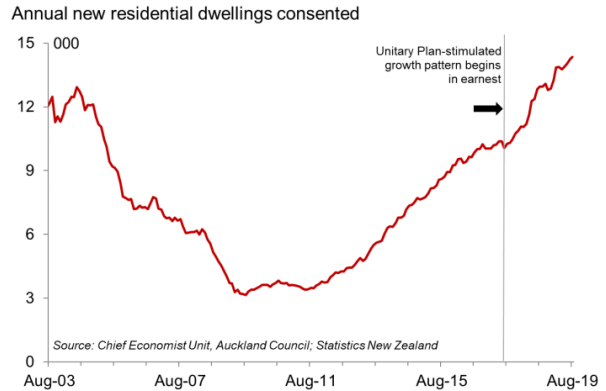
• Auckland has consented 14,345 new dwellings in 12 months to August, up 11% in the year, 43% since the Unitary Plan began to affect development two years ago, and up 356% (not a typo) since we bottomed out in August 2009.
• Non-residential floor area consented is up 49% in the year to August 2019 compared to two years earlier. Almost 100% of this growth is driven by the downbeat private sector.
• Auckland is also constructing its consenting. Annual building work put in place in Auckland is up 20% in nominal terms, or an estimated 15.6% in real terms in the 12 months to June 2019.
• The region has added 160,000 jobs in the last five years, in construction, in tourism, and 22,000 in usually well-paid professional services, which includes lawyers, accountants, and engineers.
• Wages are growing strongly at last, and with higher labour force participation has boosted household incomes by 57% in the last 10 years.
The message is clear. Auckland is not growing at the 5% it briefly touched a couple of years back, but the region is in an exceptionally strong position and continues to grow.
Risks of contagion
So what is it that’s happening overseas that is causing concern? Primarily, it’s the trade war between the US and China. These two countries are exchanging increases in tariffs on each other’s goods, as the US administration seeks to stop what it sees as unfair advantages for Chinese exporters to the US.
Trade protectionism is not new; it was one of the bedrocks upon which the Asian Tiger economies grew rapidly in the second half of the 20th century. Put big tariffs on imports, and create your own domestic industry until you have the economies of scale to compete and even out-perform. But a once popular approach is mostly out of favour today.
The trade balance between China and the US is heavily skewed toward China. As a result, tariffs are having a bigger impact on the Chinese economy. China is also a bigger trading partner for New Zealand, so for simplicity, we’ll follow the logic of how the trade war will affect China and thus us.
Chinese manufacturers are feeling the heat and confidence is falling. This means they will be incentivised to find ways to trade more with other countries. This could actually mean cheaper imports for New Zealand consumers. At the same time, weaker trade by China will mean less job growth there, fewer pay rises and thus less money for Chinese people to spend on premium products like New Zealand dairy milk powder, holidays to our fair isles or sending their children to study here.
It may also mean less demand for overseas products used to drive China’s infrastructure development, such as logs from New Zealand or coal from Australia.
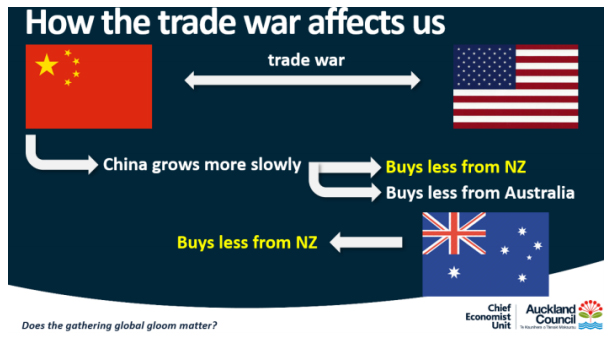
So New Zealand is affected two ways: direct trade with China may fall, and indirect trade with other countries like Australia may fall as they trade less with China.
Finally, if the trade war continues to expand, it will also become a war over political ideologies. Both sides will want peripheral nations to choose between them. Will we side with our biggest trading partner or a country with which we traditionally share more political similarities?
How big is the risk?
Auckland is not immune from this risk, but our city and our country have some buffers that will help.
• Auckland starts from a position of strength. While undesirable, even if growth drops away or unemployment rises to 5% or 5.5%, our economy can weather this.
• Our banking and Reserve Bank system is more resilient than it was at the time of the last slowdown. And to be clear, we are not suggesting GFC 2.0 is upon us, in large part because the regulatory system is much stronger.
• We have a proactive Reserve Bank. Too proactive, some would argue. The Reserve Bank has been clear that in an environment of GDP growth under 3%, it would expect to keep the OCR low to support growth.
• We have huge fiscal surpluses and reserves. Post 2020 election, whoever is in government will have plenty of room to spend if there is any reason to think the economy needs it.
• Auckland’s economy is largely focused on domestic consumption, despite being the international gateway, limiting risk. The city has a tiny primary sector (the national primary sector accounts for 71% of New Zealand’s goods exports), some exposure to manufacturing exports, and moderate exposure to tourism. But only about one-seventh of the city’s economy is in any way directly exposed to international trade in these sectors.
* David Norman is chief economist at the Auckland Council. This article was first published here.
We welcome your comments below. If you are not already registered, please register to comment
Remember we welcome robust, respectful and insightful debate. We don't welcome abusive or defamatory comments and will de-register those repeatedly making such comments. Our current comment policy is here.