
The country's commercial property market is likely to be hit by a wave of new properties being completed, just as demand for commercial premises starts to soften during an expected recession.
The latest figures from Statistics NZ show that building consents for new commercial buildings have been running at elevated levels for most types of commercial premises and it's likely that much of that additional space will be completed in the next 12 months.
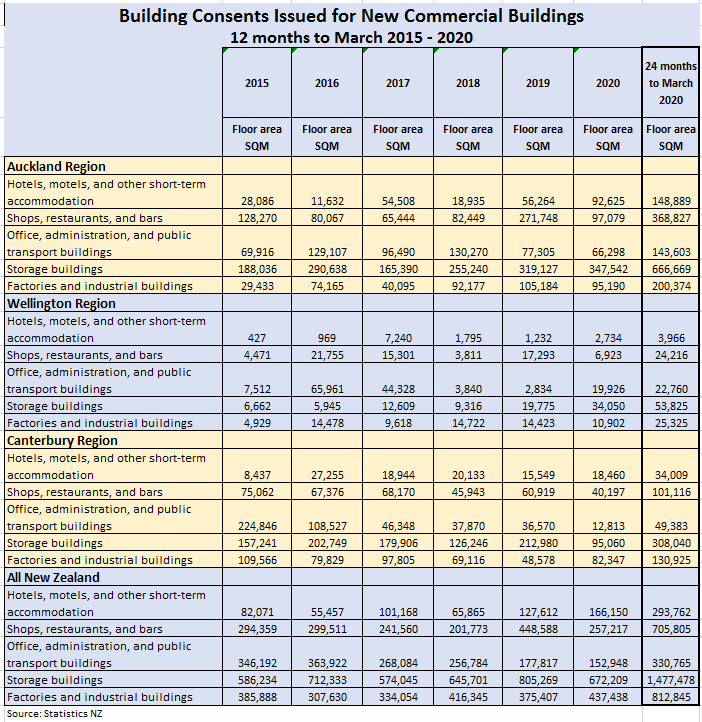
The table below shows how much new space (in square metres) was consented for offices, hotels/motels, shops/restaurants/bars, factories and storage buildings such as warehouses, in each 12 month period ending March, from 2015 to 2020, both nationally and in each of the Auckland, Wellington and Canterbury regions.
The final column on the right, (in the table below), shows how much new space was consented in the 24 months to March this year, with most of that work likely to still be at various stages of construction.
This shows that in the 24 months to the end of March this year, 293,762 square metres of new hotel/motel space was consented throughout the country, with half of that being in Auckland.
That was an average of almost 147,000 square metres a year, compared to an average of just over 76,000 square metres a year over the previous four years.
That is particularly concerning because the accommodation sector has been one of the most severely hit sectors by the fallout from the COVID-19 lockdown and is likely to remain so for some time, and also because hotels are among the most costly types of properties to build.
The estimated construction costs of hotels/motels consented in the three years to the end of March this year was $4169 per square metre, compared to $3443 per square metre for apartments and $2039 per square metre for offices.
Consents for new retail premises such as shops, restaurants and bars have also been running at elevated levels, with 705,805 square metres of new space consented in the 24 months to March this year, with slightly more than half (52%) of that being in Auckland.
Nationally, that was an average of just under 353,000 square metres a year, compared to an average of 259,000 square metres a year over the previous four years.
There were also big increases in the amount of new industrial buildings such as factories and warehouses that were consented over the last two years, particularly in Auckland.
In the 24 months to March, 1.48 million square metres of storage facility space was consented throughout the country, which is an average of 740,000 square metres a year, compared to an average 630,000 square metres a year over the previous four years.
Although demand for warehouse space may be bolstered by increased use of online shopping, it will not escape the effects of a prolonged recession that could see an overall drop in the level of goods being stored and transported. This in turn could reduce demand for space from the logistics industry.
Going against the trend, only 331,000 square metres of new office space was consented in the 24 months to March this year, an average of 165,000 square metres a year, which was well down from the average of 309,000 square metres a year over the previous four years.
All of this new space is likely to be completed at a time when many businesses are looking to downsize or reduce their costs, which will help to put downward pressure on rents, which in turn would reduce capital values.
On top of that, consents were issued for $1.14 billion of structural alteration work to commercial buildings such as offices, shops, hotels and industrial buildings in the 12 months to March this year, which will result in much of the existing space being substantially upgraded.
That means landlords who have not kept their premises up to scratch are likely to be particularly vulnerable to extended periods of vacancy and declines in rents if they lose a tenant, as tenants seek out the best bang for their rental bucks.
The comment stream on this story is now closed.
We welcome your comments below. If you are not already registered, please register to comment
Remember we welcome robust, respectful and insightful debate. We don't welcome abusive or defamatory comments and will de-register those repeatedly making such comments. Our current comment policy is here.