
Covid-19 aside, house prices are unquestionably the hottest topic in Australia this summer.
Last week Corelogic, the country’s largest property database, released the definitive figures for Australian house prices in 2021. It was great reading for existing homeowners but depressing for those looking to enter the market.
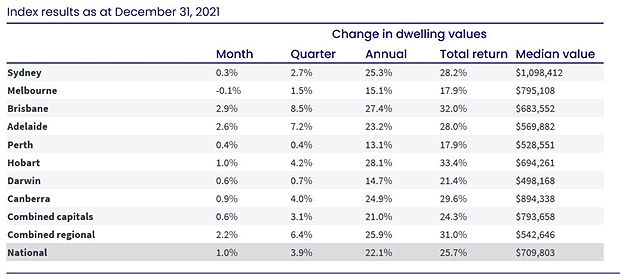
Source: Corelogic
Nationally, house prices rose 22.1% in the 12 months to 31 December 2021. That is a remarkable rise, although it needs to be seen in the context of rises of only 3% in 2020 and 2.3% in 2019, and a fall of 4.8% in 2018.
Unsurprisingly, the gains were not evenly distributed. Affordability, state border controls for Covid-19, the rise of ‘working from home’, interstate migration, rising interest rates, and the lack of international immigrants and students all played a role in widely variable price movements.
Among the major cities, Perth prices rose ‘just’ 13.1% while in Brisbane they were up an impressive 27.4%.
There was a marked difference between the performances in Australia’s two largest cities. Sydney prices were up 25.3% for the year while Melbourne’s rose a more modest 15.1%. Interestingly, those rises occurred despite population declines in both cities, largely due to the collapse of immigration and student arrivals.
Melbourne’s result probably wasn’t helped by its status as the most ‘locked down’ city in the world.
Significantly, for the second year in a row, price growth in regional Australia was stronger than in the capital cities. The outperformance of the regions looks set to continue with their growth in the last quarter of 2021 more than double that enjoyed in the capital cities.
Perhaps the most striking figure in the table above is the result for Melbourne last month – a decline of .1%. And Sydney eked out a monthly gain of just .3%. That raises the crucial question of whether the housing market is now turning.
In many places the ‘fear of missing out’ among would-be buyers is now being replaced by the ‘fear of not getting out’ among potential sellers. Some regions have seen a surge in new listings as vendors seek to take advantage of elevated prices. This has altered the supply and demand dynamic.
According to Corelogic, there is evidence that the rate of growth is now slowing everywhere except Brisbane, Adelaide, and regional Queensland. Tim Lawless, the Research Director of Corelogic, explains that “these regions show less of an affordability challenge relative to the larger capitals, as well as better support for housing demand with Queensland in particular showing strong interstate migration”. (The threat of global warming doesn’t appear to be dulling the appeal of sunny Queensland to Australians from more southern climes.)
In an environment of rising interest rates and stretched affordability, Brisbane’s median value of $683,000 compares very favourably with Sydney’s $1,098,000. And Adelaide’s $570,000 appears a steal at barely half that of the NSW capital.
The availability of funding is an issue for the housing market going forward. Last October, the Australian Prudential Regulation Authority “increased the minimum interest rate buffer it expects banks to use when assessing the serviceability of home loan applications”. This is reducing the scope for bank lending.
A more significant issue for house prices in Sydney and Melbourne is likely to be the speed with which immigrants and foreign students return to Australia. The business sector is constantly hectoring the government to fix the shortage of skilled staff and to keep the population growing. Many in the Liberal/National Coalition are sympathetic to this lobbying. But with a federal election expected in May, many are also conscious of the political implications of two perceived downsides of a major influx of people – health risks during a pandemic and the suppression of domestic wages.
The upcoming election also brings into sharp focus the tension between existing homeowners who oppose any policies that might undermine house prices and would-be first home buyers who want the government to stop rapidly escalating house prices. It seems certain that neither major party will propose tax reform that would dampen the market for investors or owner-occupiers. By contrast, both parties are likely to offer more new incentives and subsidies to first home buyers.
The latter inevitably just increase demand and push up prices further, thereby benefitting all the existing owners and exacerbating the problem. The real solution is to facilitate increased supply not to stoke demand.
What are the experts predicting for Australian house prices in 2022?
Real estate agents say, correctly, that different markets will perform very differently in the year ahead. However, there is a broad consensus that the rate of increase in 2021 cannot be repeated in 2022. That rate is unsustainable because wages growth has been much, much lower and the fear of interest rate rises over the next two years is making buyers more cautious.
The predictions of the major banks should be more accurate than anyone else’s. They have hundreds of billions of dollars at stake in Australia’s property market, and they have in-depth knowledge of what their customers are thinking and planning.
In a research note last November, ANZ predicted “capital city housing prices to rise just over 6% in 2022, and to decline around 4% in 2023”. Its expectation is for Brisbane to be the best performing market, and Adelaide and Perth to be the worst, although the differences are not great.
CBA, Australia’s largest bank and biggest home mortgage lender, also issued a research note on housing last November. It picks “national dwelling prices to peak in late 2022 around 7% higher than end-2021 levels” followed by “an orderly correction in home prices of around -10% in 2023”. Again, Brisbane would be the strongest market.
Disturbingly for those of us who live in Sydney, CBA is suggesting the correction here in 2023 would be -12%.
Westpac provided its predictions last October. It expects price growth “to slow to 8% in 2022” and that “markets will move into the first year of a correction phase in 2023 as official interest rates rise, with prices forecast to retrace by -5%”.
So, a consensus of sorts. A rise in 2022 and a fall in 2023. 6%-8% on the way up; 4%-10% on the way down.
However, Westpac’s “first year of a correction phase” sounds ominous. As if the drop in 2023 might be followed by a further drop in 2024. If so, it will be a shock to those who buy their first home in 2022. ‘Negative equity’ is an ugly concept and not one with which many Australians are familiar.
The reality is that house prices are notoriously difficult to predict. Few forecast the current boom in the middle of the worst pandemic in a century and no one can be sure what will happen next.
Ross Stitt is a freelance writer and tax lawyer with a PhD in political science. He is a New Zealander based in Sydney. His articles are part of our 'Understanding Australia' series.
We welcome your comments below. If you are not already registered, please register to comment
Remember we welcome robust, respectful and insightful debate. We don't welcome abusive or defamatory comments and will de-register those repeatedly making such comments. Our current comment policy is here.