
The gap in cost between building a new home and buying an existing one "has never been higher", BNZ chief economist Mike Jones says.
In his latest EcoPulse publication, Jones has done some number crunching and estimates that currently an average new 180 sq m house will cost around $200,000 more than an existing one.
He says with inbound migration soaring and therefore a future need for more housing at a time when construction activity is starting to drop off, the cost gap between new and existing houses will narrow - but that will largely come from higher house prices.
BNZ economists are forecasting that the "tentative upswing" in house prices will gather pace next year with a 7% lift in national house prices through calendar 2024.
"...It’s more expensive to build. It nearly always is. Our analysis puts the average ‘new build premium’ over existing going back to 1995 at about $65k," Jones says.
"Still, there’s no getting around the sheer size of the current premium. The almost $200k difference between building and buying is around the widest ever on our numbers, and about three times the long-run average.
"These numbers are of course indicative, they’re averages, and they vary by region. But they’re strongly consistent with the anecdote and feedback we’re getting around the traps."
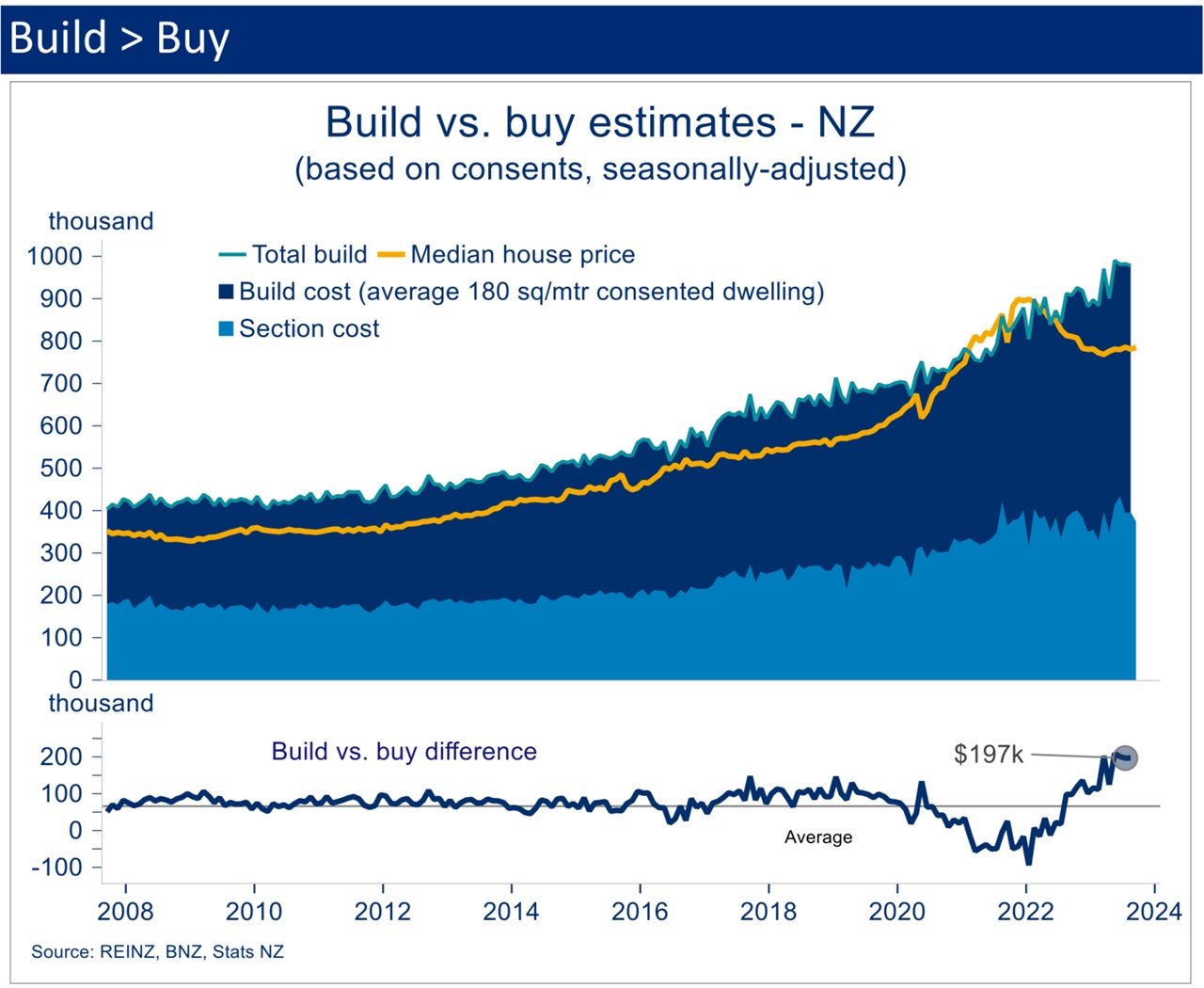
In his calculations, Jones has combined average building costs with the median cost of a section.
In terms of the size of house, Jones opted for 180 sq m, which is the post-2000 average.
"If we didn’t do this, build costs would be artificially ‘cheap’ compared to buying an existing house given the declining average size of new builds relative to existing homes.
"Doing all this produces a cost to build estimate for an average residential dwelling of about $980k. That’s made up of a near $400k section cost and a $580k build cost.
"That compares to the median sale price of existing houses of $785k (REINZ data). The latter of course remains well down on the almost $900k peak of late 2021."
Jones says to the extent these figures are representative of the decision facing the average punter, "the general incentive to build rather than buy is very low".
"Writ-large, these cost incentives matter. Witness the chart below in which we’ve mapped the ratio of house prices to building costs – essentially an ‘incentive to build’ proxy – against residential construction. There’s a tight relationship."
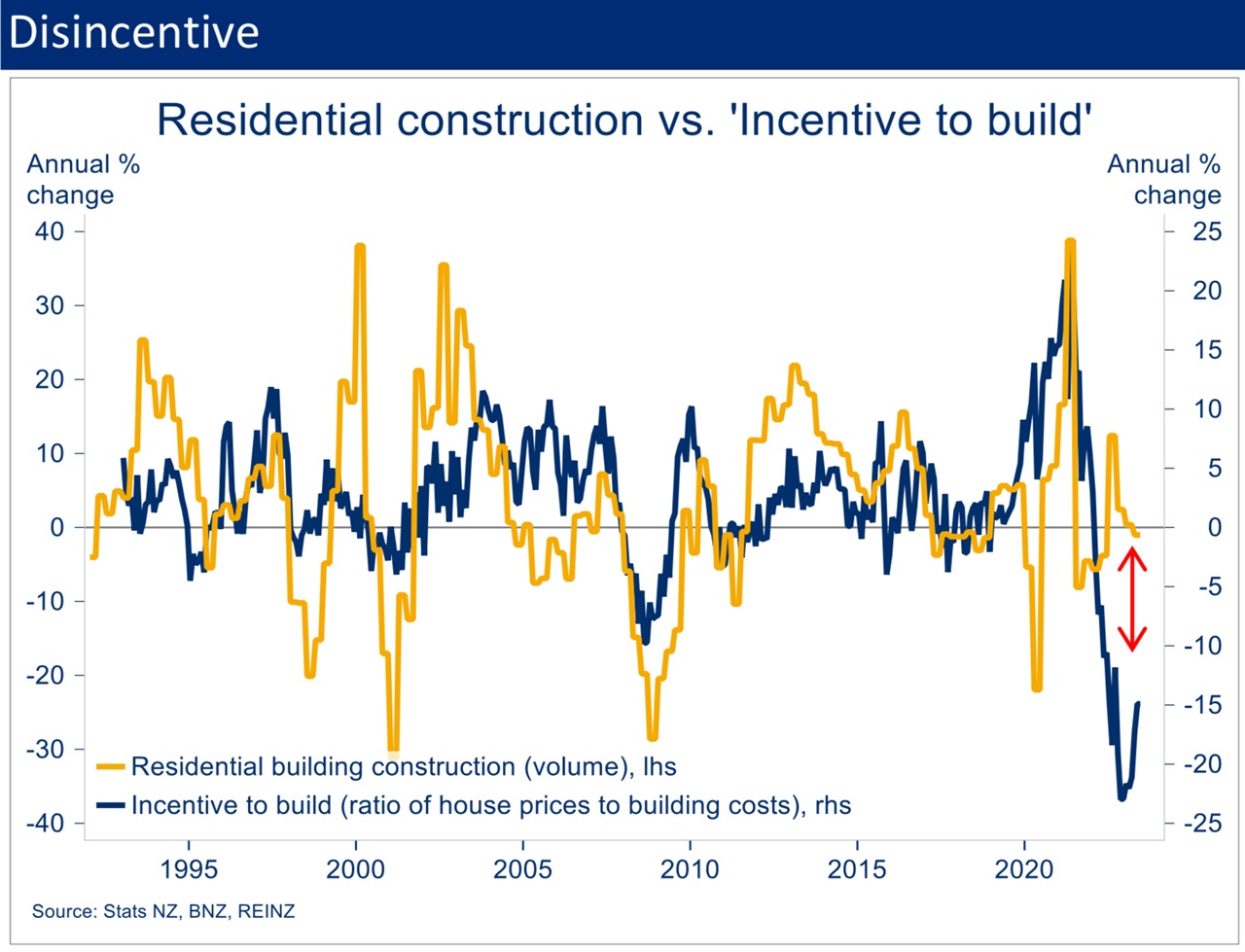
Elevated construction costs, lower house prices, and high interest rates are all currently "conspiring against building activity", Jones says and he says it is "no wonder" that new building consent issuance has been in steady decline over the past two years.
He also notes that any existing incentive to build arising from the new build carve out from the 2021 removal of mortgage interest deductibility may soon depart.
"The incoming government intends to progressively restore deductibility to all properties. All of this is potentially problematic in the current environment."
Jones says we are in the midst of a migration-fuelled population boom. There's additional pressure on housing resources "as can be seen in rents".
"If cost issues are disincentivising the building of new dwellings relative to existing homes, it raises the odds we again end up underbuilding relative to the population’s needs.
"The implication is additional upward pressure on house prices as this extra housing demand finds its way relatively more into the existing home market.
"This is essentially what we are forecasting."
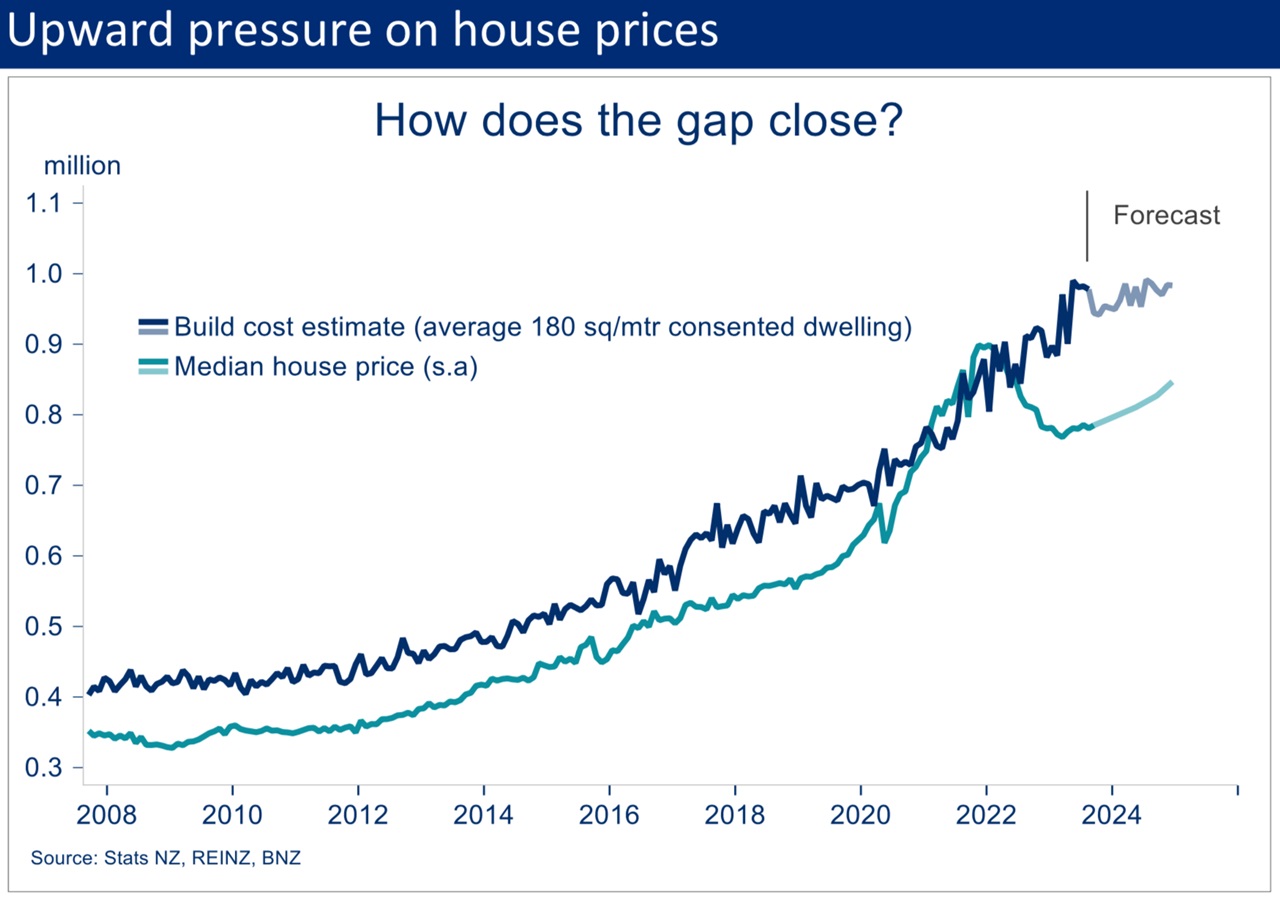
The currently wide gap in costs between building and buying should narrow, Jones says.
"The breakneck pace of construction cost inflation is flattening off, and we expect this to continue. But, as the chart [below] shows, this flattening doesn’t do much of the work in closing the build vs. buy gap. More of it is expected to come via higher house prices.
We welcome your comments below. If you are not already registered, please register to comment
Remember we welcome robust, respectful and insightful debate. We don't welcome abusive or defamatory comments and will de-register those repeatedly making such comments. Our current comment policy is here.