


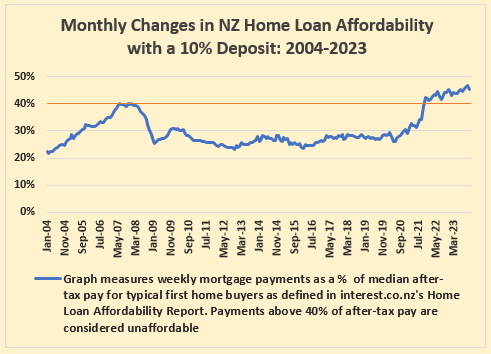
Wannabe first home buyers ended last year neither more nor less able to afford a home of their own than they were at the beginning of the year.
For those aspiring to own a home of their own, 2023 was a year in which nothing much changed.
The simple explanation is there was no significant movement in house prices at the bottom of the market last year. And although there was a moderate increase in interest rates, that was more or less offset by the increase in wages.
So overall, not much change.
That was the big picture stuff. Here's the detail.
House prices
The Real Estate Institute of New Zealand's national lower quartile selling price ended last year at $585,000.
The lower quartile price is the price point at which 25% of sales are below and 75% are above, representing the bottom end of the market that is usually of most interest to first home buyers.
At the end of 2022 the lower quartile price was also $585,000. So at the end of last year it ended up exactly back where it was at the end of 2022. Sure it bounced around a little bit from month to month during the year, but the movements were small.
Overall, the best way to describe the bottom end of the housing market last year was flat. As a pancake.
Which meant there was no change in the amount of money aspiring first home buyers needed to save for a deposit, or to borrow to get into a home of their own in December 2023, compared to December 2022.
Mortgage interest rates
However there was some movement in mortgage rates.
They rose slowly but steadily for most of 2023, with a tiny bit of downward momentum at the end of the year.
The average of the two year fixed rates offered by the major banks was 6.58% in December 2022. This had increased to 6.98% by December last year.
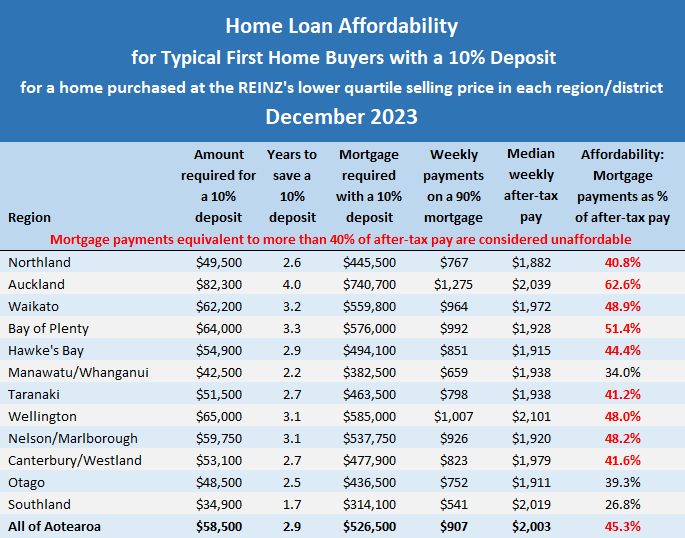
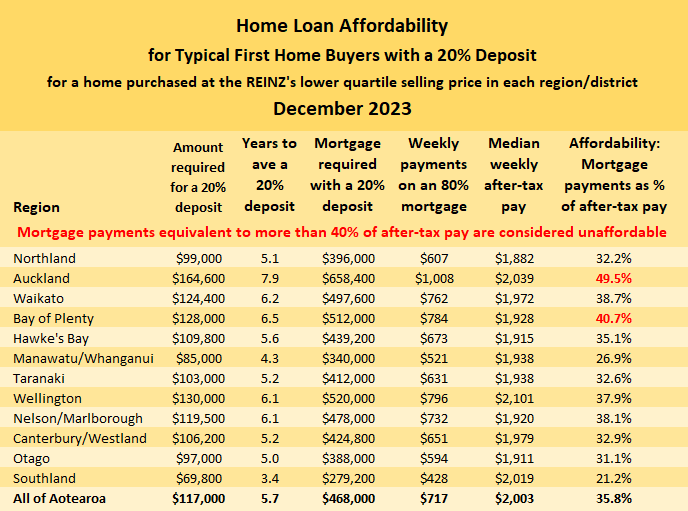
Although house prices hadn't moved much during the year and the amount a buyer would need to borrow to purchase a lower quartile-priced home had stayed the same, the rise in interest rates would have pushed up the repayments on the mortgage to $907 a week in December 2023 from around $872 a week in December 2022 if they purchased with a 10% deposit, or to $717 a week from $688 if they purchased with a 20% deposit.
So an increase of around $29 to $35 a week on the mortgage payments for a lower quartile priced home.
However affordability isn't just about costs, it's also about incomes.
Incomes
Interest.co.nz tracks the median wage rates for workers aged 25-29, because many people in that age range are likely to at least be thinking about saving for a home.
If a couple in that age group were both working full time at the median wage rates for their age group, they'd have been left with about $1930 a week between them, after tax, in December 2022.
By December 2023 that would have risen to around $2003, giving them an extra $73 a week.
So once the extra mortgage costs are deducted, the first home buyers would probably have been around $35 to $40 a week better off at the end of last year.
If we only look at the costs associated with buying a home, you could say first home buyers were marginally better off at the end of last year than they were at the end of 2022.
Unfortunately it wasn't just mortgage costs that increased last year, with the price of transport, rent, food and just about everything else, also on the rise.
How much that would have affected first home buyers would of course depend on their living costs and spending habits.
But it's probably a reasonable bet that those extra costs would have gobbled up any extra money they had in their pay packets compared to a year earlier, once the mortgage was paid.
Which means things probably didn't get much better for first home buyers in 2023, but probably didn't get much worse either.
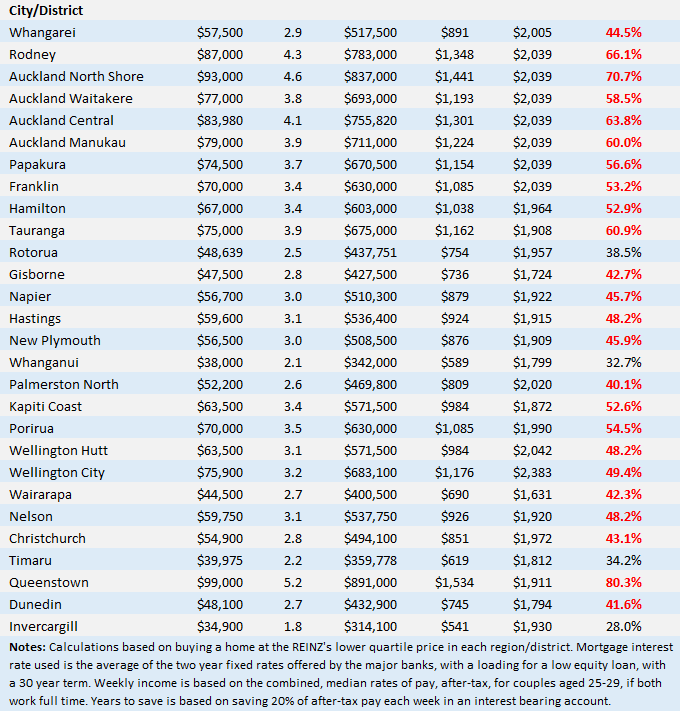
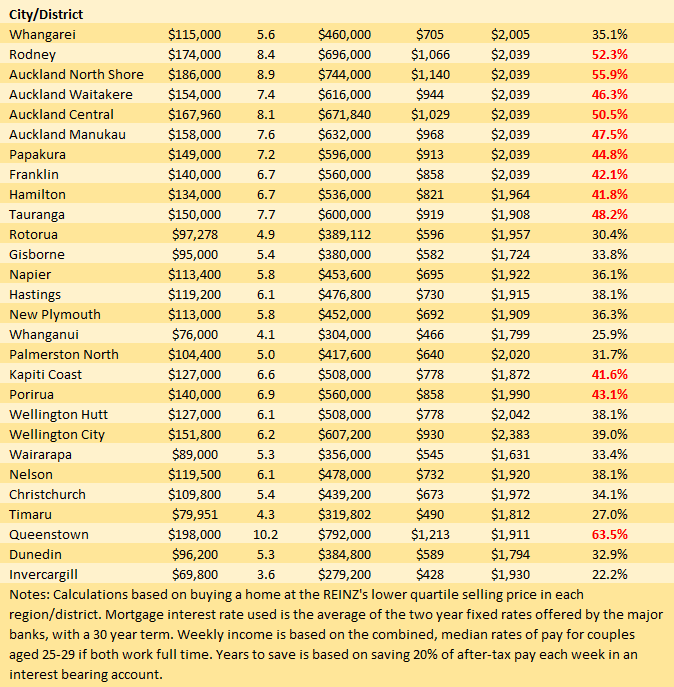
The tables below show the main affordability measures in December 2023 for typical first home buyers in the main urban areas, with either a 10% or 20% deposit.
The comment stream on this story is now closed.
•You can have articles like this delivered directly to your inbox via our free Property Newsletter. We send it out 3-5 times a week with all of our property-related news, including auction results, interest rate movements and market commentary and analysis. To start receiving them, register here (it's free) and when approved you can select any of our free email newsletters.
We welcome your comments below. If you are not already registered, please register to comment
Remember we welcome robust, respectful and insightful debate. We don't welcome abusive or defamatory comments and will de-register those repeatedly making such comments. Our current comment policy is here.