


Last year saw a significant improvement in affordability for first home buyers, allowing more of them to realise their dream of home ownership.
The improvement in affordability in 2024 was driven by three factors: declining mortgage interest rates, rising incomes and relatively flat house prices at the bottom of the market.
On their own, each of those factors may not have been that significant, but taken together they had a noticeable impact on affordability.
Prices flat at the bottom of the market
Interest.co.nz tracks the Real Estate Institute of New Zealand's lower quartile selling price each month.
That is the price point at which 25% of sales are below and 75% are above, representing the bottom end of the market that's the most affordable.
The lower quartile price typically bounces around, either up or down by a few thousand dollars each month. But over the course of 2024 it was remarkably flat, remaining between $570,000 and $607,500.
That was little different from 2023, when the lower quartile price stayed within the range of $567,000 and $600,000.
That suggests relatively stable prices, giving buyers the confidence to take their time to find the property that best suits their needs, without the urgency caused by rapidly rising prices.
Mortgage rates slide
Buyers would have benefitted significantly from falling interest rates in 2024.
The average of the two-year fixed rates offered by the major banks declined from 6.98% in December 2023 to 5.53% in December 2024.
The national lower quartile selling price was $586,000 in December 2023, and the mortgage payments on a home purchased at that price with a 10% deposit would have been around $908 a week with the mortgage rate at 6.98%.
If the home had been purchased with a 20% deposit the payments would have been around $718 a week.
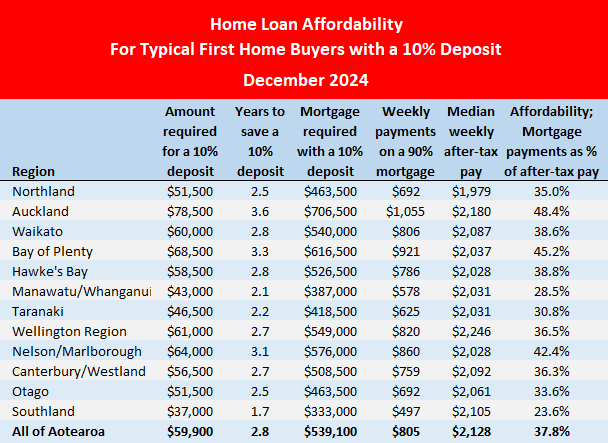
In December 2024, the lower quartile price was $599,000, and the mortgage payments on a house purchased at that price with a 10% deposit would have been around $805 a week. That's a saving of $103 a week compared to a year earlier, even though the purchase price had increased slightly.
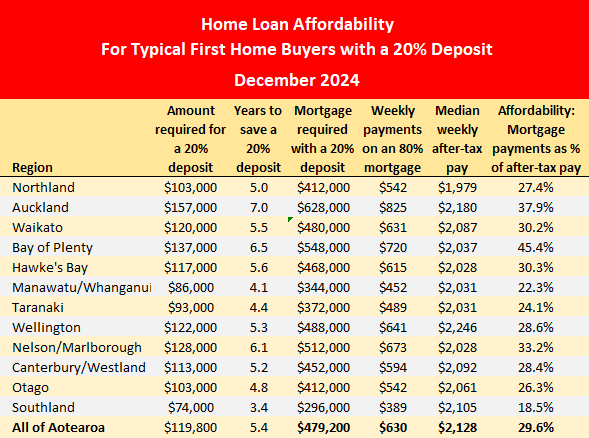
If the home was purchased with a 20% deposit the mortgage payments would have been around $630 a week, making the buyer about $88 a week better off compared to a year earlier.
Rising wages
As well as benefiting from steady prices and lower interest rates, first home buyers would also have likely benefitted from modestly rising wages.
Interest.co.nz estimates the average after-tax pay for a couple aged 25-29 and both working full time would have been about $2064 a week in December 2023.
By December 2024 it is estimated their after-tax pay would have increased to $2128 a week, helped along by a tax cut in the middle of the year.
That left them with an extra $64 a week in their pockets compared to the end of 2023.
That extra money, combined with the cheaper mortgage payments meant someone buying a home at the lower quartile price with a 10% deposit, would have been $167 a week better off in December 2024 compared to December 2023, and $152 a week better off they purchased with a 20% deposit.
So although 2024 was a year of challenges on many fronts, the fundamentals of home home ownership were in buyers' favour last year.
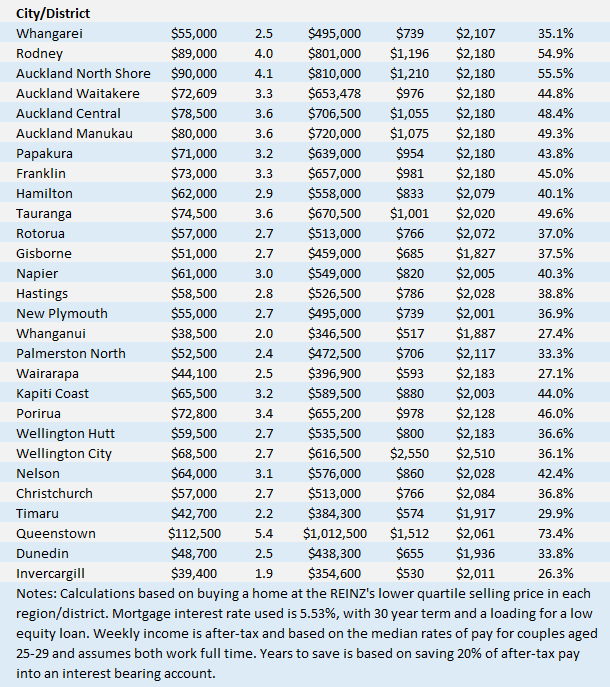
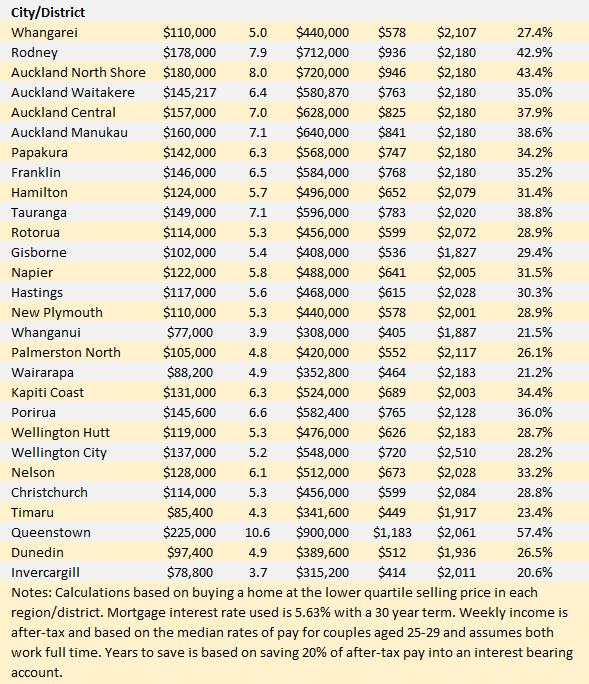
The tables below show the main affordability measures for typical first home buyers with either a 10% or 20% deposit in all major urban districts in December 2024.
The comment stream on this story is now closed.
*This article was first published in our email for paying subscribers. See here for more details and how to subscribe.
We welcome your comments below. If you are not already registered, please register to comment
Remember we welcome robust, respectful and insightful debate. We don't welcome abusive or defamatory comments and will de-register those repeatedly making such comments. Our current comment policy is here.