


Affordability continued improving for first home buyers at the start of this year, thanks to ongoing declines in house prices at the cheaper end of the market, lower mortgage interest rates and marginally higher wages.
According to the Real Estate Institute of New Zealand, the national lower quartile selling price was $575,000 in January 2025. That was down $25,000 from December 2024, and down $95,000 from its peak of $670,000 in November 2021, since when lower quartile prices have been in a more or less slow but steady decline.
The lower quartile price is the price point at which 25% of sales are below and 75% are above, representing the most affordable end of the housing market.
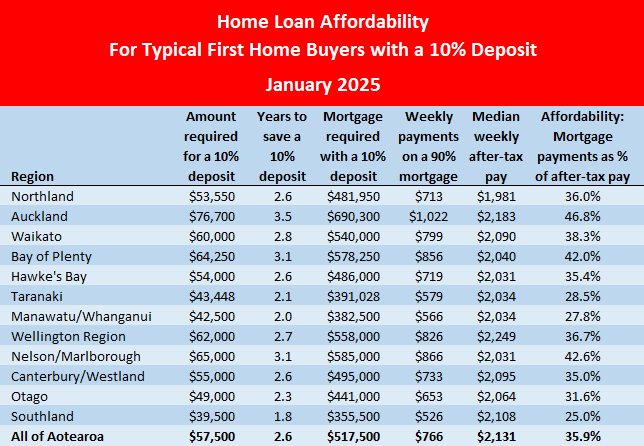
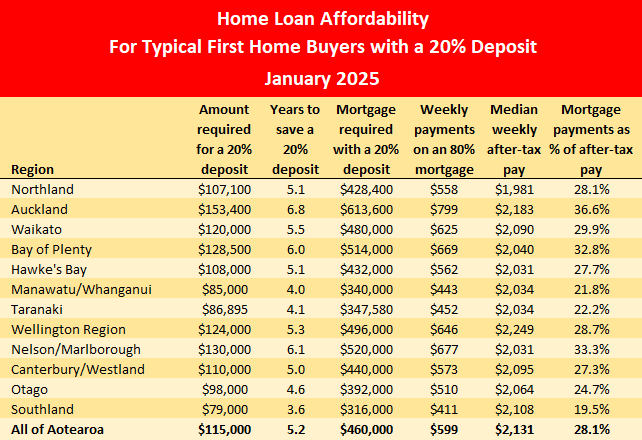
The decline in prices has seen the amount required for a 10% deposit on a lower quartile-priced home drop from $67,000 in November 2021 to $57,500 in January 2025, while the amount needed for a 20% deposit has declined from $134,000 to $115,000 over the same period.
Mortgage interest rates have also been falling steadily, with the average of the two year fixed rates offered by the main banks dropping from its recent peak of 7.04% in November 2023, to 5.45% in January 2025.
That combination of lower prices and lower mortgage interest rates has pushed down the mortgage payments on the purchase of a home at the national lower quartile price with a 10% deposit from its record high of $935 a week in November 2023, to $766 a week in January 2025, providing a saving of $170 a week.
Over the same period, the mortgage payments on a home purchased at the lower quartile price with a 20% deposit would have dropped from about $740 a week to $599, a reduction of $141 a week.
At the same time, incomes have been slowly rising.
Interest.co.nz estimates the combined, after-tax wages, of a couple working full time at the median rates of pay for people aged 25-29, would have increased from $2053 a week in November 2023, when mortgage interest rates peaked, to $2131 a week in January 2025, giving them an extra $78 a week in the hand.
Over the same period, the mortgage payments on a home purchased at the national lower quartile price with a 10% deposit would have declined by around $169 a week, while the mortgage payments on a home purchased with a 20% deposit would have declined by around $141 a week.
That means as a percentage of after-tax pay, mortgage payments on a home purchased at the national lower quartile price with a 10% deposit would have declined from 45.5% in November 2023 to 35.9% in January 2025.
Housing is traditionally considered unaffordable when mortgage payments exceed 40% of after-tax pay. So by that measure, home ownership has gone from being quite substantially unaffordable for typical first home buyers to well within affordable limits in the space of 14 months, even if they only have a 10% deposit
And the good news for aspiring first home buyers is that those trends are evident to a greater or lesser degree, across the entire country.
Problems persist
That's not to say that there aren't still problems.
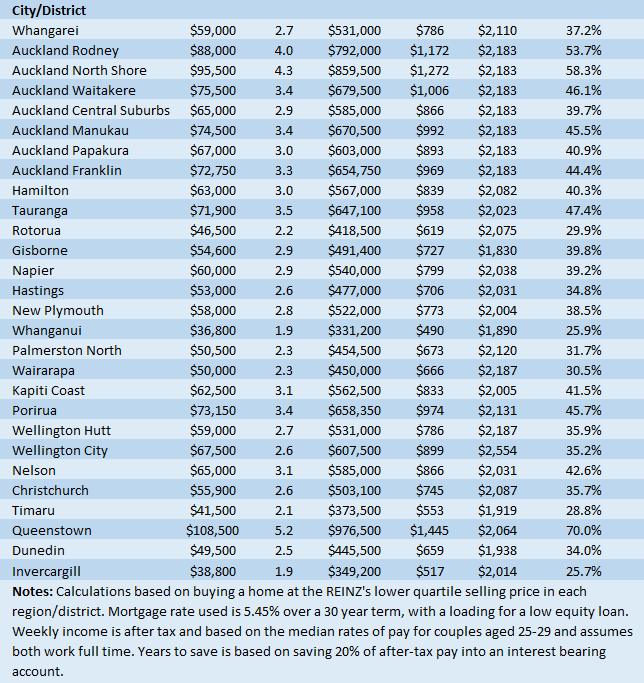
Although prices have declined everywhere, they remain high enough to keep housing in unaffordable territory for typical first home buyers across the entire Auckland region and in Tauranga, Kapiti Coast, Porirua and Nelson, while Hamilton is marginal.
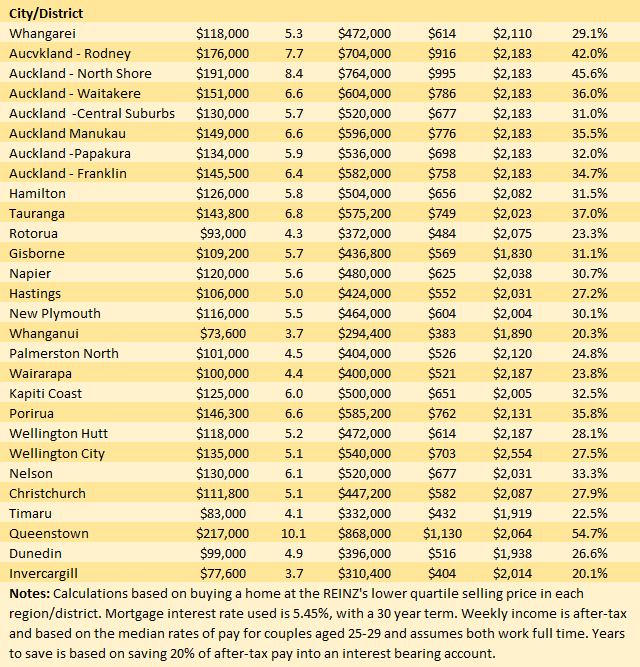
And prices in Queenstown are so ridiculously high that home ownership there is simply not a realistic option for people on average incomes.
However the trend is clear, the prospect of home ownership is improving for first home buyers across the entire country, and the turnaround in affordability has happened in a relatively short space of time.
The tables below show the main affordability measures for typical first home buyers with either a 10% or 20% deposit, in all of the country's main urban areas.
The comment stream on this article is now closed.
We welcome your comments below. If you are not already registered, please register to comment
Remember we welcome robust, respectful and insightful debate. We don't welcome abusive or defamatory comments and will de-register those repeatedly making such comments. Our current comment policy is here.