
Australia has an international reputation as the laid-back, lucky country. When you think of Australia, you don’t think revolutionary or world leading. Yet those are the terms being used to describe the country’s latest move to ban social media for under 16-year-olds.
The new law, the Online Safety Amendment (Social Media Minimum Age) Act introduces a mandatory minimum age of 16 for accounts on a range of social media platforms. Significantly, the law imposes obligations not on children or their parents, but on the platforms.
As the Minister for Communications, Anika Wells, told the United Nations General Assembly, the law “puts the onus back on social media platforms to act with responsibility towards children.” Those platforms face fines of up to $49.5 million for breaches of the law.
How will Big Tech enforce the age ban? A range of mechanisms are being employed including identification requirements and facial age estimation technology.
The problem with the former is that some kids will ‘borrow’ the identification of others such as older siblings or parents. The problem with the latter is the limitations of the technology. Some young looking 17-year-olds will fail while some old looking 15-year-olds will not.
Yoti, a market leader in facial age estimation, claims that for 13-17-year-olds it can estimate age with accuracy of 1.3 years. That’s good but far from precise, particularly where hundreds of thousands of young people are involved.
Recent research from Roy Morgan reveals the scale of the issue. Practically all (99.96%) of 14-15-year-olds in Australia are on social media. In an average four-week period, 624,000 of them use at least one platform.
% of 14- and 15- year-olds who use social media in an average 4 weeks
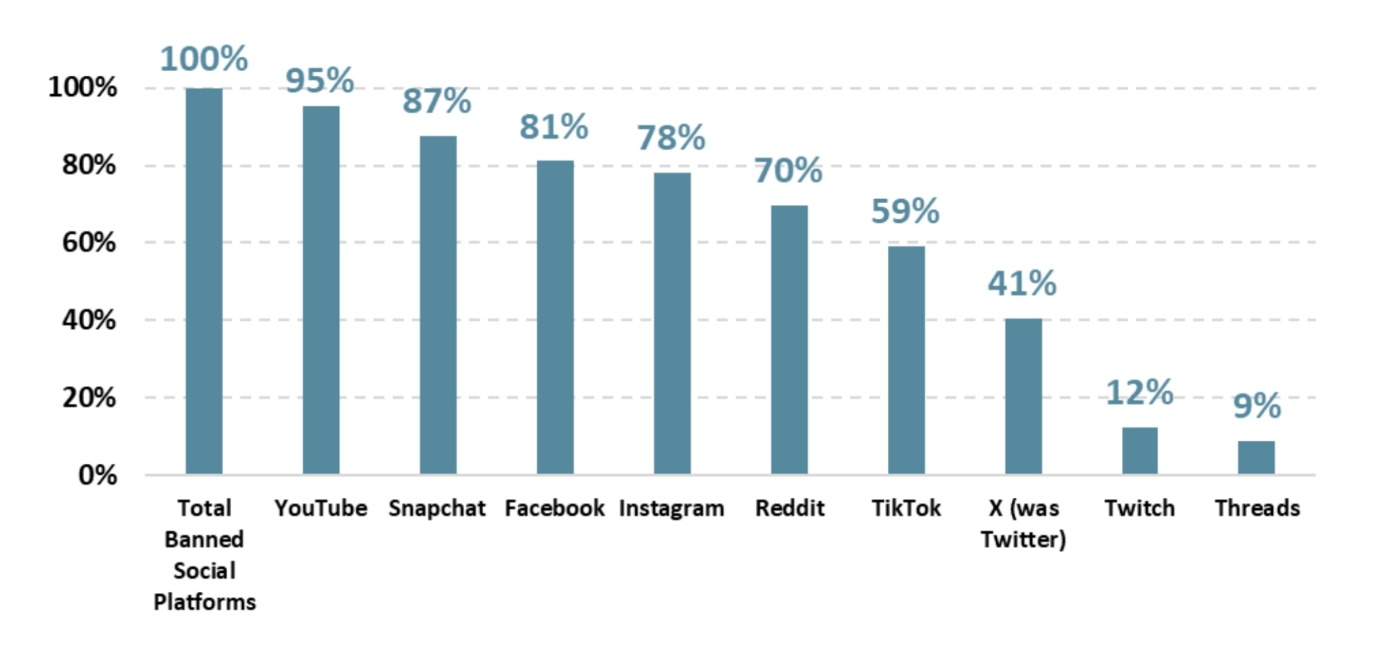
Source: Roy Morgan
The government’s purpose in introducing an age limit for social media is self-evident. It is to protect Australian children and teens from the dangers of social media, including cyberbullying, harmful content, and online predators.
The last decade has witnessed rising concern worldwide about the impact of social media on the mental health of children. The US social psychologist Jonathan Haidt has been at the forefront of research on this issue. In his book The Anxious Generation, Haidt argues that the smart phone and the cyberworld within it has created an epidemic of anxiety and depression among young people.
It would be an understatement to call Haidt a fan of Australia’s social media ban. He describes it as “by far the most important single piece of legislation ever enacted on planet Earth to protect children in the internet age.”
The risks of social media are also a concern for many adult Australians. Polling suggests a large majority support the ban, although similar numbers doubt its efficacy.
With effect from 10 December 2025 the ban applies to ten platforms - YouTube, X, Facebook, Instagram, TikTok, Snapchat, Reddit, Twitch, Threads and Kick. However, it will be extended to other platforms where necessary. Minister Wells has made the government’s position very clear.
If everybody ends up on LinkedIn, and LinkedIn becomes a place where there is online bullying, predatory algorithms, targeting of 13 to 16-year-olds in a way that is deteriorating their mental and physical health, then we will go after LinkedIn. And that's why all platforms are on notice. We have to be agile and dynamic, because that's what big tech is.
A range of online services are specifically excluded from the ban. They include services solely for the purpose of gaming, professional development, and communication (such as messaging and emailing).
Significantly, a parent is not able to exempt a child from the ban.
Will the ban be effective? That will take months to assess. Young people are digital natives and thousands will be looking to circumvent the ban, either via technology such as virtual private networks or through ‘old world’ techniques like using someone else’s identity.
Already many have moved to alternative services like Coverstar (a video-sharing platform) and Lemon8. Australia’s eSafety Commissioner will be watching such services closely.
Two intrepid 15-year-olds have launched a legal challenge to the social media ban. After a brief appearance last week, they have secured a special hearing next year before the High Court, Australia’s highest court. Their argument is that the ban infringes their constitutional right to freedom of political communication.
Spare a thought for the child influencers in Australia who were previously making money, sometimes a lot of money, from social media. One family with two such young entrepreneurs has even left Australia and moved to the UK to continue their social media activities.
One thing is certain. Governments around the world will be monitoring the progress of Australia’s online experiment. Several, including New Zealand, have already indicated an intention to go down the same path. If the ban is a success, it seems likely many others will follow suit.
No doubt that’s a major worry for the social media platforms. Given Big Tech’s close ties with US President Trump, and the president’s ‘America First’ approach to international trade, action against countries that seek to restrict the social media platforms can’t be ruled out.
But if Australia’s revolutionary social media ban is a success, one question stands out. What will young Australians do with the tens (hundreds?) of millions of hours previously devoted to social media every year?
*Ross Stitt is a freelance writer with a PhD in political science. He is a New Zealander based in Sydney. His articles are part of our 'Understanding Australia' series.
We welcome your comments below. If you are not already registered, please register to comment
Remember we welcome robust, respectful and insightful debate. We don't welcome abusive or defamatory comments and will de-register those repeatedly making such comments. Our current comment policy is here.