
Apartment owners and investors are the most likely to suffer a loss when selling a residential property, according to property data company Cotality's latest Pain & Gain Report.
It found 41.1% of the apartments resold in the first quarter (Q1) of this year were sold at a loss compared to their previous purchase price, while 13.7% of the properties sold by investors were loss making.
Overall, 12.2% of all the residential properties sold in Q1 were sold for less than their previous purchase price.
That figure has been increasing since late 2021 when less than 1% of residential sales were made at a loss.
The main determinant of whether a property sells at a profit or loss appears to be how long it has been owned for.
The median length of ownership for loss making properties was 4.2 years, while the median length of ownership for those that sold for more than their previous purchase price was 10 years.
The median loss of those properties that sold for less than their previous purchase price was $54,000, while the median gain for those that sold for more than their purchase price was $285,000.
Those figures do not take into account any selling expenses, with agent's fees alone averaging around $25,000, nor do they allow for any money owners have spent on improving a property prior to its sale, both of which would likely increase the overall loss or decrease the gain on a sale.
There were significant regional differences in the trends with the north/south divide that's evident in the wider property market also showing up in the Pain and Gain Report.
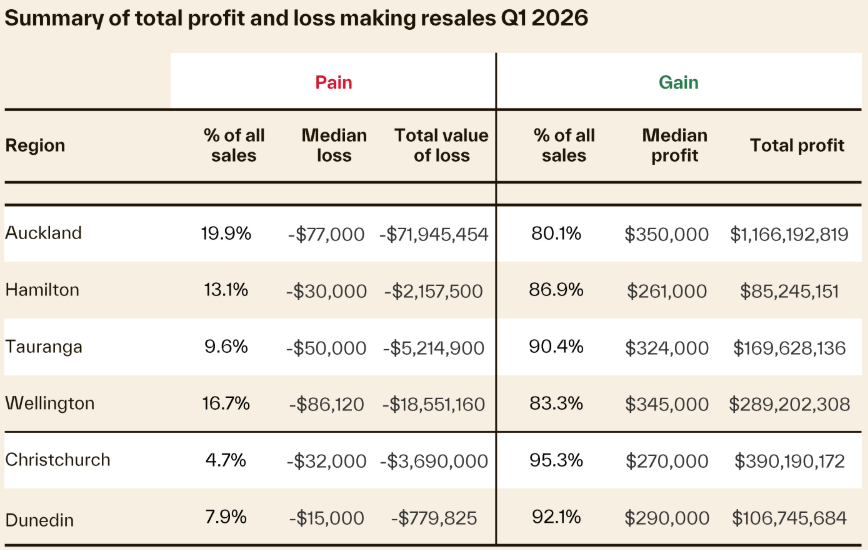
Almost one-in-five (19.9%) of the residential properties sold in Auckland in Q1, and 16.7% of Wellington sales were loss-making, compared to 13.1% in Hamilton, 9.6% in Tauranga, 7.9% in Dunedin and 4.7% in Christchurch.
Wellington had the highest resale loss at -$86,120, followed by Auckland -$77,000, Tauranga -$50,000, Christchurch -$32,000, Hamilton -$30,000 and Dunedin -$15,000.
The table below shows the losses and gains in each of the main centres in Q1.
The comment stream on this article is now closed.

16 Comments
I think this is proving that speculation was never the problem. If there were loads of speculators in the housing market we’d have witnessed a bitcoin style crash as they all exited.
It seems quite obvious to me that supply was the problem all along. When councils finally and reluctantly allowed people to increase the supply they did so, and now prices are dropping.
They should be stripped of their ability to regulate completely and leave it to the market to decide what gets built where. Imagine if the councils were in charge of other necessities like food, lord help us.
Good point re councils being guilty of constraining supply of land for housing - and intensity for that matter.
If you looked close enough from Invercargill to Northland councils are probably still defaulting to constraints, but should be asking the question - where is the expected population growth going to live?
Councils vested interest is higher rating values, but less new infrastructure. Add in the false dawn that artificial cheap money presented with a side order of tax free specu greed and voila...today's mess.
Lots of noise about future interest rates rises and global volatility going up.
I think I read the average holding time for a property in NZ was 7 years, so still pre-covid. I'm expecting the figures to get worse in the next 2 years once peak buyers start to sell (or maybe decide to hold longer?).
If there were loads of speculators in the housing market we’d have witnessed a bitcoin style crash as they all exited
There are a lot of speculators. For them to exit they first need to believe there's no gains to make. Given the NZ culture and the constant skewed view from MSM, and, especially, the media the speculators consume, they're still in the denial phase
That doesn't make them immune, just makes their reaction tardive
Given the NZ culture and the constant skewed view from MSM, and, especially, the media the speculators consume, they're still in the denial phase.
Plenty of denial at the water coolers and BBQs. Ashley Church reckons things will go ballistic in a few years. Guy's like a cult leader.
The Aotearoa Ponzi and crypto have a few similarities related to psychology.
"....... If there were loads of speculators in the housing market we’d have witnessed a bitcoin style crash as they all exited......"
Not sure of that Jimbo. Here on interest.co there were plenty saying house prices were about to go up. Only recently they have been quiet.
So it took a long time for them to move, many have not yet. So no knee jerk reaction and no immediate sale.
And as for bitcoin. There are a lot of those things about and the price is volatile. Yet only a small percentage are traded. Most are long term holds.
(to be clear this is not spruiking bitcoin. I would never touch the things.)
And as for bitcoin. There are a lot of those things about and the price is volatile. Yet only a small percentage are traded. Most are long term holds.
Ratty is not crypto. Those pushing all the garbage have fallen flat on their faces as AI-related stocks have exploded (opportunity cost), while the crypto crap is 80-90% down.
Look at IREN, past 12 months has returned 890%. Makes crypto look like playing the pokies.
The influ-grifters like to think they're on the cutting edge of transformation, but it's obvious most of them are not.
This is very much a tale of two Islands. The big cities in the North Island went crazy during Covid, while the South Island cities did not.
Only 4 properties at Lodge's auction today in Hamilton, still all passed in for the second week in a row (7 properties last week). Delusional sellers you say?
This is only a nominal comparison (as acknowledged in the article)
After accounting for real estate fees, periods of dead rent, money invested in properties before sale, opportunity cost of equity etc, how many more were loss-making investments? 40%?
Heartbreaking for those affected.
Yes sadly it will have affected the younger ones starting out the most. I feel for the ones with young families that would have lost it all. Though some on here seem to enjoy the falling values (a little too much) it doesn't really affect us oldies
It is great that the NZ housing ponzi is broken and now buried deep.
For every NZer to be a totally addicted gambler on housing, in the period upto 2021/2022, was a sure fire bubble, worse than the leadup to the 1987 sharemarket boom/crash. Property just resets over years, not hours/days.
The size of this bubble was massive and surpassed the epic Japanese bubble of the 1980s. It was always sure to bust.
FYI a rule that has proven true in all history - all bubbles bust and bust completely.
The bust has just begun.
So NZ, look at real endeavours, real work and real businesses. Dumping a whole heap of massive debt, into property is s surefire way to burn your funds.
Buy smart and offer low, walk if they balk.
2010 prices are coming back.
I am heartbroken for those young ( and not so young actually) still stuck in renting.
Yes, to that too. Successive governments' lack of interest in regulating the private sector housing market is very telling - and they've been given a valid, mathematically robust , equitable and targeted proposal on how to do it;
https://www.interest.co.nz/property/119377/katharine-moody-takes-look-r…
Indeed. But prices are falling so keep you powder dry and do something when it makes sence.

We welcome your comments below. If you are not already registered, please register to comment
Remember we welcome robust, respectful and insightful debate. We don't welcome abusive or defamatory comments and will de-register those repeatedly making such comments. Our current comment policy is here.