
sign up log in
Want to go ad-free? Find out how, here.

Residential property is looking like an increasingly poor investment in the current market

Property / analysis
Residential property is looking like an increasingly poor investment in the current market


There's no doubt residential property is not as popular with investors as it was 10 years ago.

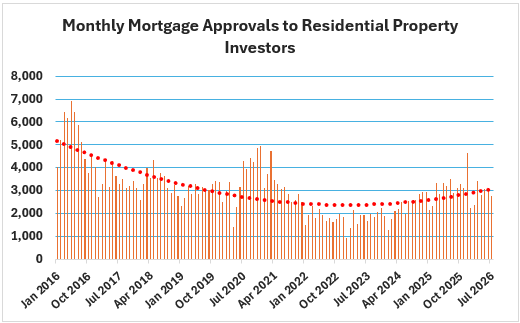
You can clearly see that in the first graph below, which tracks Reserve Bank figures showing the number of mortgages approved to residential property investors each month.

Ten years ago, in July 2016, 5862 new residential mortgages were approved to property investors. In July this year, that number had declined to just 2766.

It is not a perfect measure, but it suggests residential property investor activity could have halved over the last decade.

So far this year there has been plenty to make investors cautious, with prices largely flat or falling slightly, mortgage interest rates slowly rising and uncertainty around the tax situation ahead of November's election.

However, there has also been a more fundamental long term shift in the market, as house prices have grown much faster than rents, reducing the income returns rental housing can provide to investors.

Interest.co.nz has been tracking residential rents compared to lower quartile house prices since 2012.

At the start of 2012, the Real Estate Institute of New Zealand's lower quartile selling price was $250,000. By June this year that had increased to $585,000, a 134% increase over that 14 year period.

Over the same period the national median rent, as measured by rental bonds received by Tenancy Services, increased from $325 to $595 a week, up 83%.

So what does that mean for investors?

If you bought a property at the January 2012 lower quartile price of $250,000 and rented it at the median rent of $325 a week, it could generate rental income of $16,900 a year.

That's a gross return (referred to as the rental yield) of 6.8%.

Jump forward to June 2026 and the lower quartile-priced property would cost $585,000 and the median rent would be $595, generating potential rental income of $30,940 a year, providing a gross rental yield of 5.3%.

A return of 5.3% might seem ok, but there's a catch.

That figure is gross, and the investor would need to allow for periods of vacancy, which could have a major negative impact on rental income, plus expenses such as rates, insurance, maintenance and the property manager's fee if there was one.

While those expenses can vary widely between properties, they would likely reduce the rental yield down below the return the investor could get by putting their money on term deposit with a bank.

 And of course the above calculations assume the investor paid cash for the property - they make no allowance for mortgage payments.

Let's say the investor purchased the same lower quartile-priced property with a 40% deposit and a mortgage of $351,000.

In June this year the average two year fixed rate charged by the main banks was 5.26% (compared to 5.91% in January 2012).

Interest.co.nz estimates the payments on a $351,000 mortgage, assuming an interest rate of 5.26% and a 20 year term, would be around $546 a week.

Deducting that from weekly rent of $595 leaves just $49 a week to cover rates, insurance, maintenance, property management and accounting fees and anything else that needs paying.

That makes it very likely the investor would be in a negative cash flow situation, dipping into their pocket to meet the outgoings.

Instead of generating an income, the property would be loss making.  

Many investors were prepared to suffer those losses when prices were running hot, generating substantial capital gains, which of course were tax free.

But with prices flat at best, capital gains are drying up, and along with them, investors' enthusiasm for residential property.

If they can afford to pay cash for a property, they are probably looking at mediocre returns at best, but if they need a mortgage they will probably be in a loss making situation.

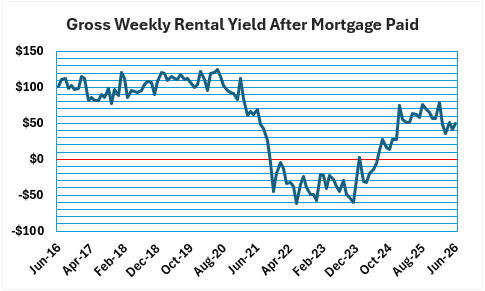
The second graph below shows how much cash would be left each week going back to 2012, if an investor bought a property at the prevailing lower quartile price, rented it at the median rent, and paid for a 60% mortgage at the prevailing rate.

That has declined from $101 a week in June 2016 to $49 a week in June 2026, so it's more or less halved over the last decade.

 So it should be no surprise that investors are increasingly sitting on the sidelines of residential property, because it's becoming more and more difficult to make the numbers stack up.

The comment stream on this article is now closed.


We welcome your comments below. If you are not already registered, please register to comment

Remember we welcome robust, respectful and insightful debate. We don't welcome abusive or defamatory comments and will de-register those repeatedly making such comments. Our current comment policy is here.

32 Comments

Without having the skill to add value, resi PI doesn't stack up.at all.

Up
13

Actually those figures aren't as bad as i expected (i am used to seeing Auckland numbers that are much worse).

If you put in 40% and the bank puts in 60% and the rent covers the mortgage and costs, 20 years later you own 100%, a gain of 150% in 20 years, probably tax free. 

Maybe the rent doesn't cover the costs on day one, (although I suspect you can find a place that does), but rent should increase to some extent over time. 

If you happen to make a capital gain over those 20 years, that's a big bonus. I would think that is likely over that period but not guaranteed of course (you could make a loss).

Up
1

150% over 20 years is a 4.7% return p.a., pretty low given the sum tied up in one asset when that is available from much more diversified sources. Noting that is tax free so realy 6-7%, but still pretty low on a risk adjusted basis

Up
9

Like I say "not as bad as I expected", I thought it would be worse.

In a normal world I would expect the house price to keep up with inflation (supposedly a capital gain). If that was the case the return would be very good as you also get a return on the bank's money. But houses are so overpriced I doubt you could be certain of that. I would expect some capital gain over 20 years, so it could be 10% or more return (no guarantee of course, but that is like any investment). 

But yes as you say there is a fair amount of risk due to currently falling prices, rising costs, and the leverage. You could walk out owing money, that won't happen with stocks etc (unless you borrow). 

Up
4

Seems insane to buy an investment property when the NZX listed property companies are looking well priced again. Take on extra risk, extra hassle, less consistent payments, and all for a much lower yield? 

Up
9

I guess that if you buy your own IP you have full control over it, whereas if you buy shares in a company, you rely on the company to do well or not.  Which takes us back to my original post, if you're skilled to add value you're better off buying RE in your own name (or company).  If not, I would suggest stay out.

Up
4

I classify Ryman as a property company. A financial advisor  in May24 had an advisory of buy as their 12 month target was $6.46. In Apr25 it was sitting at ~$2.80. It's now ~$2. Ryman's CEO and possibly with board approval,  borrowed from a USA company and for whatever reason had to pay them off to get out of that borrowing with some hefty penalties. So much for a CEO who is paid probably North of $500k/year. I think it's the same CEO now. If still in place getting rid of him could likely implicate the board as well.

Up
2

Seems insane to buy an investment property when the NZX listed property companies are looking well priced again.

Smartshares NZ Property ETF down 33% past 5 years. Flat since being launched in 2015.

SuperLife NZ Property ETF is the current leader in the KiwiSaver NZ-property category: 12.32% over one year and 8.71% p.a. over three years, versus ANZ OneAnswer KiwiSaver Australasian Property at 9.36% and 8.56% respectively.

Up
1

Yeah, I'm not saying buy REITs 5 years ago, I'm saying the price today is looking decent. Given the choice between buying a chunk of industrial/commercial property at a healthy discount and decent yield with no time investment required, buying full priced residential property as an investment seems crazy. 

Up
2

Exactly.

Up
1

Given the choice between buying a chunk of industrial/commercial property at a healthy discount and decent yield with no time investment required

Buying property funds does automatically not get you exposure to discounted property. Quite the opposite.  

And why do you think Sept 2026 has greatly discounted property in Aotearoa compared to any time in P10Y?

Up
0

That depends on your definition of skill. So many think chucking a cheap, modern kitchen and bathroom in will guarantee their money back and some, which doesn't add up in this market.

Up
2

Last twenty years have been focused on tax avoiding capital gains. All at the expense of everyone else not playing the leveraged ponzi game thru an inflationary parachute. Take away the gains and the reality is laid bare for even the most blinkered. Smart money exited in 2021-22. 

Lets see what new taxes the election delivers...

Up
10

Is there any analysis of houses owned with no mortgage, but being rented? 

Not a significant sample I know, but two persons that I know well, have both sold properties recently. Neither had a mortgage, both purchased over 25 years ago. 

One moved into a retirement village, the other completely tired of tenant hassles.

Up
1

In our case we purchased a 2-bedroom apartment in 2019, central Auckland for $500K largely mortgage free due to an inheritance.

Average weekly rent since then $600 pw and we've been lucky with the same tenants all the way through.

After bodycorp fees and rates we're left with around $24K pa before tax.

The gv is now $460K and we'd be lucky to get that in the current market.

So no good for capital gain, but the cashflow provides a better return than a TD. Plus the intangible feelgood of providing a home for somebody

Up
6

Good on you. Capital gains should be well down your list of reasons to buy and IP. If you can purchase without taking on too much debt, property is most definitely a good investment. Many people here seem to think all property investors are leveraged to the hilt while expecting annual capital gains in the double figures. In my case, I am somewhat leveraged but with a clear path to becoming mortgage-free by the time I retire.

Up
4

"property is most definitely a good investment" - that is less than 5% return with fairly high risk. Easier and better return in the share market. 

Up
3

Most investors I know don't pile all their money into a single asset class. Many will have a bit of bricks and mortar (low-yielding, but safe bet), some in shares, some in gold. The article and comments make it sound like people have 100% of their investments in property.

Up
4

Good point. 

It sounds like property is priced about right; its no longer making people rich, but has a reasonable return for the risk profile. 

Up
0

But, but, I've been assured it's a Ponzi, how can it have a reasonable return for the risk profile?

Up
0

Come on, most kiwi investors don't put 100% of their net worth into property. It's more like 200-300%.

Up
11

its worked well for those who have traded well, for others not so much, every bubble has a perfect trade in it


Up
1

These two people would have done incredibly well over the last 25 years !

Up
0

Not necessarily Dr Y. Many of the boomers and the Ponzi cheerleaders I talk with have a superficial understanding of Ponzinomics. There's much they don't really understand about the dynamics of how it all works, such as essentially being a product of broad money growth. Those that do understand it seem to gloss over the reality that this money growth needs to keep expanding for them to get their alpha and release their savings. 

The trade-offs have not been accounted for. That is the biggest issue as I see it. 

Up
2

Man purchased some bitcoin, and some gold before it went mental. Is he an investment savant or did he just get lucky as the stupid world events swept those products up up and away...?

Kinda the same isn't it.

Up
3

Man purchased some bitcoin, and some gold before it went mental. Is he an investment savant or did he just get lucky as the stupid world events swept those products up up and away...?

Kinda the same isn't it.

No. It's false equivalence. 

Up
0

A real life North Shore example perhaps puts some context around this.

Property purchased in 2020 for $1.05m, effectively fully geared at the time. Rent today is $705 per week before property management fees.

Over the last six years more than $400,000 of principal has been repaid, bringing the mortgage down to around $650,000. At the current fixed rate of 4.99%, the interest bill is still about $32,400 a year against gross rent of $36,660.

So after paying down $400k of debt, the property is now only producing about $4,200 a year above the interest cost  roughly $81 a week.

Then come rates, insurance, property management, repairs and maintenance. So it is still not actually cash-flow positive.

And during part of that period we also had the extraordinary situation where the previous Labour Government progressively removed interest deductibility on residential investment property. In other words, an actual financing cost of earning the rental income was progressively denied as a tax deduction. Thankfully that has now been reversed, although the ring-fenced tax losses accumulated along the way at least remain available to offset future residential rental income.

The current CV is $1.35m versus the $1.05m purchase price, so on paper there has been a $300k capital gain over six years. But the gross rental yield on today's CV is only about 2.7%.

Has it stacked up? Maybe over the very long term it will. But I think it demonstrates the problem with saying simply that the tenant pays the mortgage and eventually you own the property.

In this case it has taken six years, more than $400k of principal repayments and considerable negative cash flow along the way just to get the rent above the interest bill.

Whether that ultimately proves to have been a good use of capital compared with the alternatives who knows?

Up
1

Indeed. A number of other purchases of $1m at the time  would have returned far better results, but it is doubtful that the bank would let you borrow in the same way as on a another house. So really other than supporting high prices the only winner is... the foreign owned banks.

Up
0

That's the key point  leverage is what makes property investment possible. A bank isn't going to lend someone $1.05m to put into the sharemarket.

But after six years and more than $400k of principal repayments, it does raise the question whether continuing to aggressively pay down a low-yielding property is the best use of capital, or whether retaining sensible leverage and diversifying elsewhere makes more sense.
 

Up
2

your 400k would have doubled in share markets?


Up
0

We're seeing the true returns on property now that the capital gains punch bowl has been removed. The "you can't go wrong with property" brigade has been very quiet lately. 

Up
4

Yep, cant disagree with you Mike.

Up
2