
By Alex Tarrant
The government is in for a huge fiscal shock if it does not address a rental subsidy it pays to half of all renters, and if market rents move back in line with elevated house prices, the Productivity Commission says.
The government is currently paying about NZ$1.2 billion to 320,000 renters - most are private renters - through the Accommodation Supplement, a figure the Ministry of Social Development expects to remain stagnant over the next four years, but which a government-appointed housing advisory group has tipped could hit NZ$2.2 billion by 2016.
The Green Party has called for the government to redirect spending on the supplement to build more state houses. However, Prime Minister John Key has said the government is not keen on increasing the state house portfolio, and is focussed on upgrading the current stock.
Having canvassed recommendations for ways to use the accommodation supplement more effectively, such as allowing recipients to capitalise payments for a first home deposit, and relaxing eligibility criteria, the Productivity Commission said there may be scope to use the Accommodation Supplement more effectively as a mechanism to increase scale in the community housing sector. Other options were likely to be too costly, the Commission said.
Despite a number of recommendations for changes to the supplement, the Commission in its final report to the government on housing affordability, recommended the government provide market rent levels of the Accommodation Supplement where community housing organisations provided reduced rents to their clients.
With respect to controlling the rising costs of the supplement tipped by the government-appointed Housing Advisory Shareholders Group in 2010, the Commission said that in the long-run, an improvement in incomes without a commensurate increase in housing costs would improve housing affordability and therefore reduce reliance on the accommodation supplement.
A reduction of house prices may in the long-run also filter through to reduced rents for those on lower incomes in the private rental market.
Fiscal risks
A growing shortage of both private rental and affordable housing would expose the Government to increasing fiscal risk in the form of an escalating Accommodation Supplement and growing state house rental subsidies, the Commission said.
Although there were caps on how much renters were allowed to receive from the Accommodation Supplement relative to their incomes, generally 70% of their housing costs up to a maximum level, there was no overall fixed cap on how much was paid out under the supplement.
"This risk would grow significantly if rents move back into line with still elevated house prices, ending the recent and historically unusual period of disconnect and increasing the level of financial distress for many low-income renters," it said.
"The Housing Advisory Shareholders Group projects that Accommodation Supplement expenditure will grow rapidly to between NZ$1.7 and NZ$2.2 billion by the year 2015. However, government projections for future Accommodation Supplement expenditure are more moderate and suggest that total payments will remain largely unchanged over the next few years."
Allow people to capitalise it for a first home deposit
In its final report to the government on housing affordability, the Productivity Commission said some inquiry participants suggested the Accommodation Supplement would be more effective if recipients were able to capitalise it to provide a deposit for home ownership.
"In order for this to be fiscally neutral, the amount capitalised would have to be offset through the recipient being able to manage their housing costs without further government assistance after purchasing a house. But in most circumstances, even with a substantial deposit to reduce the initial mortgage size, Accommodation Supplement recipients would still struggle to meet the costs of servicing a mortgage and paying other ongoing costs (such as rates and maintenance), particularly given the current disequilibrium between rents and house prices," the Commission said.
As such, that model was unlikely to be viable in the private market. There may, however, be scope to use the Accommodation Supplement more effectively as a mechanism to increase scale in the community housing sector, the Commission said.
Relax eligibility thresholds? Too expensive
Another option to improve housing affordability through changes to the Accommodation Supplement would be a simple relaxation of its eligibility thresholds, or to increase the percentage of costs that the Accommodation Supplement pays.
"But this would be a costly option. As well, any increase in its provision is likely to lead to an increase in demand for accommodation, as those previously just unable to form their own household would now be able to. This increase in demand would stimulate some increase in supply only if rents were to increase, leading to part of the subsidy increase being captured by landlords. A simple increase in the subsidy would therefore be costly and would increase rents, although less than the full value of the subsidy," the Commission said.
It's being reviewed
The Ministry of Social Development, Treasury and the Department of Building and Housing were undertaking a review of the supplement.
"While the Commission encourages investigation into more effective ways in which Accommodation Supplement expenditure could be used to improve housing affordability, any changes to the supplement would need to take full account of the immediate and ongoing impacts that the changes would generate for housing affordability," the Commission said.
"When rental affordability is measured relative to income, Accommodation Supplement payments are included as a form of income. The trend for lower-income households to spend more than 30% of their income on housing costs indicates that Accommodation Supplement only moderates housing affordability to a certain extent. As such, a reduction in Accommodation Supplement payments or a restriction of eligibility criteria, without a commensurate improvement in rental affordability, would further exacerbate existing housing affordability pressures," it said.
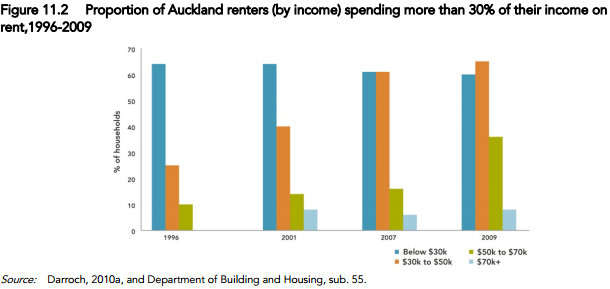
A long-run improvement in incomes without a commensurate increase in housing costs would improve housing affordability.
"In the short to medium term, an improvement in household incomes relative to housing costs is more readily achieved through changes in housing support policy, particularly the Accommodation Supplement. However, Accommodation Supplement expenditure is already high, and has grown in recent years," the Commission said.
"An increase in the size of the subsidy or relaxation of eligibility criteria would come at significant additional cost to government, and some of the benefit from the subsidy may be captured by landlords. On the other hand, lower-income renters are already under housing stress, and Accommodation Supplement payments are embedded in both tenant and landlord cost structures. As such, a reduction or phasing-out of the Accommodation Supplement would present a number of risks," it said.
'So what to do? Here's our recommendation'
The Commission said inquiry participants had raised the possibility of better using the Accommodation Supplement to deliver more value, possibly through funding the community social housing sector.
After giving four options for ways this could happen, the Commission recommended to the government that it provide market rent levels of the Accommodation Supplement where community housing organisations provided reduced rents to their clients.
Below are the Productivity Commission's own comments on the four options:
Inquiry participants raised with the Commission the possibility of better using the Accommodation Supplement funding to deliver more value, possibly through funding the community sector. Four options have potential to better fund the community housing sector which may either in part be offset by reduced expenditure on the Accommodation Supplement, or be funded from it in a fiscally neutral way:
- Invest heavily in growing the scale of the community sector rapidly through additional funding.
- Reduce eligibility for the Accommodation Supplement and use these savings to fund growth in the community sector.
- Reduce the amount the Accommodation Supplement pays to each recipient, and use these savings to fund growth in the community sector.
- Provide market Accommodation Supplement levels where CHOs provide reduced rents to their clients.
Investing in growing the scale of the community sector rapidly through additional funding, offset by reduced AS expenditure
The HSAG projected that expenditure on the Accommodation Supplement would rise to between $1.7 and $2.2 billion in 2015. The question has been whether some of that can be spent now to achieve better affordable housing outcomes and reduce the future cost of the Accommodation Supplement.
The most obvious approach would be to invest heavily in growing the scale of the community housing sector. This could be offset if reduced rents in the community sector translate largely into savings on the Accommodation Supplement.
As well, if the community housing sector achieves sufficient scale, it will reduce demand in the private rental sector, placing downward pressure on rents and the Accommodation Supplement temporarily.
This is a high-risk strategy which, reliant as it is on large-scale borrowing to provide grants, may not be viable in the current environment of fiscal restraint. A way of reducing this risk, but potentially increasing others, would be to reduce the eligibility for the Accommodation Supplement and use the money this ‘saves’ to fund growth of the community sector.
Reduce eligibility for the AS and use these savings to fund growth in the community sector
Half of all renters receive the Accommodation Supplement, some at fairly low weekly amounts. In its engagement meetings it was suggested to the Commission that the threshold for qualifying could be lifted. Households receiving relatively small amounts of money would ‘tighten their belts’, and the money that government saves could be re-targeted to provide more community housing. The downward pressure on private rents that a larger community sector creates might perhaps with a lag offset the decrease in Accommodation Supplement some households receive.
It could take years for the community housing sector to be large enough to significantly affect rents across the market. During this adjustment period, loss of the Accommodation Supplement may place some households under financial strain.
Community housing could have a significant effect on rents in a regional submarket, which is one reason why growing the sector would be positive. Cuts to the Accommodation Supplement though would need to be a matter of national rather than regional policy, so the costs and benefits would be unequally distributed.
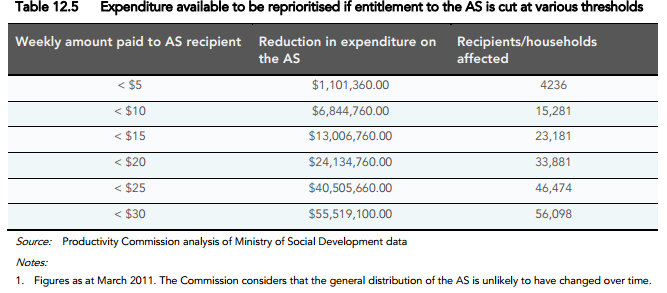
Table 12.5 shows how much funding would be available if those who were receiving low amounts of the Accommodation Supplement ceased doing so. Quite significant cuts would need to be made to achieve anything like the amount of funding needed annually to expand the sector sufficiently to meet anticipated demand.
Reduce the amount the Accommodation Supplement pays to each recipient, and use these savings to fund growth in the community sector
Another option would be to cut the amount paid to each Accommodation Supplement recipient by, say, $5 a week. Modelling indicates that this would result in around $80 million that could be reprioritised (using payment amounts as at June 2011).
However, there are significant spikes in the distribution of Accommodation Supplement recipients that may be explained by clustering around the upper limits of payment in particular areas or for particular household types. This in turn would suggest that a significant proportion of these recipients may have accommodation costs above levels that the Accommodation Supplement will assist with (likely to be those who are paying above 30% of their incomes for accommodation).
These spikes would represent those most likely to struggle with any cut to the amount of Accommodation Supplement they receive.
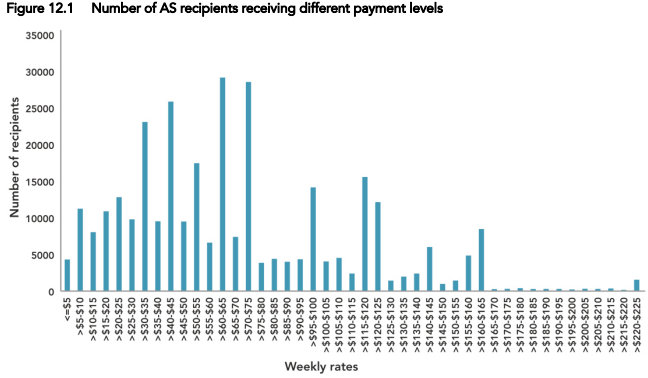
If no cuts were made to those groups above $70 a week where there are spikes, the amount available to be reprioritised would reduce to about $50 million annually. If no households represented by the spikes received cuts, then the amount available to be reprioritised would reduce to about $27 million annually.
Any exceptions may prove hard to administer in practice, as people seeking re-assessment of their level of need may over time move into higher brackets. Moving away from a simple need criteria based on rent and income would further complicate the system. Significant modelling and analysis would be needed to prove this option viable.
Provide market Accommodation Supplement levels where community housing organisations provide reduced rents
Reduction in rent from market value will largely be absorbed by reductions in the Accommodation Supplement, which won’t make a tenant much better off. However, if the tenant received market rent levels of Accommodation Supplement where the CHO offers a reduced rent, this would enable the CHO to materially improve the wellbeing of its tenants.
As a subsidy paid to the tenant the Accommodation Supplement is relatively bureaucratically efficient. If the tenant moves, the subsidy goes with the tenant relatively freely, based on their housing costs. There is potential to put the tenant at risk of financial hardship if there is a delay in the Accommodation Supplement being shifted due to organisational processes or poor coordination in assessing whether they are with a CHO or not.
Of the four, option four is the only option that would address the disincentives to achieve the HSAG vision of moving lower-need state housing tenants who are ready to move on into community housing. The other three maintain the gap between IRRS and the Accommodation Supplement such that it would act as a significant disincentive.
Regardless of the need to fund community housing organisations further, the Accommodation Supplement needs to be adjusted so that rent reductions in community housing create meaningful financial benefits to their clients.
This article was first published in our email for paid subscribers this morning. See here for more details and to subscribe.
19 Comments
My goodness, is there anything that the Productivity Commission isn't qualified to look at?!
The answer, of course, is "anything that actually influences productivity"
The Act Party, with 1% of the vote, must be thrilled that its proxy agency hogs the political agenda so much!
That was a well written article Alex.
- Phase out the AS all together.
- Free up land use restrictions.
- Free up the RMA.
- Bring rental investor capital gains obligations into line with everyone elses.
I don't get this government. Anything to relieve housing presures is answered with "no"
It's all about supply. Make it easier and cheaper to build. Here's a bunch of idea's govt.... "no"
The Productivity Commission is a very useful tool for the Nats.
It LOOKs like they are addressing issues that their constituents are concerned with, without actually doing anything (other than eating up a year or two in investigations - regurgitating things already known - followed by recommendations that can be taken or left)
There is NOTHING in the housing affordability report that wasn't already known or well documented. The investigation has allowed the govt to bide their time, in the meantime housing prices have inflated again. How convenient!
Key's govt are a bunch of gutless muppets
Matt, you are sadly, SO RIGHT.
And Hugh was right all along - fair enough that he declined to even bother to get involved in this round. NZ actually did have a Housing Affordability Inquiry a few years ago that was well aware of the facts, even if they wimped out at the time probably because the Clark/Cullen cabinet contained several property investors.
So much for the media watchdog beating up John Key's TranzRail shares, when there was a far more egregious and nationally destructive set of vested interests at work.
The AS is a tool to protect the property bubble...it's as simple as that. Those calling for the govt to make housing affordable fail to understand the bubble rules, via the banks who own the economy....the Beehive dolts are just puppets....
Agree. Subsidies such as this simply fuel the demand side and push up prices further. The $2.2b projected would be a measure of how much of the tax payers money that National would be spending to look after their property speculating mates and the banking sector. The core problems lie in the supply side of the housing market which as others have noted, the National Government refuses to address, presumably because of the vested interests.
They go on about trying to reduce the government deficit. Maybe one of the best means of doing this would be to address the housing supply side blockages and to ensure a vibrant, compedative land development and building materials supply sectors. Lower accomodation supliment costs; A boost to employment; Lower house costs = less overcrowding and all the social and health costs; Lower house costs = lower cost of living= more compedative labour costs. etc etc
They will however do nothing as they appear to be corrupt.
I quoted a study on here recently that stated that one third of households in Britain were in "public housing" by 1970, which figure had steadily risen in the aftermath of the Town and Country Planning Act, and relentless inflation of housing median multiples.
This is just one of many effects that stuff an economy and society permanently when you let planners try and play God with urban growth.
Nowadays Wooly...they prefer the term appointees to puppets. In a mechanised world it's ..
' No strings attached.'
Confucious say..." Man who slip hand in dummy's pocket not necessarily ventriloquist "
The government is currently paying "accomodation supplement" to 320,000 renters ... considering there are 1.6 million houses in NZ, 20% are subsidised rentals. Surprised Wolly's not all over this. Because he's right. Question is ... how many of the 320,000 are not NZ citizens.
It's a great rort Icono....likely most MPs when they have their snouts out of the Parliament trough...are face deep in the landlord AS trough..?
That's $4,000 each (on average)
This will probably end up as a kill thread but has any noted that a housing advisory group has suggested rent subsidy will double in the next fours years - and that's a percentage of market rent.
So what? well, the thing is if rents may be doubling in four years what's that going to do to property values. well if rents move up so do property prices - maybe double in the next five years.... (given we are a couple of years into the property cycle anyway)
That will generate an almost impossible void to cross between lifetime tenant and homeownership. Choose the best option - for me it is property ownership
President of Property
There was a book written by a KGB defector called Tomas Shuman in the 1970's, called "Love Letter to America". In it, he outlined how the KGB was far more involved in sowing destructive ideology than they were in actual espionage.
Besides the destruction of the traditional family, and the creation of "victim" groups as useful idiots against their own society, one KGB objective was "urbanise the population, reduce the rate of property ownership, and create more distinct class divisions of landlords and tenants".
Funny how the most-dismissed conspiracy theories are the most successful ones..........watch the watermelons and lefties jump all over me now..........
Gordievsky wrote 'Next Stop Execution' also a good read. I had a beer with the guy once, interesting experience.
No Phil, you are absolutely right of course. The only thing that should be pointed out is the CIA does exactly the same thing and has done for years. Have you seen Reefer madness? The battle of America?
Looking at the UK, its not surprising that the affordable housing focus here in NZ has switched to the revenue side of things and the implications for this of a shortage in supply of good quality rental housing – either via the state, non profits or the private sector. Last time I looked the housing benefit bill in the UK was just over 21 billion pounds a year – compared with a capital investment programme in social housing that peaked over 08-11 at 8.9 billion pounds, but now languishes at just about 1 billion pounds (that is what happens when you face a deficit reduction programme of the scale being put in place there).
The NZ and UK systems are quite different - social rent regulation model, a historical social landlord asset base of 4 million homes and their capitalisation of benefits for new build, the benefits system in general, planning [which is currently changing in the biggest shake up in decades] - and the shortage of supply in the UK is worse than here - about 100,000 being built per annum, with around 290,000 pa needed depending on who you read.
Parts of NZ seem to be slowly waking up and realising we have our own acute housing crisis – especially in some important housing markets. Unless the fundamentals around supply are addressed and significant improvements made in numbers and quality of affordable rented homes then it would seem the revenue pressures are only going to head in one direction. Unfortunately this looks like reinforcing a “right to buy, wrong to rent” mentality - if you can’t afford to buy or even worse don’t want to, then you are some kind of second class citizen - if you can’t afford to rent then you need to work harder – not that something isn’t working in the housing market. The danger is that the easier reforms are to cut the bill, rather than fix the systemic problems.
The UK approach to benefit reforms and especially the introduction of a single universal credit benefit payment (which included housing benefit alongside the job seekers allowance amongst a wider bucket of allowances) provides a heads up about some of the ideas in this space that could influence thinking here. While collapsing a complex benefit regime down seems to have been welcomed as a good thing, the bit that didn’t seem to go down so well with some public policy folk (but went down well with Express and Daily Mail readers) was that the UK Treasury then capped the overall benefit at 25k pounds pa (the average working household income) – regardless of household size or where households were located. The parallel reforms of the local housing allowance (housing benefit for the private sector) also put a cap on the maximum amount that could be claimed – again regardless of location (in other words London families were given the same rent support as those in Hull).
The UK situation is like a warning to all countries about where strict urban growth containment will lead your economy and society.
Nations that are land plentiful have to have rocks in their head to do this stuff.
It is easy to understand why Hong Kong and Japan cannot avoid becoming seriously uncompetitive as they "run out of land", forcing up the costs to every productive part of their economy. It is not so easy to understand why nations that are not short of land would voluntarily put their own economies and societies under identical disadvantages.
It is also strange that the same left wing politicians who are all in favour of international co-operation and multilateralism and disarmament and so on, are not willing to simply let a tiny part of the 40% or so of their land that is farmland, be sacrificed to urban growth in the cause of urban economic competitiveness and social justice, given that they can buy all the food they need from the people just across the water that they trust so implicitly with so much transnational sovereignty anyway.
"A reduction of house prices may in the long-run also filter through to reduced rents for those on lower incomes in the private rental market."
Gee too bad that what is affected by sentences such as that one is people, families especially. The housing crisis is here and now, not somewhere in the "future"
Ban all foreign landlords for a kicker, housing prices must again reflect what the average NEW ZEALANDER earns in New Zealand not anywhere else in the world
We welcome your comments below. If you are not already registered, please register to comment
Remember we welcome robust, respectful and insightful debate. We don't welcome abusive or defamatory comments and will de-register those repeatedly making such comments. Our current comment policy is here.