
By Bernard Hickey
New Zealand's two-speed housing market continued to diverge in May as central Auckland and Christchurch prices and volumes kept surging, while the rest of the country remained stalled at weak levels.
The Real Estate Insitute of New Zealand (REINZ) has reported 7,175 properties were sold nationally in May, up 26.4% from April and up 24.4% from May a year ago.
But a disproportionate amount of activity and the highest price rises were in Auckland and Christchurch, where supply shortages due to the earthquake, a lack of new building over the last decade and leaky buildings continue to distort activity. Most external migration and internal migration, including from Christchurch, is going to Auckland.
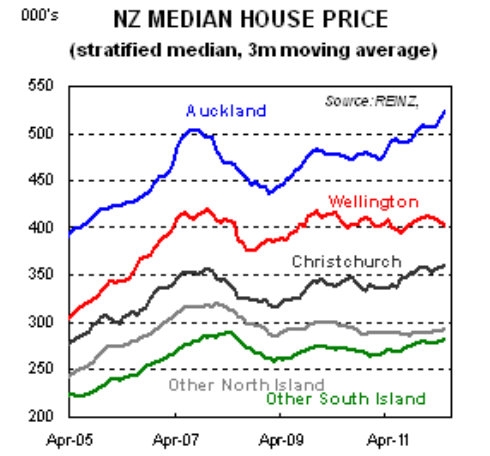
Auckland's median price rose 7.8% in May from a year ago to a record high NZ$500,000, while 2,792 properties were sold, up 28% from a year ago.
The increase of 26.4% in the number of properties sold between April and May compares with an average increase of 12.3% between April and May over the past 10 years, with May the third strongest month for real estate sales across the year.
Canterbury/Westland sales rose 56% from May a year ago, while Central Otago Lakes sales rose 31.9% and Wellington sales rose 28.3%.
There is one strong exception to the Auckland/Christchurch vs the rest divergence. Taranaki property sales rose 60.3% in May from a year ago and the median price rose 11.8% in May from a year ago.
The REINZ Stratified House Price, which adjusts for some of the variations in mix that can impact on the median price, is 6.4% higher than May 2011 and is now also 0.3% higher than the previous peak of the market in November 2007. See interactive charts below.
“Sales volumes have been surprisingly strong in May, with all regions recording increases in sales over April and over May last year,” said REINZ Chief Executive Helen O’Sullivan.
“May is typically stronger than April, ranking as the third busiest month in the year for real estate sales, but the increase is considerably stronger than normal seasonal trends would suggest. This is likely partly driven by good deals on interest rates during the month, and a desire by buyers to complete purchases before winter,” she said.
“The strength of the real estate market continues to be focused on Auckland and Canterbury, with Auckland reaching a new milestone with a record median price of $500,000 and Canterbury/Westland again hitting its record median price of $335,000.”
The national median ‘days to sell’rose by one day in May from April to 38 days, but was seven days lower than in May 2011 and remains below the average 41 days over the last five years.
Auckland and Canterbury/Westland recorded the shortest days to sell at 33 days, followed by Otago with 35 days and Wellington with 42 days. Northland recorded the longest number of days to sell at 67 days, followed by Central Otago Lakes with 63 days and Taranaki with 58 days. See full REINZ regional breakdowns here at REINZ site.
Auckland auctions hot
Nationally there were 1,071 dwellings sold by auction in May representing 14.9% of all sales, up from 584 sales in May 2011 representing 10.1% of all sales.
Auction sales in Auckland dominated the auction market, representing 71.9% of the national total with 27.6% of all dwelling sales in Auckland by auction, up strongly from the 16.9% of sales by auction in May 2011.
ASB Economist Jane Turner said house sales rose 17% in May in seasonally adjusted terms, rebounding from an 8% fall in April.
Turner said the early timing of Easter being in April in 2012 drove more activity into May so the three month average turnover level was a better indicator.
Rental property popular again
"This shows that the underlying trend in housing market turnover is one of gradual improvement. The recent decline in fixed-rate mortgages, to below the floating rate in some cases, is likely to stimulate additional buyer demand," Turner said.
"In addition, the ASB housing confidence survey shows that expectations are for house prices to increase over the coming year and, reflecting this, the ASB investor confidence survey shows that rental property has become the most favoured investment. This suggests there is a return of investment demand in the housing market," she said.
The housing market remained tight due to low supply, she added.
"However, the national average masks differing regional trends. Housing shortages appear to be most acute in Auckland and Christchurch and we are seeing growing pressure on house prices in these regions. The REINZ stratified house price index shows that house prices are up 6.4% on year-ago levels, with Auckland house prices leading that growth up 8.3%. House prices in Christchurch and the rest of the South Island are also growing strongly, while house prices in Wellington remain flat," she said.
The RBNZ was expecting to see around 5% annual house price inflation over the coming year, "although with momentum continuing to build the risks are house prices growth faster than this."
"For the time being the RBNZ will stay focussed on near-term downside risks stemming from offshore. However, over the coming year the strength in the housing market, and potential to spill over into generalised inflation pressures, may start to be more of a concern to the RBNZ."
(Updated with more detail, ASB comments, interactive chart)
We welcome your comments below. If you are not already registered, please register to comment
Remember we welcome robust, respectful and insightful debate. We don't welcome abusive or defamatory comments and will de-register those repeatedly making such comments. Our current comment policy is here.