
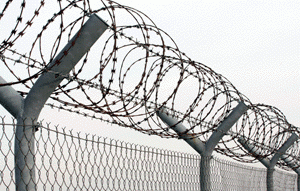
Auckland Mayor Len Brown says short of putting up barbed wire around the city and telling Aucklanders to stop breeding, the city is going to grow and needs his council's Unitary Plan to prevent families from being permanently excluded from the housing market.
In a speech to the Transport NZ Summit Brown also said the Government will eventually agree to the Auckland Council's proposed multi-billion dollar central rail loop, something the current government is unwilling to help fund.
Brown said that by 2040, Auckland's population was "expected" to reach around 2.5 million people, meaning up to a million new Aucklanders with 60% of the growth coming from within Auckland, and New Zealand - "our children, and our children’s children."
"This is not a target, but Statistics New Zealand’s best current forecast," said Brown.
"Short of putting barbed wire around our city and telling Aucklanders to stop having babies, our city is going to grow."
The Council's Auckland Plan points to Statistics New Zealand projecting medium population growth of 700,000 and high population growth of one million people for Auckland over the next 30 years. It puts Auckland's current population at 1.5 million, and says "given Auckland’s history of rapid population growth, Auckland Council believes it is prudent to plan for the high-growth projection."
Elsewhere Statistics New Zealand says projections show the Auckland region having the highest annual growth rate of all New Zealand regions between 2006 and 2031, with growth averaging 1.4% between 2006 and 2031, compared with annual average population growth of 0.8% for New Zealand as a whole. Also see David Hargreaves opinion piece: The 'should Auckland go up or out' debate misses the real point - the city is already too big for the country anyway.
This "expected" population growth to 2.5 million, made agreeing the council's draft Unitary Plan "fundamentally important" to Auckland’s future, suggested Brown.
"Without a new plan, that provides for more options for affordable homes, many Auckland families risk being permanently excluded from the housing market," said Brown. "If we are serious about having more options for affordable homes in Auckland, then we need to keep moving this plan forward."
The draft Unitary Plan, Auckland's new development "rulebook" was launched in March with the intention that after feedback and consultation it would be formally notified by the council, ahead of October's council elections, with a three-year period for the plan to legally take effect. The plan envisages 60% of development over the next 30 years taking place within the city's existing urban limits through the development of more high rises and terraced housing. Feedback closes this Friday. See here for all interest.co.nz's articles on the subject.
'Affordable housing & integrated public transport at core of Unitary Plan'
Brown said the Unitary Plan had both affordable housing and integrated public transport at its core.
"That means in the future, as the city grows and as our transport system improves, the options for people to live close to transport links will get better. The plan also includes - for example - limits on the amount of parking in centres where there are good public transport options available, and where we know public transport options will improve over time."
"That means more space is freed up for housing. And it means greater incentives for people to use public transport," Brown added.
"And if you want an environmental benefit - it means more ability to absorb rainwater, and therefore less pressure on the storm-water system."
He also said the draft Unitary Plan includes a proposal for inclusionary zoning.
"This is a requirement for developments to include a percentage of affordable housing that remains affordable in perpetuity," said Brown.
"But the biggest and most profound impacts on affordable housing are likely to be indirect. For example, the plan will make affordable housing developments much more viable, by enabling people to make greater use of land, and by providing more land outside the urban limit. A balanced approach - smarter use of urban land, along with more new land to develop."
On top of this Brown suggested the Unitary Plan limits the cost burdens of new developments on existing ratepayers.
"If all of Auckland’s growth was on greenfield sites outside the existing city, the costs of all those new roads, water and wastewater facilities, and all the other infrastructure needed, then the added cost to existing ratepayers would be significant."
And he said the cheapest way to grow would be from only allowing intensification.
"We’re not doing that because that would curtail the desire of many Aucklanders for a section and a house. But the balanced approach we’re proposing - with up to 40% of growth on new greenfield sites and the remaining on existing land in Auckland - is certainly more cost effective for ratepayers than LA style sprawl."
'The shape of communities will change'
He acknowledged, however, that this meant the shape of many communities will need to change. But said this would be gradual change, over three decades.
"But the fact is we can’t improve options for affordable homes if all of Auckland’s communities stay the same."
Brown said there was a duty to "our children, and to our children’s children," to make Auckland fit for their future.
"If we stick with the fragmented approach of the past, we will fail them. But if we are brave enough to move forward with a new plan for our city, and bold enough to make investments now in our transport system - then we can give all Aucklanders a shot at being residents of the world’s most liveable city."
Extra $400 mln a year needed for transport
Meanwhile, Brown also took the opportunity to spruik the Council's proposed central rail loop. He also acknowledged current sources of funding aren't enough to pay for the Auckland Plan's 30-year transport programme.
"We need to find an extra $400 million a year from 2016 to fund the ongoing improvements needed. It could either come from rates - meaning large rate rises for Aucklanders. Or we can decide on a range of different mechanisms to raise the funding - which puts some of the costs and those that get the most benefit from new infrastructure."
On the central rail loop, he said the Council was working "at pace to designate and secure" its route. He said it would effectively double the capacity of Auckland’s train network.
"The train congestion we saw on the opening night of Rugby World Cup would not have occurred if there had been a central rail loop," said Brown.
On the issue of funding for the central rail loop, Brown said; "I'm confident we will get there. The business case is strong. Aucklanders back it. Eventually the government will need to agree to it."
Auckland's bus network was also undergoing a transformation with a review of every single bus route.
"The current fragmented set of bus routes will soon be replaced by a sensible network, with more frequent buses at peak times and sensible interchanges - so people can move around the city more easily. More broadly, we are working to create a single network of buses, trains and ferries - one that will present an attractive option for those who have never really considered it before. This will include a single ticketing system for trains, ferries and buses - to be completed by the end of this year," said Brown.
We welcome your comments below. If you are not already registered, please register to comment
Remember we welcome robust, respectful and insightful debate. We don't welcome abusive or defamatory comments and will de-register those repeatedly making such comments. Our current comment policy is here.