
By Bernard Hickey
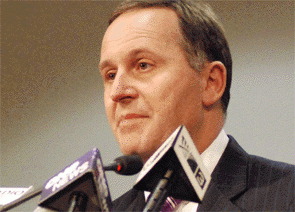
Prime Minister John Key has defended the Reserve Bank's attempts to slow riskier mortgage lending, saying it was ultimately necessary to slow down Auckland's unsustainable house price inflation and avoid fast interest rate increases for everyone across New Zealand.
Key told Local Government New Zealand's annual conference in Hamilton he still thought first home buyers should be exempt from the Reserve Bank's proposed 'speed limit' on high Loan to Value Ratio (LVR) lending, but that the Reserve Bank needed to slow down Auckland's housing market.
"You can't afford to have housing prices going up 20%. It's not sustainable and it's actually not the right thing to do for the country," Key said in his most detailed comments in months about Auckland's housing market.
"So we do need to deal with that, and the government's response is through the supply side, but the Reserve Bank does need to look at the demand side and they'll need to work through the equity and fairness of that," he said.
"My view is that first home buyers should be a priority within that system, but overall they (the RBNZ) need to take a bit of steam out of that train in Auckland, and hopefully that's what will happen."
Key told the conference that taming housing inflation and avoiding its wider effects on the economy was a major priority for the government.
"You're going to hear a lot about housing, mark my words, over the course of the next 18 months," he told the gathering of more than 200 mayors, councillors and council staff.
"We live in a property-owning democracy. People either own a house or fundamentally want to a buy a house. That is the default position of most New Zealanders," he said.
He described house price inflation in Auckland of 20% over the last year as "a hell of an uplift." Inflation in Christchurch had been in the double digits and he said he suspected prices in Hamilton and Tauranga were already beginning to move as the Auckland effect started to spread.
The government could improve the supply side of the housing market and was working with councils to form Local Housing Accords, he said. These accords would allow councils to approve housing consents for greenfield developments with at least 50 properties and brownfields developments with at least 5 properties within 6 months without referral to the Environment Court, he said.
Auckland was currently building 3,500 to 4,000 homes a year, but needed to build at least 13,000 houses a year to 'stand still' with a growing population. "We can't afford to build 12,000. We need to build 39,000 over the next three years," he said.
But the problem was not just a supply problem, he said.
"The other part of the debate is around the demand side," he said, referring to the Reserve Bank's proposals to limit the growth of high LVR loans and his own views that first home buyers should be given priority.
"But I think it's worth putting some context around that. Absent of any other alternatives...if those macroprudential tools were taken off the table...the only alternative for the Reserve Bank is to raise interest rates for every mortgage holder and business right around the country," he said, referring in particular to Tim Shadbolt's city of Invercargill.
"You're having to pay higher interest rates because of a housing problem in Auckland," he said. "It's also going to put a lot of pressure on the exchange rate and we're an export driven economy."
"Our interest rates are likely to go up anyway. The question is how quickly the Reserve Bank Governor needs to raise rates."
US housing bubble
Key then talked about the risk of a housing bubble bursting and hurting the banking system in the same way it had in America.
"The very people that tried to get into these homes paid far too much, borrowed far too much and when the bubble burst they had negative equity," he said.
"That is a serious issue and that's why I don't think it's a simple thing for central government politicians to say: 'ah well we can afford all these things.'"
(Updated with more comments from Key)
We welcome your comments below. If you are not already registered, please register to comment
Remember we welcome robust, respectful and insightful debate. We don't welcome abusive or defamatory comments and will de-register those repeatedly making such comments. Our current comment policy is here.