

With rising interest rates and low rental yields on Auckland houses, "something has to give", according to ANZ economists.
Writing in the bank's latest monthly Property Focus, ANZ chief economist Cameron Bagrie, senior economist Mark Smith and economist Steve Edwards, said that according to official March inflation figures, the annual increase in Auckland's dwelling rents was 2.3% - slightly above the nationwide average of 2% and less than half the 4.9% rise in Canterbury.
"One of the peculiarities about Auckland’s housing issues has been the disconnect between the shortage [of housing in the region] thesis and lack of movement in dwelling rents," the economists said.
"Other motives, including the focus on capital gain, may be behind small movements in rents, but with rental yields in the Auckland residential market (around 4% according to our estimates) already very low in relation to (rising) interest costs, something has to give. Either rents move up more sharply or prices fall," they said.
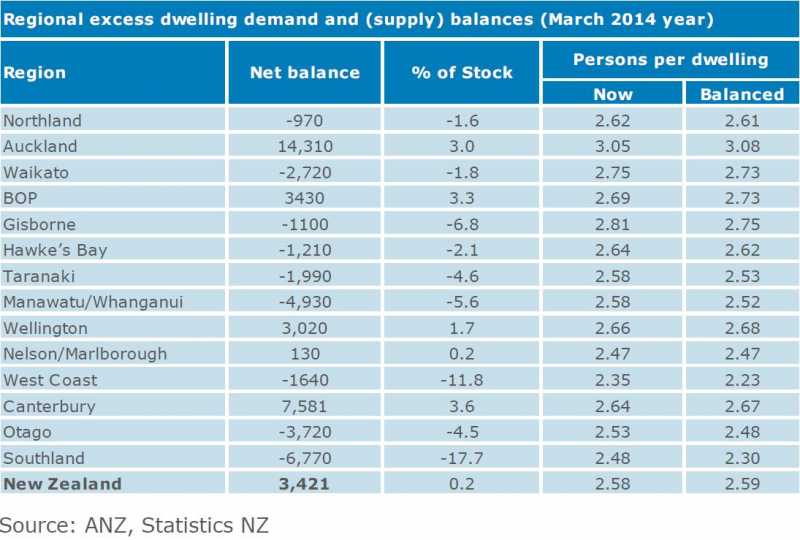
The economists have crunched the numbers, based on updated 2013 census information to look at the overall supply v demand equation for housing around the country. (See tables below)
They have concluded that nationwide there's a negligible shortage of houses, based on the latest information.
They said that in the March 2014 year, there was an ‘excess demand’ of around 3400 dwellings nationwide, equating to approximately 0.2% of the nationwide dwelling stock.
"Given the margin of error around such estimates, this suggests the nationwide situation is broadly in balance," the economists said.
"It compares to earlier estimates of a nationwide housing shortage of more than 10,000 units, with the lower positive balance largely attributable to lower than expected population numbers provided by the postenumeration figures from the 2013 Census (104,000 more persons than the provisional census estimates, but still around 125,000 persons lower than suggested by earlier projections)."
The ANZ economists said there was a shortage of 14,000 dwelling units in Auckland (3 percent of the housing stock).
This, they said, was "problematic but far from disaster material, and to some degree partially explains why the rental market has not gone ballistic".
"Recall, early estimates put the housing shortage in Auckland as high as 30,000 units; revised and updated census figures have cut that by more than half."
The economists said there were marked regional differences in the supply and demand equations, with an excess demand situation primarily in Auckland and Canterbury, but also in Wellington and the Bay of Plenty.
"In these regions the rate of household formation has clearly exceeded the construction of new dwellings. In contrast, the remaining regions appear to be in an excess supply situation."
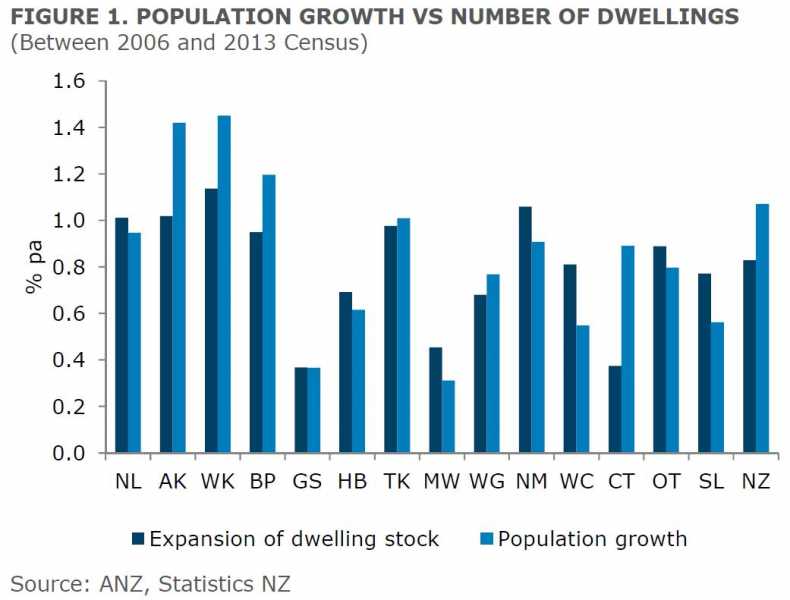
The economists said given that the residential construction sector was still recovering from its pre-Global Financial Crisis slump it was not surprising to see that the expansion of the dwelling stock has been more modest than population growth.
"This, however, has not been a regionally uniform trend. In regions such as Auckland, the Waikato, Bay of Plenty, Taranaki, Wellington and Canterbury, the construction of dwellings has undershot resident population growth.
"In Canterbury, an estimated 20,000 fall in the dwelling stock as a result of the earthquakes resulted in more static growth in dwelling numbers. In other regions, notably Manawatu- Whanganui, Southland and Nelson-Marlborough, growth in the dwelling stock has outpaced that of the resident population."
On other property market related matters, the economists said they expected the Reserve Bank's 'speed limits' on high loan-to-value lending would remain in force until 2015.
"The RBNZ is caught between the proverbial rock and a hard place.
"The restrictions have worked a treat; had they not been enacted we would likely see interest rates 30 basis points higher.
"However, such measures cannot be kept in place indefinitely before the law of unintended consequences starts to unfold, so such a mechanism is on borrowed time. That said, we should be careful what we wish for: if they’ve saved the RBNZ having to hike by 30 basis points, bringing LVR restrictions off carries the reverse implications."
The economists said the RBNZ "must be taking heart" from recent data that had shown a slowdown in the housing sales market.
"Sure house prices haven’t been reined in as much as they’d like, but with the expectation that another OCR hike is just around the corner, this is just a matter of time.
"...Meanwhile, strong migration gains are doing their darndest to keep the demand-supply imbalance out of kilter."
We welcome your comments below. If you are not already registered, please register to comment
Remember we welcome robust, respectful and insightful debate. We don't welcome abusive or defamatory comments and will de-register those repeatedly making such comments. Our current comment policy is here.