
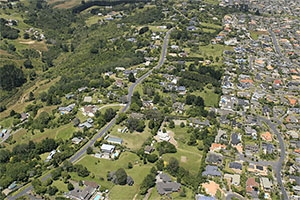
Auckland Council has hit back at calls from Wellington politicians on both sides of the political fence to abolish its Metropolitan Urban Limit (to be renamed the Rural Urban Boundary) which supposedly puts a ring around where new housing can be developed in the region.
The council has released a statement arguing it is a "myth" that the current Metropolitan Urban Limit constrains building beyond its boundaries.
"Over the past three years Auckland Council has approved developments outside of the MUL that could provide up to 23,000 new homes," the statement said.
"This is possible through Special Housing Areas legislation, but it is also part of council's strategy for the forward supply of urban land.
"The proposed Auckland Unitary Plan... includes proposals to open up 11,000 hectares of land outside the MUL to cater for growth over the next 30 years, with the potential to build 110,000 new homes."
The MUL had been in place since the 1990s and the proposed Unitary Plan talked about replacing it with the Rural Urban Boundary (RUB), which would not be a hard line, the statement said.
"In fact the idea of a hard urban limit would be scrapped in favour of a commitment that there is always a boundary that ensures 30 years of land is available to expand into," it said.
The council estimated it would cost $17 billion over 30 years to provide the necessary infrastructure to allow land outside the current MUL to be developed.
"No one wants to see development in areas which aren't properly serviced - it needs to be properly sequenced and thought out," the statement said.
'They just don't get it'
Earlier this week Labour's Housing and Auckland Issues spokesman Phil Twyford called on the Government to use its upcoming National Policy Statement on housing and urban land use to abolish Auckland's RUB and to free up density rules to accelerate Auckland's ability to grow housing supply both out and up. Building and Housing Minister Nick Smith said he welcomed Labour's repositioning on the RUB and a broad political consensus was helpful, but he stopped short of endorsing a full abolishment.
Finance Minister Bill English then ramped up pressure on Auckland Council saying; "It's a pretty clear signal to Auckland City Council that when the plan turns up in six weeks time they need to demonstrate it enables enough supply and Mr Twyford's statement illustrates to them that there's a strong Parliamentary majority for a plan that's going to allow more houses."
Twyford responded to the Auckland Council statement with one of his own, saying they just don't get it.
“The Auckland Council doesn’t understand the reality that having an urban growth boundary where land is cheaper on the outside and more expensive on the inside is a magnet for land bankers and speculators. And that periodically adding new land to a highly speculative land market just feeds that speculation.“I am not surprised Council Chief Executive Stephen Town was too embarrassed to put his name to this nonsense,” said Twyford.
Here's Auckland Council's statement
Urban boundary myth busted
Auckland Council is busting the myth that there is a constraint on building beyond Auckland’s current Metropolitan Urban Limit (MUL).
23,000 homes already planned outside the MUL
Over the past three years Auckland Council has approved developments outside of the MUL that could provide up to 23,000 new homes. This is possible through Special Housing Areas legislation, but it is also part of council’s strategy for the forward supply of urban land.
The Unitary Plan could open up 11,000 hectares outside the MUL
The Proposed Auckland Unitary Plan, which is currently before the Independent Hearings Panel, includes proposals to open up 11,000 hectares of land (that’s about one and a half times the size of Hamilton) outside the MUL to cater for growth over the next 30 years, with the potential to build 110,000 new homes.
The new Rural Urban Boundary would not be a ‘hard line’
While the proposed plan talks about a Rural Urban Boundary, this is not a hard line, unlike the existing MUL that has been in place since the 1990s and was located hard up against the urban development.
In fact, the idea of a hard ‘urban limit’ would be scrapped in favour of a commitment that there is always a boundary that ensures 30 years of land available to expand into.
Servicing land outside the MUL would cost $17bn over 30 years
Additionally, expanding into the RUB can’t happen overnight. The land is currently un-serviced and it will take time and in excess of $17 billion to put the right bulk infrastructure in place. No one wants to see development in areas which aren’t properly serviced – it needs to be properly sequenced and thought out.
Hearings before the Independent Hearings Panel have now finished. The Panel will deliver its recommendations to the council on July 22. The council will then have until August 19 to consider the recommendations and make a final decision.
And here's Phil Twyford's response
The Auckland Council’s statement today shows they don’t understand the problems created by the urban growth boundary, says Labour’s housing spokesperson Phil Twyford.
“I have been the first to defend the Auckland City Council when Bill English has been blaming them for the housing crisis over the last few years, however reading their latest press release, maybe he has got a point.
“Their statement from an unnamed council bureaucrat shows they just don’t get it.
“The Auckland Council doesn’t understand the reality that having an urban growth boundary where land is cheaper on the outside and more expensive on the inside is a magnet for land bankers and speculators.
“And that periodically adding new land to a highly speculative land market just feeds that speculation.
“I am not surprised Council Chief Executive Stephen Town was too embarrassed to put his name to this nonsense,” says Phil Twyford.
We welcome your comments below. If you are not already registered, please register to comment
Remember we welcome robust, respectful and insightful debate. We don't welcome abusive or defamatory comments and will de-register those repeatedly making such comments. Our current comment policy is here.