
By Bernard Hickey
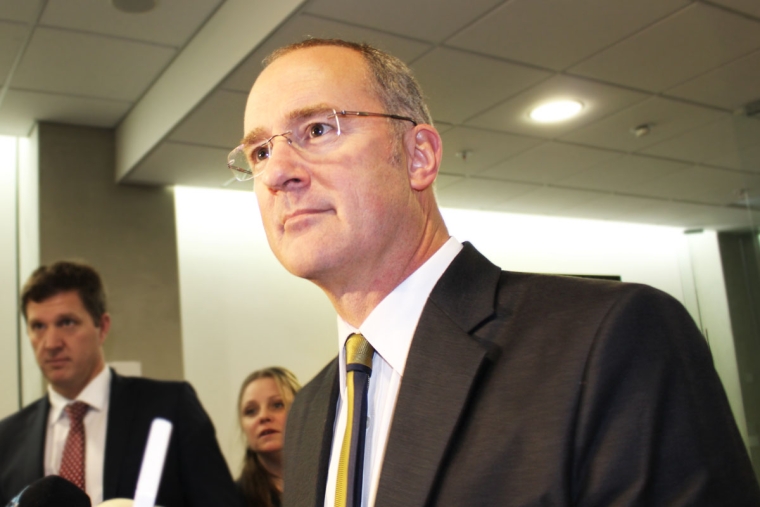
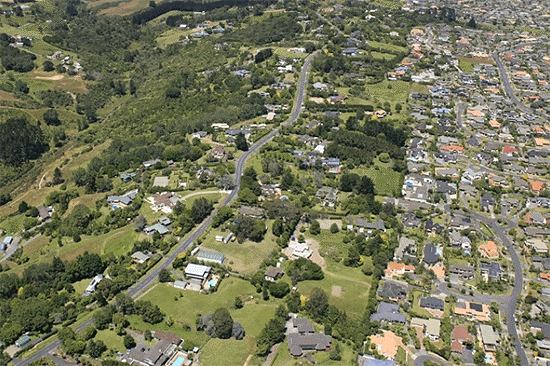
Labour's Housing and Auckland Issues spokesman Phil Twyford has called on the Government to use its upcoming National Policy Statement on housing and urban land use to abolish Auckland's Rural Urban Growth Boundary (RUB) and to free up density rules to accelerate Auckland's ability to grow housing supply both out and up.
Twyford also called on Councils and the Government to use new methods of funding infrastructure so that Councils don't have to lump costs on all ratepayers and on developers, who are stuck paying high development contributions that they pass on to home buyers in a lump sum.
Twyford said Councils and the Government should work together to create special purpose vehicles that can borrow using bonds backed by targeted rates, which would reduce the up-front burdens of infrastructure costs on developers and on ratepayers elsewhere in the city. Instead of paying development contributions, a developer would instead just build the house and a council or Government-controlled special purpose vehicle would issue bonds that were serviced through targeted rates to home-owners in that development.
This would allow Councils to avoid asking ratepayers in general to pay for the heavy infrastructure costs of new pipes and roads and lighting and footpaths for new greenfields developments in other areas, and it would allow the Council to avoid further increasing its existing core debt.
Using such a vehicle essentially takes advantage of the lower borrowing costs of Governments than of individual home owners, and removes the local political constraint of Councils having to get all ratepayers to agree to take on more debt that is used to fund specific developments that only some ratepayers get the benefit of. Auckland Council borrowed NZ$250 million in late March for 3.04%, while home buyers face interest rates of over 4%.
"Over 25 years the urban growth boundary hasn’t prevented sprawl, but it has driven land and housing costs through the roof. It has contributed to a housing crisis that has allowed speculators to feast off the misery of Generation Rent, and forced thousands of families to live in cars, garages and campgrounds," Twyford said.
“Labour’s plan will free up the restrictive land use rules that stop the city growing up and out. It will stop land prices skyrocketing, and put the kibosh on land bankers and speculators," he said.
“Nick Smith is talking up his soon to be released draft national policy statement under the RMA. But to avoid it becoming yet another of his long list of his ineffective stunts, he needs to stop land bankers by doing away with the urban growth boundary – and make sure it doesn’t re-emerge under a different name. The urban growth boundary creates an artificial scarcity of land, and drives up section costs," he said, pointing to studies showing land inside the boundary is up to ten times more valuable than rural land.
Twyford said the Auckland Council was already talking about replacing the existing RUB (which replaced the MUL from pre-Super City days) with zoning rules, but he said such zoning rules still restricted development and enabled land-banking.
“It is not enough for the Council to progressively add more land zoned for development here and there. That just feeds the beast of speculation that is an inevitable result of having the boundary."
Twyford also called for careful spatial plans for new development corridors that connected new developments with public transport corridors and protected certain areas such as Auckland's Northern beaches and fertile horticultural land near Pukekohe.
'Release the density limits'
Twyford said freeing up growth on the fringes needed to go together with allowing more density close to the CBD and around transport corridors, "so people can build flats and apartments in parts of the city where people want to live, particularly around town centres and transport routes."
Twyford said Labour was not specifically proposing US-style Municipal Utility Districts, where new privately-controlled urban authorities are created that can issue bonds, pay for infrastructure and charge targeted rates, but saw the central Government and the Council working together to either create special purpose vehicles that issue infrastructure bonds or do it outright from a Government authority.
“It is also essential to reform the way infrastructure is financed. The cost of new infrastructure must rest with the property owners of new developments to prevent the ratepayer carrying the can for expensive infrastructure investment in places where it's too expensive to build. Labour proposes using bond financing paid back by targeted rates over the life of the asset. This can range up to 50 years in some of the jurisdictions using this mechanism," he said.
“With the Budget coming up, the Government has a chance to finally do something to genuinely rein in Auckland’s housing crisis. But unless Nick Smith deals to the urban growth boundary – and its proposed watered-down replacement – integrates transport planning and investment, frees up the density rules, and reforms infrastructure finance, his national policy statement won’t amount to much.”
Smith and English welcome Labour on RUB
Building and Housing Minister Nick Smith said he welcomed Labour's repositioning on the RUB and a broad political consensus was helpful, but he stopped short of endorsing a full abolishment.
"The new Unitary Plan is only six weeks away from going to the council, and I'm confident it will provide a far more permissive approach to new housing because of the depth of analysis that has gone into the new plan. It would be counter-productive to ditch this work at this time with a simplistic approach of just abolishing city limits. We still need some rules to ensure new urban areas have appropriate infrastructure and services and that we make separate provision for industry from housing," Smith said.
Finance Minister Bill English also welcomed Labour's stance on the RUB at a stand-up news conference called hastily in Parliament. He said the broad political consensus was something the Auckland Council should take into account as it considers the Unitary Plan.
RUB analyst supports move
Economist and former Reserve Bank Chairman Arthur Grimes, who has researched the effects of the Metropolitan Urban Limit on land prices, said he also supported its removal and a change to infrastructure financing, as well as the relaxation of density limits. Along with other researchers from Motu, Grimes found in 2008 that land prices inside the Auckland boundary were 10 times higher than outside the boundary. See my 2009 article on that here and subsequent Productivity Commission research showing similar results here.
"I'm partial to removing whatever they want to call it this week -- the Metropolitan Urban Limit or the Rural Urban Boundary," Grimes told Interest.
"There are two urban growth boundaries in Auckland. One is a horizontal one and one is a vertical one, and it's important to get rid of both of them," he said.
Grimes said he opposed the recent practice of progressive extensions of the RUB, which simply gave land owners serial monopolies on land that pushed up land values.
"The way it's been discussed in the draft Unitary Plan really shows a misunderstanding of basic economic principles and is almost designed to give people their own specialised monopoly for a while that forces up the price of land."
Grimes also supported moves to finance the infrastructure needed for development with targeted rates, pointing to other similar tools used overseas such as as (Tax Increment Finance) TIFs.
"These sorts of things are quite mainstream internationally and would seem to me to make a lot of sense to investigate. I can't see major fishhooks in them and they're definitely worth looking at," he said.
Grimes also said Councils also had low debt ratios in New Zealand and linking rates payments to infrastructure bonds was an accepted and sensible practice.
Businesses and developers supportive
Property Council CEO Connal Townsend said he agreed with Labour's call to abolish the Rural Urban Boundary.
“The Rural Urban Boundary is a barrier to entry into Auckland’s land market which will continue to distort market behaviour. An artificial boundary that chokes land supply is counter intuitive," Townsend said.
He said he also agreed a rethink of infrastructure financing was needed.
“We know that paying development contributions through targeted rates over a number of years is workable. And, we already have the Local Government Funding Agency which more and more councils are starting to make use of," Townsend said.
"That is a good start but we need to build onto that and look at alternatives. Central Government assistance is needed in looking at private funding options for infrastructure provision, out of sequence servicing of our future urban areas, as well as in reducing councils’ costs when it comes to hedging risks."
Business NZ also welcomed Labour's proposal.
CEO Kirk Hope said providing more land for building was needed.
“With agreement on this issue between both main political parties, it is to be hoped that local government planning decisions will take heed of the need to focus on land and housing supply," he said.
ACT Leader and Epsom MP David Seymour also supported the call to abolish the RUB, which he said was ACT's policy.
"Hopefully this is a turning point and all political parties will focus on the real solution - freeing up land and increasing housing supply by removing red tape," Seymour said.
"In 2014 ACT was the only party that campaigned on abolishing Auckland's urban limit. Extraordinarily high land prices have locked an entire generation out of home ownership, and as the Productivity Commission found, it's the urban limit that artificially pushes up the price of land, he said.
(Updated with reaction)
We welcome your comments below. If you are not already registered, please register to comment
Remember we welcome robust, respectful and insightful debate. We don't welcome abusive or defamatory comments and will de-register those repeatedly making such comments. Our current comment policy is here.