
Housing is driving inequality in New Zealand, a new report by the New Zealand Initiative has concluded.
The think tank has found that with income and consumption inequality remaining broadly unchanged over the past 20 years, sky-rocketing housing costs are what's boosting inequality in New Zealand.
“Inequality is a very real issue and we seem to be missing the point in New Zealand,” says the institute’s executive director Oliver Hartwich.
“Imported narratives from overseas about ever-increasing income inequality and CEO salaries are not the issue here. New Zealand’s real issues with inequality are being driven by housing.
“Rising house prices have made homeowners richer while those in poorer socioeconomic groups are having to pay an increasing share of their income on housing. This is causing real hardship for too many New Zealanders.
“We feel strongly that a modern society and affordable housing do not have to be mutually exclusive, as long as the Government is willing to act.”
The authors of the NZ Initiative report, ‘The Inequality Paradox Why inequality matters even though it has barely changed,’ Bryce Wilkinson and Jenesa Jeram, argue undue attention and resources have been placed on income inequality, which has distracted us from the real issue. They say:
It is difficult to make sense of the increasing public concern with inequality if we look only to income or wealth statistics. But, there is a massive inequality concern that is rightly troubling many New Zealanders: housing.
In short, New Zealand’s ‘inequality crisis’ is really a housing crisis
Inequality after housing costs is significantly higher than before housing costs. While incomes have risen for high and low earners, the rising cost of housing especially hits the poor.
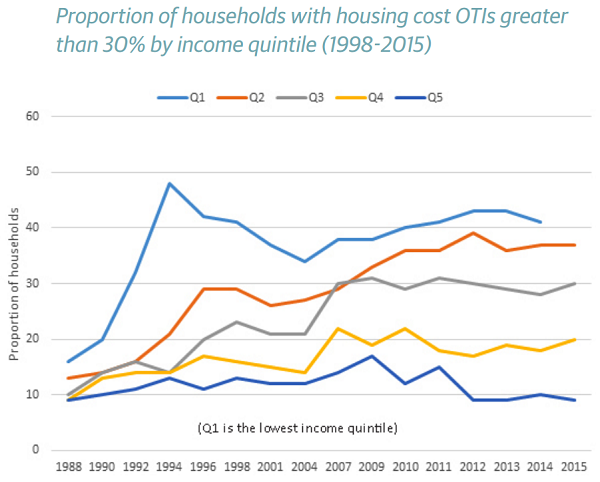
The graph below shows the differential effect of rising housing outgoing-to-income ratios (OTIs) across income quintiles (where quintile 1 is poorest and 5 is richest). The proportion of households with OTIs greater than 30% rose markedly between 1998 and 2015 for each of the bottom three quintiles. In contrast, it was the same in 2015 as in 1998 for the top quintile.
Ongoing well-informed public debate about economic inequality and its sources is important. If, as our research indicates, rising housing inequality is of particular concern, then policies to address inequality in society should address the housing market. Less restrictive housing policies could reduce hardship and economic inequality.
Myths about inequality and the misperceptions in the public debate need to be challenged more. Some of the New Zealand narratives on inequality may have been imported from overseas without sufficient critical consideration. Inequality trends here simply do not mirror what is happening abroad. What should be of concern is barriers to mobility: what is unduly stopping people from getting ahead in life?
Misperceptions about inequality in New Zealand could lead to growth-reducing policies that will make people worse off, regardless of their effects on measured inequality. There should be ample scope for policies that lift earned incomes both on average (i.e. economic growth) and in the bottom quintile of the income distribution.
At the same time, it is important that differences in income and wealth are fairly earned – and perceived to be so. Social cohesion can be corroded by poor policies that create undue barriers to education or jobs, or that allow high incomes to be earned through privilege rather than merit or effort. Thus there should be a strong presumption against corporate welfare.
This report is the second of three reports. The first report was Poorly Understood: The State of Poverty in New Zealand. It argued that issues of hardship were more important than issues of inequality, or low relative income. The third report, to be released in 2017, will examine welfare policy issues.

We welcome your comments below. If you are not already registered, please register to comment
Remember we welcome robust, respectful and insightful debate. We don't welcome abusive or defamatory comments and will de-register those repeatedly making such comments. Our current comment policy is here.