
By David Hargreaves
About 80% of the 1000 'Kiwibuild' homes the Government's targeting for completion in the 2019 financial year will likely be constructed as part of private developments that will be underwritten by the taxpayer.
Housing and Urban Development Minister Phil Twyford launched what's been termed the 'Kiwibuild Buying off the Plans Initiative' this week.
In effect it's an underwriting scheme - with the taxpayer to provide the underwriting.
The implication is that developers will find bank funding easier to get because they will be able to get guaranteed prices for the houses in their developments that are designated as 'Kiwibuild' homes - either by directly selling those to the Government, or by getting the Government, AKA the taxpayer, to cough up the difference in any shortfall they may have to take when selling Kiwibuild houses.
Developers have been invited to participate in the scheme, with applications closing on June 8.
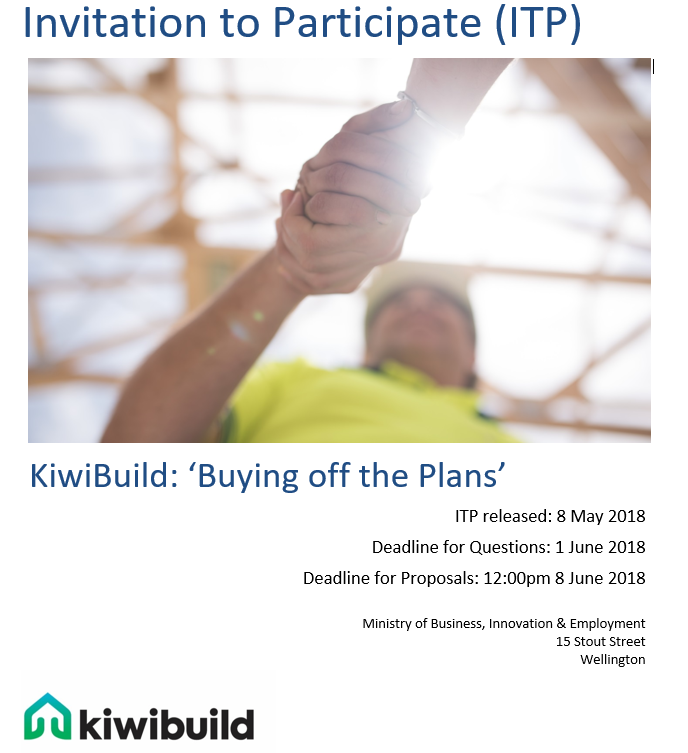
Information for would-be applicants that's been prepared by the Ministry of Business, Innovation & Employment (MBIE) has outlined the following targets for the new underwriting scheme:
- 800 Kiwibuild dwellings in Financial Year 2019;
- 2,500 Kiwibuild dwellings in Financial Year 2020; and
- 4,000 Kiwibuild dwellings in Financial Year 2021.
This compares with the overall targets for Kiwibuild houses, which are as follows:
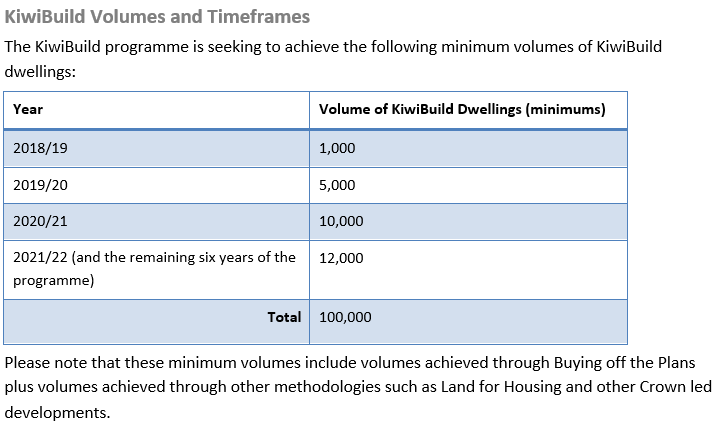
So, looking at those figures and comparing them, it means 800 of the 1000 Kiwibuild houses intended for the 2018/19 financial year will be underwritten private developments, IE 80% of the total.
In the following year 2500 of the 5000 will be built on private developments (so, 50%) and in the year after that 4000 of the 10,000 planned, so 40%.
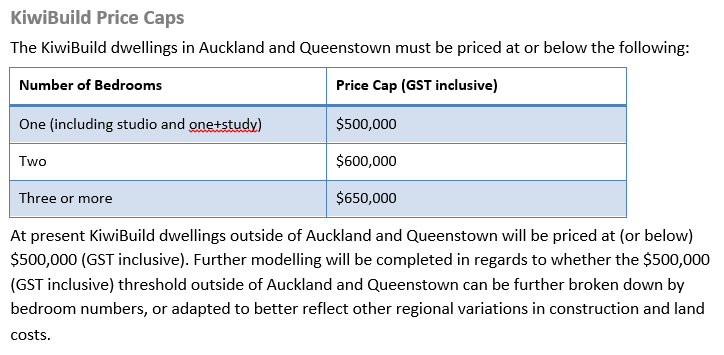
To refresh memories, the affordable home criteria being applied to officially designate Kiwibuild homes is as below:
The new underwriting scheme is in the first instance going to be targeted in these areas:
- Auckland;
- Wellington Region;
- Hamilton;
- Napier / Hastings;
- Queenstown / Lakes District;
- Tauranga;
- Whangarei District; and
- Nelson / Tasman
However, MBIE says responses for other regions will also be considered "and progressed if appropriate".
While the MBIE document (which runs to 47 pages) goes into a lot of detail about how to apply and what's involved, it doesn't give any specifics about how many affordable, IE Kiwibuild houses a development must include to be successful in getting underwritten. It talks about a "significant" proportion of the development.
And while the MBIE document refers to the taxpayer buying the Kiwibuild houses at a discount to market price, it doesn't specify how much of a discount.
Under a section titled 'Why the Underwrite?' the MBIE document says the Government has the ability to utilise its balance sheet strength and "access to low-cost capital, and through the [Kiwibuild] Unit, to provide support for qualifying developments".
The document says while the Kiwibuild Unit will continue to develop the basis by which it can support qualifying developments, that support will depend on case by case development opportunities, and market conditions.
The current thinking is that Kiwibuild, as part of an underwrite, can be supported through the following approaches:
- Backstop purchase of unsold Kiwibuild dwellings: The Government enters into an open option with the developer for the Government to purchase unsold KiwiBuild dwellings (or to pay the difference between an eventual sale price and pre-agreed amount). A backstop essentially provides the developer (and financier) a form of insurance against the ability to sell the Kiwibuild dwellings when complete.
- Outright purchase of Kiwibuild dwellings on completion: The Government enters into a sale and purchase agreement with the developer to purchase the Kiwibuild dwellings on delivery at an agreed-in advance underwrite price (as if it were a private purchaser) and subsequently on-sells these to eligible purchasers.
The document says whichever approach is utilised for supporting a qualifying development, the Unit will establish processes to facilitate Kiwibuild dwellings being sold to eligible purchasers (once finalised), whether through the developer, or through the Government, or third parties.
In terms of developers envisaged as getting involved in the underwriting scheme, the MBIE document sees two potential types:
- Tier One – This is targeted at the established developer market. The approach will be focussed on increasing scale and pace to achieve volume (i.e. larger developments and ideally a pipeline of developments run by established developers).
- Tier Two – This approach will target smaller scale developments, and will focus on removing barriers to progression, trialling different KiwiBuild dwelling typologies, and trialling innovative practices. It will be available to both larger and smaller/newer developers. This may also allow Small and Medium Enterprises (SMEs) to participate.
The document also makes clear that developers would be welcomed to apply for the underwrite as consortiums.
We welcome your comments below. If you are not already registered, please register to comment
Remember we welcome robust, respectful and insightful debate. We don't welcome abusive or defamatory comments and will de-register those repeatedly making such comments. Our current comment policy is here.