By Shane Martin & David Norman*


• We would expect that properties in Auckland’s rapid transit network catchments (the train and northern busway stations) would sell for more money given the additional amenity that comes from access to frequent, faster public transport.
• Our analysis shows that the maximum walk-up distance to the rapid transit network (RTN) that adds value to a property is shorter than we had anticipated although there are several likely reasons for this we have not been able to model.
• Nevertheless, homes that are well-served by trains or express buses command a significant premium over those that are not.
• The work suggests that the completion of the City Rail Link (CRL) and the proposed light rail project would provide a significant windfall gain to nearby properties that has not yet been fully realised. This has policy implications in terms of the case for recouping some of the costs of construction from those who benefit from the windfall gains of new RTN infrastructure.
Widespread public transport (PT) in Auckland has existed since the early 1900s, when the original Auckland tramway system opened. Over time, the trams gave way to buses, trolley buses, and trains. Historically, ridership peaked during World War II, then fell dramatically through to the 1980s. Since the mid-1990s, ridership has increased rapidly, but is still well below WWII levels, despite a population that is six times higher today.
According to Auckland Transport, rail ridership has nearly tripled in the past 10 years and the northern busway has grown from nothing to 5.5 million trips a year. Overall, ridership on Auckland’s RTN has increased eight-fold in 10 years whilst population has grown a little under 20%. All of this tells us that, while Auckland’s PT system is not currently optimised (a fact we delve into below), people are still switching to PT from other modes.
What we would expect
It stands to reason that when PT options become more frequent and accessible, the properties within easy walking distance to these amenities will increase in value.
It is important to note that it is irrelevant whether the people living in these places use the RTN themselves – the properties gain value because someone would pay more to live near the RTN1 . The question is then: how much is the premium and how far out from the station does it extend?
What we found: Go the distance
We found that on the Auckland isthmus2, properties within a 500-metre walk-up distance receive a value premium from being close to the train network. At further distances, there was no detectable value uplift from access to the RTN. This was a smaller value catchment than we thought we would discover given the distances people are willing to travel to get to train stations3. However, there are some very good reasons why Auckland’s value catchments may be smaller than in other, more transit-oriented cities.
First, as currently configured, Auckland’s train system is sub-optimal for moving people to the two main job centres in the city – the airport precinct and the CBD. The only station with CBD access is Britomart, and the upper CBD is an almost 2km long uphill walk from there. Even Auckland Town Hall is more than 1km from Britomart Transport Centre. The closest station to the airport is more than 6km away, from which a person can catch a bus that runs only three to four times per hour at peak times. This is clearly suboptimal for job access via PT.
Second, a bus network that can move people to the CBD faster than the current train alignment is available. For instance, a bus from Avondale to the central CBD takes less time than walking to the train, riding to Britomart, and then walking up Queen Street. For many people on the isthmus, unless you live very close to a train station, it just does not make sense to use the train instead of the bus. The CRL (and proposed light rail project) aim to overcome this sub-optimal idiosyncrasy of the Auckland train network.
The CRL will cut 10 or more minutes off travel times across the train network to the CBD and double frequency on much of the network. Part of the value of this increased access will already be incorporated into land values along the rail corridor and around the new stations, but as we move closer to the CRL becoming operative, we would expect homes near train stations to increase further in value. The new stations and removal of the Newmarket dog-leg will make the train a much more attractive option to people currently reliant on the bus, and we would expect to see an increase in the walk-up distance within which proximity to a train station adds value.
The train station premium
Using the 500-metre train walk-up catchments, we find a statistically significant, positive impact on property values on the Auckland isthmus. We find that the maximum premium occurs at around 260 metres. This makes sense as despite the huge accessibility benefits of living right next to the train station, these are offset by the accompanying noise and congestion. But living a three-minute walk away from frequent train services is ideal.
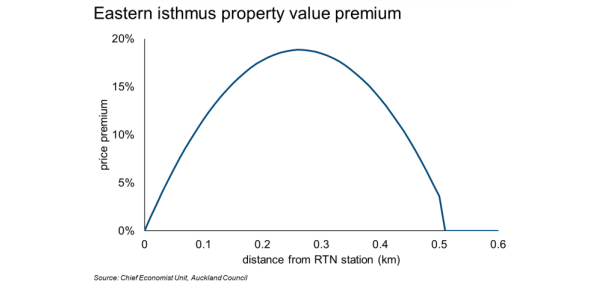
However, the pattern varies significantly across the isthmus. When the isthmus is split into east and west roughly along Manuaku Road/Pah Road (see the map at the end of this paper), the results vary drastically. On the west side of the isthmus, there is no detectible premium for RTN access.
However, on the east side, the premium is large and statistically significant. On the eastern isthmus, a home with a 260-metre walking distance to an RTN station has a premium of about 19% over a home more than 500 metres away from a station. Some explanations for this premium include that:
• The eastern isthmus has much more train access than the west. The Southern, Eastern, and Onehunga lines provide reasonably dense coverage of that half of the city.
• Options on the eastern, southern and Onehunga lines are higher due to the many stations that are covered by more than one line.
• Trains on these lines enjoy a direct trip into the CBD, unlike the Western line which requires a dog-leg through Newmarket until the CRL opens.
This is a surprisingly large premium, though not unprecedented in the international literature.4 While this result is positive and statistically significant, a relatively small share of sales in the eastern isthmus were within the 500 metre catchments. Further, we would highlight that our analysis is limited to properties with a land component; it excludes apartments and townhouses without a specific land component, and the premium, if any, to these typologies is unknown. Nevertheless, the results do give us a guide to the existence and scale of premiums that could occur in the west as the opening of CRL approaches.
Outside the isthmus, there is no detectible premium for living near a train station. This could be due to several factors beyond the ones already mentioned. In particular, many of these stations are “Park and Ride” stations, where walking access is less crucial for using the train. It stands to reason that people are not willing to pay much extra to be able to walk, when they can take a short drive and park their car for free or at low cost.
What about the northern busway?
The northern busway was officially opened in February of 2008, with dedicated bus lanes from Constellation Drive to the Harbour Bridge. After just two years of operation, Auckland Transport estimated that the busway was removing more than 5,000 cars from the morning peak rush hour, improving the commute for everyone. Today, ridership has reached 5.5 million trips a year.
But how much is the busway valued? Using the same methodology, we find that homes located within 500 metres’ walk-up distance have a flat premium of approximately 6.5%.
Part of the issue for walking access to busway stations is that there are few homes near them, as the busway is along the motorway. However, for those homes where walking is possible, there is a real, measurable premium.
What does it all mean?
Auckland’s RTN adds value to the city and as it improves and expands, we would expect this value to roll out to a number of additional households, most notably across the western line, the light rail route, and to greater walk-up distances around existing train stations.
These major infrastructure projects will result in a windfall gain to many thousands of properties within the walk-up catchments, and we now have a sense of the likely scale. This has policy implications for thinking about how infrastructure like light rail may be funded. A model that gets those who reap a significant windfall gain from proximity to the RTN to contribute some share toward its development is more than reasonable and is good economics – those who benefit should contribute in a commensurate way.
How we did it
To analyse the premium (if any) that the RTN adds to properties in its catchment, we compared properties inside and out a defined catchment.
Naturally, there are likely to be other differences between these properties, beyond the presence of PT nearby, so we controlled for these factors as thoroughly as possible. A statistical method called “hedonic pricing” allows us to estimate the price of a property based upon the characteristics of the dwelling (e.g. size, quality, construction type, age, decks, garages) and the characteristics of the land itself (e.g. views, proximity to CBD, school zone, proximity to the coast, proximity to green space). By doing this, we could see the effect of proximity to an RTN station separately from other things that add value to a property.
As with our previous studies on upzoning and special character areas, we used a log-linear hedonic pricing model with time and location fixed effects, and robust clustered standard errors at the Census Area Unit level.
Data on house sales from 2013-2016 was used. To be included, the sale must have been of a freehold property including land and a dwelling of at least 30 square metres.
Several model specifications were tested, and the results were reported for the model with the best fit.
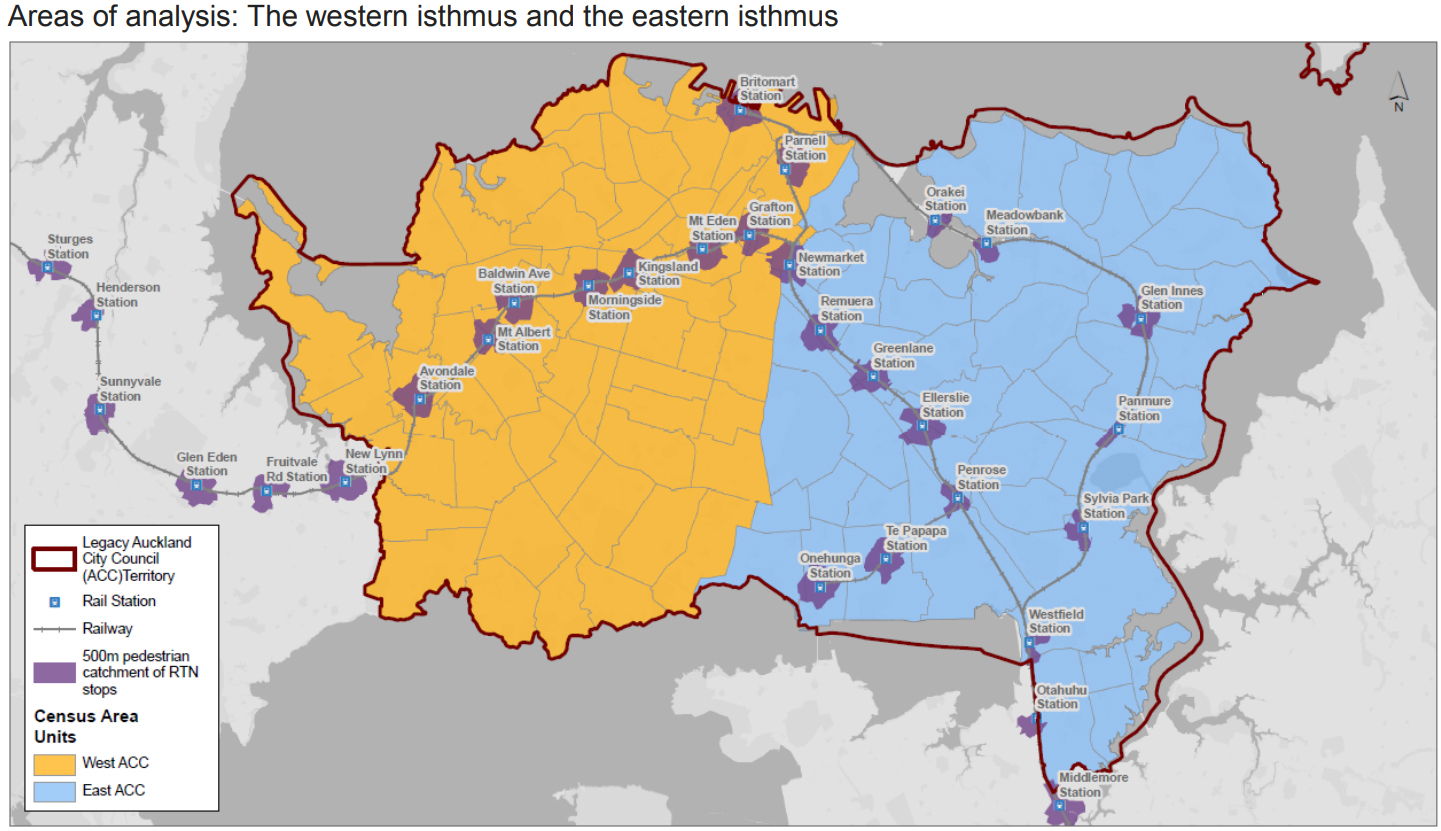
*Shane Martin is an economist in the chief economist unit & David Norman is chief economist at the Auckland Council. This article was first published here.
We welcome your comments below. If you are not already registered, please register to comment
Remember we welcome robust, respectful and insightful debate. We don't welcome abusive or defamatory comments and will de-register those repeatedly making such comments. Our current comment policy is here.