

Property information and analytics company CoreLogic is talking down the likely impact of new rules around 'ring fencing' of tax losses on investment properties.
CoreLogic senior property economist Kelvin Davidson says in the firm's Market Pulse publication that while some investors - especially those new to the game and/or with a big mortgage and hence greater likelihood of a loss - will be hit quite hard by this rule "on the whole, we’re doubtful that the ring-fence will dramatically affect investor confidence or significantly reduce the stock of property in the rental sector".
He says "equity rich" landlords might just "snap up" sold properties thereby limiting the adverse effect on the number of available rentals.
The ring fencing proposals are part of a bill currently going through the select committee process ahead of being returned to Parliament. In short, the proposals mean a rental loss can no longer be used by an investor to reduce their tax bill on non-property income. However, rental losses on one property can be used as deductions against other rentals in a portfolio.
Davidson says it would appear that it is a mere formality the proposals will become law and when it does the ring fence will effectively be imposed for the current tax year starting 1st April 2019.
"In other words, investors need to be accounting for the ring-fence now – i.e. running their sums on the basis that a rental loss can no longer be used to reduce the tax bill on non-property income(s)."
But in assessing that the proposals will not have much overall impact on investors' behaviour, Davidson makes a couple of points.
"First, because of the loan to value ratio (LVR) restrictions, investors have required a deposit of at least 30% for several years now and, on average, will be less likely to be making operating losses than in the past – hence, less likely to actually be utilising the tax advantage. Sure, many will still be using it. But it’ll be less common than in the absence of the LVR rules.
"Second, and perhaps most importantly, it’s a ring fence, not complete removal. Investors will still be able to use losses to reduce their tax bill, just only within a property portfolio, not against non-property income."
Davidson says it's "reassuring" to look back at investor behavior when the depreciation allowance was removed in April 2011.
"This was also a significant change in the rules around property investment, yet our Buyer Classification figures show that the upward trend in the share of purchases going to mortgaged investors barely paused for breath."
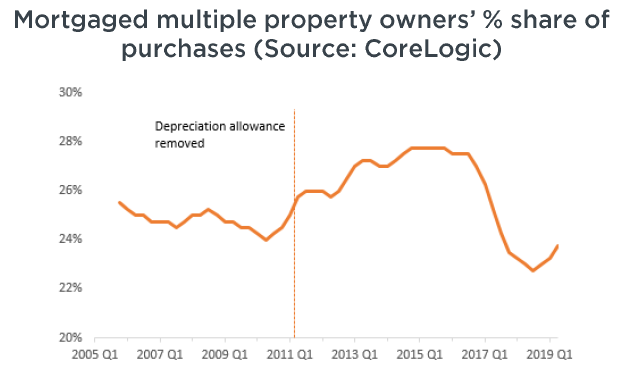
Davidson does say however, that property price rises more generally were starting to "kick into gear again" around the time of the depreciation removal and the gains available may have "swamped" the effect of its removal.
"And clearly, that factor isn’t as strong now, with values flat or slightly falling in Auckland and Christchurch for example, and slowing in many other parts of the country.
"All that said, another factor to keep in mind here is the tighter availability of new interest-only loans in the past few years, as well as the reduced ability for investors to roll over existing interest-only lending."
Given that interest-only loans (and hence lower mortgage payments) are an important tool for negatively geared landlords, Davidson says it’s conceivable that some will have already looked at their sums (regardless of the ring fence proposal) and decided to sell properties that don’t stack up anymore.
"This may have affected rental supply in some areas and would be another factor helping to explain the gradual slowdown we’re seeing in property values around the country.
"Of course, this would only serve to lessen the potential effect when the new [ring fencing] law does actually come into force.
"Moreover, let’s not forget that just because a landlord sells their property, it doesn’t necessarily vanish from the rental stock – it may well be snapped up by another investor, perhaps with more equity behind them."
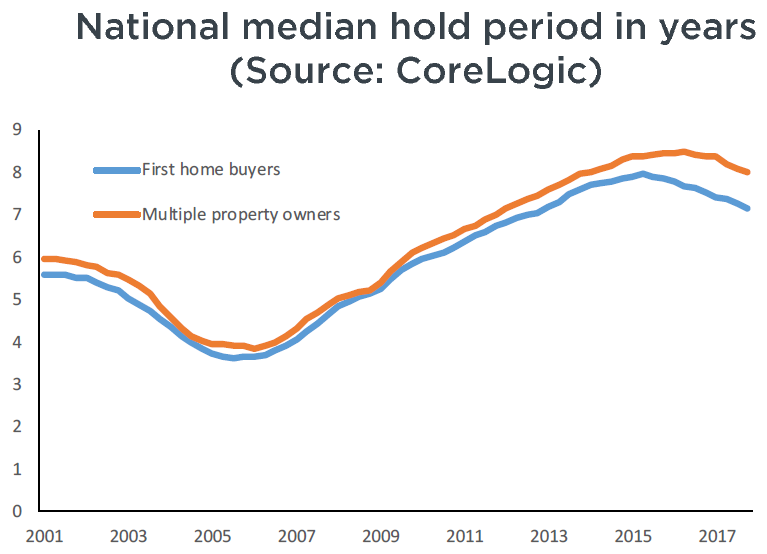
In addition, Davidson says rather than selling, landlords may just hold their properties for longer than they planned in order to compensate for the effect of the ring-fence on their expected return.
"That would just reinforce what we’ve already started to see in the past year or two – that is, investors holding for longer than in the past, and also relative to other buyer groups, such as first home buyers."
"Bottom line, we doubt that the looming tax ring-fence for rental property losses on its own will drive a sea-change in investor behaviour," Davidson says.
We welcome your comments below. If you are not already registered, please register to comment
Remember we welcome robust, respectful and insightful debate. We don't welcome abusive or defamatory comments and will de-register those repeatedly making such comments. Our current comment policy is here.