
By Chris Trotter*
The sheer weight of it takes your breath away.
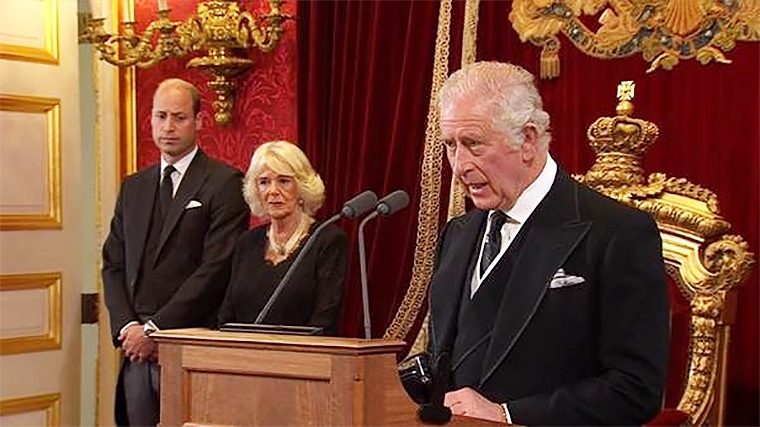
On display in St James’s Palace on Saturday night (10/9/22) were rituals and traditions dating back centuries. To say the weight of those rituals and traditions, and all the gilt machinery of monarchical government, is crushing, would be no exaggeration. To the millions watching on television, the ceremony proclaiming King Charles III, conveyed another message. That the House of Windsor is the last great royal house of Europe.
When the late Queen’s great-great-grandmother, Victoria, sat upon the throne of Great Britain and Ireland, the House of Saxe-Coburg (latter re-named Windsor) was just one of many great royal houses. Alongside it stood the House of Hapsburg, the House of Hohenzollern, and the House of Romanov. By the end of the First World War, the Queen’s grandfather, the King-Emperor, George V, was the last man standing.
Kaiser Wilhelm II had abdicated and Germany had declared itself a Republic. The Emperor of what had been the Austro-Hungarian Empire, Karl I, had similarly renounced his throne. The Tsar of all the Russias, Nicholas II, along with his family, had been murdered by the Bolsheviks. The Ottoman Empire, which had once threatened to conquer all of Western Europe, had similarly disintegrated under the hammer blows of war.
Britain, alone of all the great monarchical European empires, stood alone. Only once, in a span of close to 1,000 years, had the English people succumbed to foreign invasion, defeat and occupation. The Norman Conquest of 1066 broke the Anglo-Saxon state into pieces and re-constituted it according to the principles of feudalism. That feudal state then proceeded to see off all foreign challengers for the best part of ten centuries. The Spanish failed in 1588. The French in 1805. The Germans tried and failed twice. The first time between 1914-18. The second, between 1939-45.
It is hard to over-emphasise the importance of British resilience. The grim audit of war had seen the other great royal dynasties declared politically bankrupt. The emperors and aristocrats who ruled them had failed in their first and most important duty – to protect the security and integrity of their realms. That failure allowed their peoples to reconfigure their political systems into new and (sometimes) more democratic ways. Old ideas and old institutions were either tossed aside in revolutionary fervour, or, carefully retired to the national attic – pending more favourable circumstances.
But not the House of Windsor. Not the British Empire. At the end of every existential struggle, England’s king, and its ancient aristocratic families, were there to take the salute of their triumphant armies. Proof that the ideas and ideals of the Middle Ages were more than equal to the challenges of economic and social change. Certainly, other classes had been admitted to the magic circles of political power, but the splendid feudal pageantry, the resonant feudal vocabulary, remained undisturbed – as the millions watching on Saturday night could see and hear.
Yes, the Cromwellian revolution of the 1640s and 50s, and the “Glorious Revolution” of 1688 had tamed Great Britain’s kings and queens, transforming them slowly but surely into that most curious of creatures – half-medieval, half-modern – the “constitutional monarch”. But, it was never a purely one-way process. Century after century, the rebellious and democratic instincts of the British people have been tamed and domesticated by their kings and queens.
It was impossible to look upon that extraordinary line-up of former prime-ministers – four Tories, two Labour – all of them members of His Majesty’s Privy Council – standing loyally to attention and bellowing “God Save The King!”, without mentally doffing one’s cap to the extraordinary political legerdemain of the British ruling-class.
It is easy to scoff at such scenes, dismissing them as so much medieval mummery, but the deeper truth remains: they’re still being played out. J.M. Barrie in Peter Pan informs his young readers that fairies will continue to exist only for as long as people believe in them. The same is true of kings and queens.
Politicians under-rated the political perspicacity of Elizabeth II at their peril. In the 70 years of her extraordinary reign, the late Queen saw the British economy and the British people transformed. By a sustained act of tutelary will, she convinced them that, in spite of all the evidence to the contrary, they remained one people: that there was more holding them together than there was tearing them apart. Her stubborn refusal to be convinced otherwise thus acted as a sort of dam, behind which the waters of division and disquiet rose higher and higher.
It was Louis XV of France who famously declared: “Après moi, le déluge” (After me, the flood!) Although she would never have indulged in such nihilistic despair, Elizabeth II could justifiably have said the same.
King Charles III must be wondering, along with the British political journalist who came up with the metaphor, whether his mother’s death signals “the conclusion of a season, or the end of the whole series?” Certainly, he could be forgiven for considering the term “United Kingdom” to be a joke in very poor taste. Those who witnessed Scotland’s First Minister Nicola Sturgeon’s angry rejection of Boris Johnson’s arm, or watched on Twitter the Welsh nationalist actor Michael Sheen’s stupendous evocation of Welsh pride, would surely agree with the king.
A principled man (not a healthy attribute in a constitutional monarch) Charles must be looking with grave apprehension at the new, far-right British prime minister, Liz Truss. She cut a positively creepy figure in the otherwise splendid surroundings of St James’ Palace – bearing a frightening resemblance to the wicked queen in Disney’s Snow White.
The go-to explainer of Britain’s unwritten constitution, Walter Bagehot, wrote that the British monarch has only three constitutional rights: The right to be consulted. The right to encourage. And the right to warn. Given the ferocious ambitions of the Truss ministry, one suspects that King Charles III will soon be in need of all three.
And, here, in his far-flung realm of New Zealand? What will his antipodean subjects make of their new king? These islands are no less troubled by division and disquiet than Charles’ own beloved British Isles. Looming constitutional debates, all having at their heart the historical relationship of the British Crown with Aotearoa’s indigenous people, can hardly avoid attracting his royal attention.
In the meantime, the pageantry and pathos of the late Queen’s funeral – not to mention the looming pomp and circumstance of Charles III’s coronation – will serve as a reminder to Māori and Pakeha alike, that their nation is the deliberate creation of an empire presided over by the great-great-great grandmother of its new Head of State. A reminder, too, that, in Karl Marx’s memorable formulation:
“Men make their own history, but they do not make it as they please; they do not make it under self-selected circumstances, but under circumstances existing already, given and transmitted from the past. The tradition of all dead generations weighs like a nightmare on the brains of the living.”
King Charles III’s brain, and those of his subjects, alike.
*Chris Trotter has been writing and commenting professionally about New Zealand politics for more than 30 years. He writes a weekly column for interest.co.nz. His work may also be found at http://bowalleyroad.blogspot.com.
We welcome your comments below. If you are not already registered, please register to comment
Remember we welcome robust, respectful and insightful debate. We don't welcome abusive or defamatory comments and will de-register those repeatedly making such comments. Our current comment policy is here.