
This Top 5 comes from interest.co.nz's Gareth Vaughan.
As always, we welcome your additions in the comments below or via email to david.chaston@interest.co.nz. And if you're interested in contributing the occasional Top 5 yourself, contact gareth.vaughan@interest.co.nz.
Pace of rate hikes. #FedDay pic.twitter.com/kquHBtygvk
— Kathy Jones (@KathyJones) September 21, 2022
1) When central banks woke up to the potential of digital currencies.
Remember when Facebook announced its plans for a digital currency named Libra in June 2019? It hasn't panned out as the tech titan hoped. Nonetheless in 2019 it was a big deal, and set alarm bells off within the global central banking, financial markets regulation and government fraternities.
This point is well made in a new episode of Bloomberg's Odd Lots podcast. The episode features Timothy Massad, former Chairman of the Commodity Futures Trading Commission (CFTC), who is now a research fellow at Harvard's Kennedy School of Government.
Here's what Massad told Bloomberg's Joe Weisenthal and Tracy Alloway.
It was really, a huge moment, not just for the regulation of stablecoins, but also for the development of central bank digital currencies. You know, before Facebook announced that, Chair Powell testified and he kind of brushed off a question about cryptocurrencies by saying, you know, we don't regulate that. We regulate banks. When Facebook made its proposal, and you will recall the initial proposal was for essentially a stablecoin, they didn't call it that right? But it was a stablecoin based on a basket of currencies, not just one currency, but the dollar, the euro, the pound and a few others. And so central bankers around the world immediately were alarmed because they thought, boy, this could actually displace sovereign currencies. Facebook has, you know, 2 billion+ users. What if they all use it?
It also prompted some countries to really accelerate their CBDC [central bank digital currency] development. In particular, China. I was over in China shortly after the Facebook announcement was made. And, you know, everyone in Congress sort of looked at Facebook and said, ‘oh, you're going to undermine the US dollar. Well, every government official I spoke to in China had the opposite reaction. They saw Libra as essentially a way to backdoor dollarize other economies because the dollar would be the main component. So they got very worried about it and they accelerated their CBDC research because of that. Interesting. So, you know it was big from the standpoint of causing people to recognize stablecoins as an issue and also from CBDC.
Here in New Zealand the Reserve Bank also initially played down cryptocurrencies, or crypto-assets as it prefers to call them. In 2018 Acting Reserve Bank Governor Grant Spencer described bitcoin and other cryptocurrencies as “a bit of a sideshow.” Fast forward to today and the Reserve Bank is considering launching a central bank digital currency (CBDC), at least in part to protect the Reserve Bank and NZ's monetary sovereignty.
After the battle with inflation, CBDCs are probably the biggest issue in global central banking today. And Facebook is certainly a major factor in making that the case.
(Reserve Bank Director of Money and Cash Ian Woolford talks about CBDCs in an episode of our Of Interest podcast here).
2) Auckland University's misleading attack on JP Morgan Chase and Citibank.
This week I received a press release from the University of Auckland. It was highlighting work by Michael Rehm, a Senior Lecturer in Property at the University of Auckland Business School. It started off by saying banks are "aiding and abetting" housing speculation, contributing to New Zealand’s housing crisis and "making massive profits in the process."
That caught my attention so I read on. I was, however, left confused by this bit below.
Rehm, who published a paper titled Betting on capital gains: housing speculation in Auckland, New Zealand in 2020 and another, Housing prices and speculation dynamics, late last year, says many people are unaware that the banks they thought were Australian-owned are majority US-owned.
"We're experiencing a kind of financial colonialism here, and the real culprits are the likes of JP Morgan Chase and Citi Bank."
Why this confused me is because it implies that the likes of JP Morgan Chase and Citibank are major shareholders in the Australian parents of NZ's major banks, ANZ NZ, ASB, BNZ and Westpac NZ. This isn't the case, and nor do JP Morgan or Citi offer mortgages in NZ.
To be clear on the ownership question I went to check the major shareholder lists of the big Aussie banks. On these you will find names like HSBC Custody Nominees (Australia) Ltd, JP Morgan Nominees Australia Ltd, Citicorp Nominees Pty Ltd and BNP Paribas Nominees Pty Ltd.
These entities are, however, not the beneficial owners of the bank shares. Rather they are providing a custodian service. Note that a custodian bank holds and transfers securities on behalf of its customers with whom it has custody agreements, and of course they charge custody fees for the privilege.
The major Aussie banks, which are all share market listed, provide a breakdown of their ownership on their websites. You can find the one for Commonwealth Bank of Australia (CBA), ASB's parent, here. This shows that at June 30, 48.38% of CBA's shares were owned by institutional, or professional, investors, and 51.62% by retail "ma and pa" investors. Additionally 77.38% of CBA's shares were domestically held with 22.62% held by offshore investors.
On several occasions in the years after the 2011 Christchurch earthquake we at interest.co.nz were asked about the Reserve Bank owning Fletcher Building, the key corporate involved in the rebuild. This was not the case.
The Reserve Bank does own New Zealand Central Securities Depository Ltd. The Reserve Bank also owns NZClear, which provides financial markets with clearing and settlement services for debt securities and equities. Securities, including those of Fletcher Building, held on behalf of participants of NZClear are registered in the name of New Zealand Central Securities Depository, as custodian trustee.
As for the suggestion in the Auckland University press release a JP Morgan spokesman said:
We don’t offer retail products and the nominee company is for our custody business, which provides the safekeeping of assets for our institutional clients, e.g. the super funds. We are not the beneficial owner of the shares.
And a Citi spokeswoman said:
Confirming that the research paper from University of Auckland is incorrect in its claims that Citi is a major shareholder in AU/NZ banks.
Your thinking on custodial holdings was on the mark. While Citi’s name will be recorded as a top 20 shareholder on the share registry of the majority of banks, this is merely in our capacity as a custodian on behalf of our clients who are either the beneficial owner, or another intermediary sitting between us and the underlying beneficiary.
These holdings being referred to in the article are held in the name of Citicorp Nominee Pty Limited. This is the registered name to support our custody business and in our capacity as custodian Citi acts only on instructions from clients and does not exercise any discretion with respect to investment decisions i.e. our relationship with our clients is on a ‘bare trustee’ basis only.
It's a real shame to see a university press release containing such a misleading suggestion. Spreading misleading information can lead to baseless conspiracy theories, and the world certainly doesn't need anymore of those. When wanting to criticise banks, there are plenty of legitimate ways of doing so.

3) Is the Covid-19 pandemic as we've known it nearing its end?
Is the Covid-19 pandemic over? US President Joe Biden says yes. The World Health Organization says not quite.
What happens with the virus, whether a new mutation causes another nasty variant, remains to be seen. But what is interesting is that Japan, Taiwan and Hong Kong, which have had safeguards/restrictions in place that have been among the strictest in the world, are either easing them or expected to ease them.
Here's Bloomberg.
Japan will abolish a slew of Covid border controls from Oct. 11, in a move that looks set to revive the tourism industry. Individual visitors will be allowed to enter and a cap on daily arrivals will be lifted. The news came hours after Taiwan said it may scrap its three-day quarantine requirement for arrivals around mid-October, while an announcement on easing strict travel restrictions is also expected from Hong Kong in coming days. Meanwhile, days after US President Joe Biden declared the “pandemic is over,” the World Health Organization says we’re not done with it just yet.
The fall in overseas visitors to Japan, detailed below, is some drop-off.
Before Covid, Japan let visitors from 68 countries and regions, including the US, stay for as long as 90 days without a visa. Visitor numbers reached a record of almost 32 million in 2019, slumping to about 246,000 last year.
If Japan, Taiwan and even Hong Kong ease restrictions, it may place even more focus on China's zero-Covid strategy.
In late August I spoke to David Mahon, the Beijing-based Managing Director of Mahon China Investment Management, in an episode of the Of Interest podcast.
His view was that no changes to the zero-Covid policy would be made before the Communist Party's national congress in October, for which thousands of party delegates are set to travel from all over China to meet in Beijing.
After that, however, Mahon suggested, things may begin to change.
They won't announce policy changes. But I think post the October congress, they'll begin to loosen the application of policy. And they'll do it in a patchwork. They'll experiment with some cities where they'll open up more than others and just see how the hospital system copes. So I think their gradual approach to things will mean they'll come out of this quite steadily.
4) RIP the Covid inflation shock?
Continuing on the Covid-19 theme, the Institute of International Finance (IIF) has pronounced the Covid inflation shock over. That's the IIF's good news. The bad news is the inflation shock stemming from Russia's invasion of Ukraine continues. The following comes from a note by the IIF's economists led by Robin Brooks, its Managing Director and Chief Economist. The IIF describes itself as the global association of the financial industry.
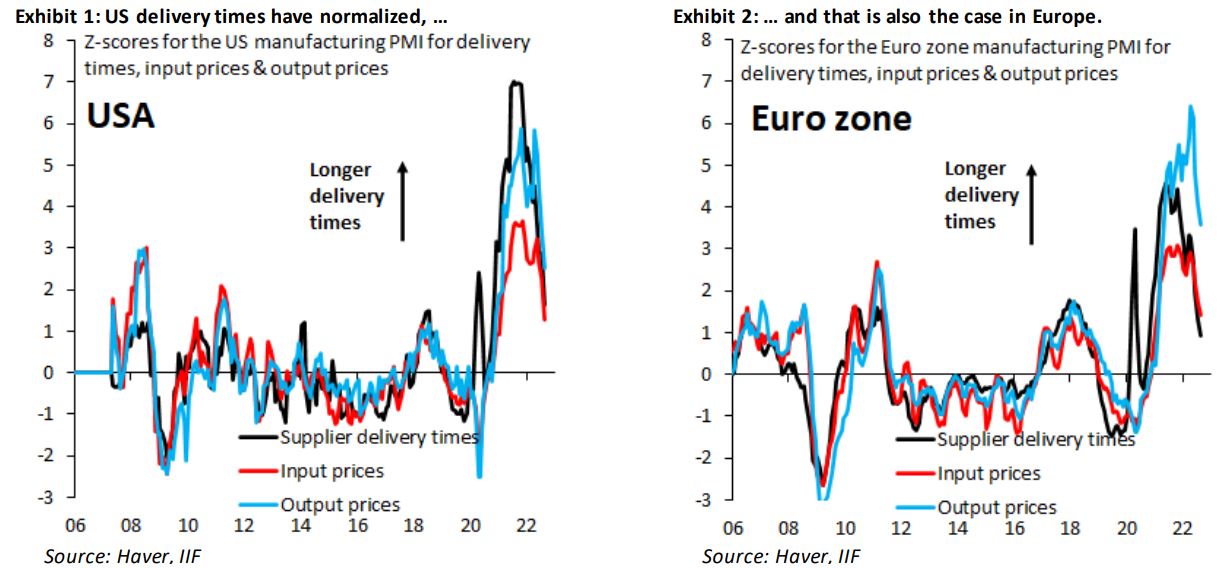
The reopening of the global economy after COVID caused supply chain disruptions around the world, as pent-up consumer demand stretched manufacturing and shipping capacity, resulting in severe delivery delays and substantial mark-ups embedded in the prices firms charged consumers globally. This Global Macro Views updates work we did in 2021, tracking the scale of supply chain disruptions and mapping those into producer price and CPI inflation. Around the world, delivery times have essentially normalized, so the shock to supply chains – and resulting upward pressure on inflation – has abated. It would be nice to think that this ends the inflation scare that engulfs the world, but that is not the case. The war in Ukraine is exerting upward pressure on inflation globally and especially across Europe.
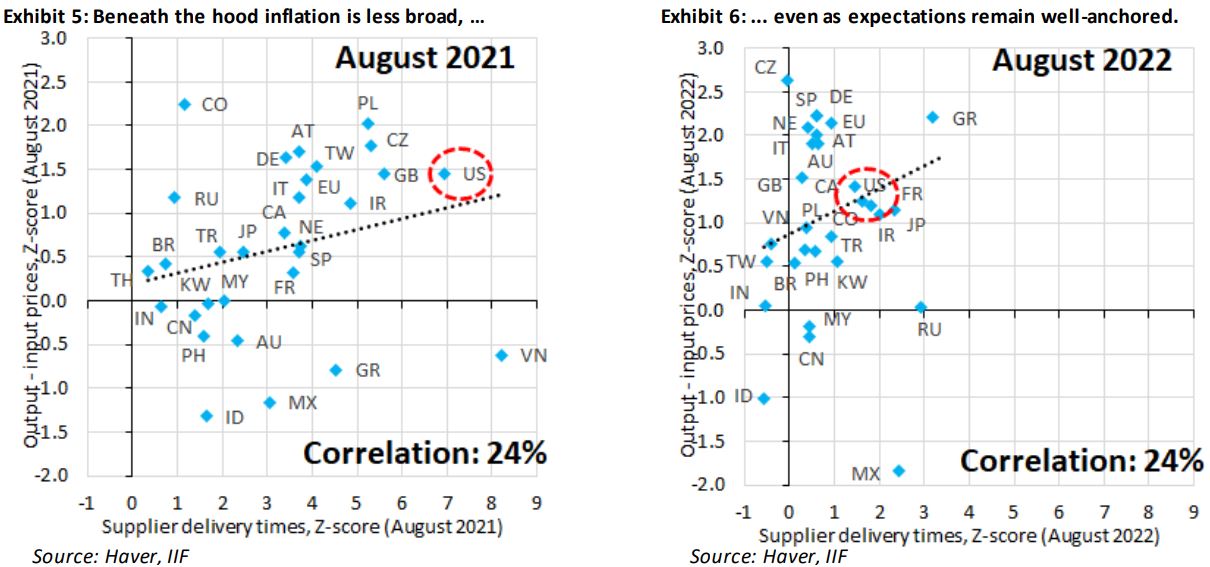
How has the global picture on delivery delays and mark-ups changed from a year ago? Exhibit 5 shows supplier delivery times for August 2021 on the horizontal axis, while it has mark-ups for the same month on the vertical axis. Exhibit 6 is the same thing for August 2022. It remains the case that the mark-ups firms charge are positively correlated with delivery times, but – other than that – the picture is radically different. Across the board, delivery times have fallen, while it is European countries that have especially pronounced mark-ups, as high energy prices due to Russia’s invasion of Ukraine feed into these mark-ups. As a result, while the inflation shock from supply chains has faded, the coast is far from clear, because another supply shock has come along to cloud the inflation picture.
5) Allegations of an audacious fraud.
The Atlantic's David A. Graham wrote a succinct article on the complaint filed by New York Attorney General Letitia James against Donald Trump's Trump Organization. According to the complaint the Trump Organization was "just a massive fraud with incidental sidelines in property development, merchandising, and entertainment," Graham writes.
The basic scheme alleged in the complaint is straightforward. Trump would use different valuations for properties depending on what he needed: When he wanted to lower his taxes, he’d claim a low valuation; if he wanted to obtain loans on more favorable terms, he would inflate the valuation. His overarching goal was to inflate his claimed personal net worth year over year, which in turn allowed him to obtain better loans by personally guaranteeing them—all built on bogus claims about his assets.
The way Trump did this was often brazen, in James’s account. In 2011, for example, he obtained an appraisal for his property at 40 Wall Street, valuing the building at $200 million. But Trump claimed the building was worth nearly $525 million (even while attributing the valuation to information from the appraiser). In another case, he calculated an astronomical value of his apartment at Trump Tower by claiming that its square footage was roughly triple the true figure. He also changed values by shifting the methods he used to calculate them from year to year, so that, for example, the claimed value of undeveloped land at a golf course in Westchester County, New York, quadrupled from about $25 million in 2012 to nearly $102 million in 2013.
Graham goes on to suggest the case should be a pretty back and white one.
Trump will claim that James is a partisan Democrat who is out to get him, and he is not entirely wrong: She is a partisan Democrat; she has pursued him aggressively, and her decision to target him certainly has political merits—she is responding to constituents who want to see Trump targeted, and could benefit politically herself.
But the complaint is damning because what James alleges is not especially complex and does not require much imagination or financial numeracy. The figures are all right there in filings and documents, rather than lost in the miasma of vagueness and mob-boss talk Trump often uses in other venues. Either the documents say what James says they do and Trump was juking the stats, or they don’t and he’s been unfairly maligned.
Watch this space.
Call me "Letitia" pic.twitter.com/zUDFn7oR5K
— Matt Wuerker (@wuerker) September 21, 2022
We welcome your comments below. If you are not already registered, please register to comment
Remember we welcome robust, respectful and insightful debate. We don't welcome abusive or defamatory comments and will de-register those repeatedly making such comments. Our current comment policy is here.