
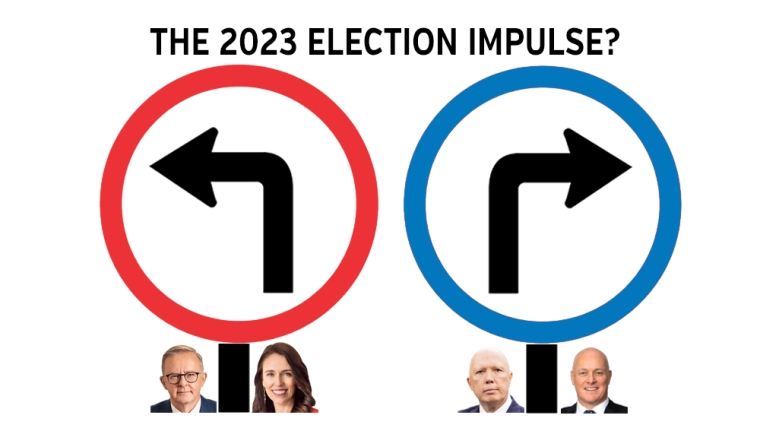
As New Zealand enters an election year, the country’s politicians would do well to consider what worked, and what didn’t work, in Australia’s federal election in May. If they’re looking for some useful holiday reading, Ardern, Luxon, and co could do a lot worse than The 2022 Australian Federal Election.
Published in December, this is a report from the Australian National University and Griffith University based on the results of the Australian Election Study (AES), a comprehensive survey of “a nationally representative sample of 2,508 voters … to find out what shaped their choices in the election”.
There are two categories of election that lead to a change of government – those that are lost by the incumbent and those that are won by the challenger. Australia’s last election clearly fell into the former category. The governing Coalition (the equivalent of NZ’s National Party) was the author of its own demise.
According to the AES results, there were three major elements of the government’s performance that led to its dismissal by the electorate – its management of the economy, its management of the Covid-19 pandemic, and the leadership of Prime Minister Scott Morrison.
Two-thirds of Australian voters believed that the economy had deteriorated in the lead up to the election. This was “the most pessimistic view of the economy in over 30 years”. The rising cost of living was the single biggest issue for voters, and a majority favoured the Labor opposition over the government on this issue.
That’s no great surprise. Hip-pocket politics is always important in Australian elections and voters invariably blame the current government, even when many of the causes of economic trouble are beyond the government’s control.
Ominously for NZ’s Labour Party, the Australian election was back in May when the worst of the cost-of-living crisis was still in the future. By the time NZ goes to the polls, there will have been much more economic pain than Australian voters had endured when they cast their ballots.
The second major performance problem for the Coalition government was its management of the pandemic. Only 30% of voters thought the government did a good job.
Was this a fair assessment? No doubt, the Morrison government could have done better on the vaccination front, but on a per capita basis, Australia’s death rate was low compared to most countries. And this was achieved with much less damage to the economy than comparable countries. The AES results indicate that the Australian electorate was very unforgiving on pandemic management.
Again, this could be a bad sign for NZ’s Labour government. Prime Minister Jacinda Ardern won kudos for her initial handling of the pandemic in the 2020 election. The danger is that ‘Covid fatigue’ will produce a different result in 2023.
The third performance problem for Australia’s Coalition government last May was the deep personal unpopularity of the Prime Minister. According to the AES data, by 2022 Scott Morrison had become “the least popular major party leader on record”.
Many voters had formed a very negative view of the PM known as “Scotty from marketing”. The Labor leader, Anthony Albanese, was preferred by voters in eight out of nine leader characteristics, including honesty and trustworthiness.
The Australian election analysis confirms that leadership matters in these days of “presidential politics”. Is Jacinda Ardern’s leadership still a major vote winner? Is Christopher Luxon an attractive alternative?
In addition to identifying the three performance problems that undid the incumbent government, the AES results reveal two major socio-demographic influences with potentially long-term electoral implications – gender and generational voting differences.
As part of its detailed investigation, the AES asks respondents to place themselves on the left-right political spectrum. In 2022, the average position of women on that spectrum was well to the left of the average position of men. The gender gap in left-right placement was the largest ever recorded by the AES.
That gap was mirrored in voting behaviour, with women voters favouring Labor and the Greens by a significant margin and men favouring the Coalition. The difference partly reflects the dissatisfaction of many women with the Coalition’s positions on environmental and socio-cultural issues, including its inaction on climate change and its perceived shortcomings on gender equality.
Much more concerning for the Coalition are the dramatic generational differences in voting behaviour. According to the AES, only one in four voters under 40 voted for the Coalition. That’s a remarkable statistic.
What’s the explanation?
In recent decades, there’s been a rise to prominence in Australia of a range of environmental and socio-cultural issues like climate change, indigenous recognition, and gender equality. Millennials and Gen Z are much more engaged with these ‘post-material’ issues than older generations. And their views are predominantly progressive.
Take for example a recent AFR/Freshwater Strategy poll on whether Australia should introduce a First Nations ‘Voice to parliament’, a policy of the current Labor government. According to the poll, 85% of 18–34-year respondents support the Voice, while 58% of those over 55 oppose it.
This is consistent with the strong electoral support from younger voters for Labor and the Greens. In the words of the election report from ANU and Griffith universities, “the implication is that through processes of generational replacement, the electorate is moving to the left and becoming more progressive in a range of policy areas”.
The report reaches this notable conclusion – “How the Coalition addresses this overwhelming deficit of support among younger generations is perhaps the single biggest question confronting Australian politics”.
If younger kiwis have similar ideological leanings to their Australian cousins, there’s a warning here for NZ’s National Party. Too much conservatism on environmental and socio-cultural issues risks driving away voters under 40.
The final election development worth noting from the AES analysis was the “large-scale abandonment of major party voting”. Many voters abandoned Labor and the Coalition in favour of the Greens Party and a raft of independents. This reflects a long-term trend in Australia of rising dissatisfaction with a system dominated by two political parties.
The Act Party and the Greens will be hoping for a similar shift in NZ’s 2023 election.
And Jacinda Ardern will be hoping she can avoid Scott Morrison’s fate – an electorate that rejects her handling of both the economy and the pandemic, and tires of her leadership style.
Ross Stitt is a freelance writer with a PhD in political science. He is a New Zealander based in Sydney. His articles are part of our 'Understanding Australia' series.
We welcome your comments below. If you are not already registered, please register to comment
Remember we welcome robust, respectful and insightful debate. We don't welcome abusive or defamatory comments and will de-register those repeatedly making such comments. Our current comment policy is here.