
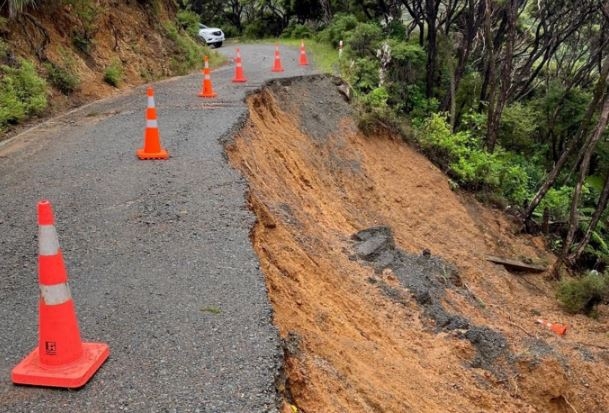
The Cabinet is meeting Monday afternoon for a last-minute re-write of Budget 2023 that could see billions of dollars of operational and capital spending diverted from other areas or borrowed freshly to repair and rebuild infrastructure wrecked in Hawke's Bay, Gisborne, Northland and Auckland in both Cyclone Hale and Cyclone Gabrielle over the last month.
PM Chris Hipkins is expected to announce initial support for small businesses in a post-cabinet news conference early this evening, including the potential for some sort of targeted version of the wage subsidy scheme pioneered during the Kaikoura earthquakes and used in a widespread way during Covid lockdowns.
The scale of the new or diverted Government spending is not clear, but Finance Minister Grant Robertson indicated Gabrielle's damage could match the $13 billion cost that the Government bore from the Christchurch Earthquake in 2011. Overall, the costs of the 2011 quake rose to $40 billion including costs paid for from insurance payouts and council spending.
Prime Minister Chris Hipkins said on Sunday evening Robertson was working with Treasury on a re-write of the Budget.
The big question will be how willing or able the Government feels about borrowing to fund the rebuild, as the National-led Government initially did in 2011 after the Christchurch earthquakes.
Hipkins said Cabinet would have to make some “tough calls” about reprioritising. Robertson spoke less about reprioritising in comments on Friday and early on Sunday, but also said that the Government had no plans to lift or change its self-imposed ‘30-30’ limits, which aim to keep the tax to GDP ratio below 30% and keep net debt to GDP below 30% of GDP, with a preference to always have it trending significantly lower over the long run.
Cabinet will meet this afternoon to consider how the Government will fund the multi-billion price tag to repair the damage of Cyclone Gabrielle, including the key question of whether to do it with with cuts in capital and operational spending elsewhere, which Hipkins suggested Sunday night, or to use borrowing, as Robertson suggested on Friday afternoon and Sunday morning.
Hipkins told a news briefing Sunday night he wanted to ‘build back better’, but that ‘tough calls’ would be needed to do that.
“Tomorrow cabinet will consider some further early measures to support the response and recovery this is going to be an ongoing process we will get through this as a government," Hipkins said.
"We will do what it takes to recover and to rebuild. The usual systems and processes of government are going to need to change and adapt to the extraordinary circumstances that we find ourselves in. If we're going to build back better and if we're going to build it quickly, some tough calls will need to be made and I'm absolutely committed to doing that," he said.
Hipkins was asked if the response could include Kaikoura and Covid-style wage subsidies. He said it was too early to say, but suggested targeted support was more likely.
“It's going to take us a wee while to to identify exactly what the need is and we are going to be wanting to make sure we're targeting the right areas. Even businesses in the same area doing the same thing have been significantly disproportionately affected," he said.
"The Minister of Finance today visited two orchards, one that had lost almost all of their apples and other that it only lost about 20 of them, and they were roughly in a very similar area. So we're going to have to think about how we best support businesses to make sure that we're being responsible, and the financial support that we're providing but that also we're recognizing that there are some people in some pretty perilous situations.”
Some big late-Budget reprioritisation calls
He also talked a lot about reprioritisation, which suggests more use of cuts elsewhere than using the balance sheet to borrow.
“I think people will expect given the size and scale of what we're dealing with that we are going to need to make some reprioritisation decisions. Some of the things that we might have been aiming to achieve we won't now be able to achieve or we might have to achieve on a longer timetable," Hipkins said.
He said there was still time to rejig the Budget.
“We're going to have to be making some reasonably significant late Budget process decisions and to make sure that we're getting them the resources allocated where they're needed.”
We welcome your comments below. If you are not already registered, please register to comment
Remember we welcome robust, respectful and insightful debate. We don't welcome abusive or defamatory comments and will de-register those repeatedly making such comments. Our current comment policy is here.