
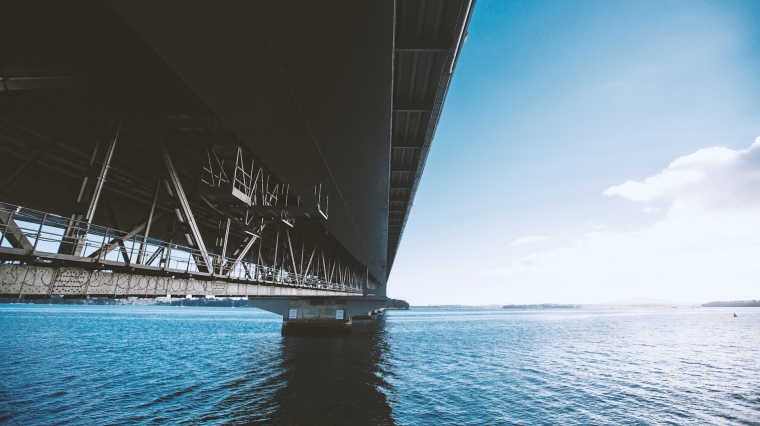
The government’s dream to build a new crossing under the Waitematā Harbour could cost over $25 billion dollars and take more than 15 years to construct.
Prime Minister Chris Hipkins and Transport Minister Michael Wood announced they would attempt to build a new crossing 10 years earlier than planned; breaking ground in 2029.
Few dispute the need for upgrades to Auckland’s transport infrastructure but there are questions around the feasibility, functionality, and cost of the five proposed designs.
All the options create road lanes, a light rail line, and space for walking/cycling using different combinations of tunnels and a new bridge.
The most expensive option, at roughly $25 billion, would involve digging two tunnels, one for State Highway 1 and another for light rail, and repurposing some of the existing bridge for foot traffic.
The cheapest option would be to build a second bridge alongside the existing one with light rail, foot traffic, and three additional vehicle lanes. It would cost about $15 billion.
All the others are mid-cost options – $20 billion – and use a new multi-purpose bridge and a tunnel, which would be dedicated to either light rail or road.
Matt Lowrie, editor of transport blog Greater Auckland, said Waka Kotahi’s high-level options underplayed how much more a tunnel could cost compared to a bridge.
He said it was good to see analysis of different options and a shift away from the transport agency’s previous preference for a combined road and rail tunnel
“But on the other hand, the extremely high costs of this project, especially when you consider it alongside the madness of $15 billion to $30 billion Auckland Light Rail, makes the whole thing seem extremely fanciful,” he wrote in a blog.
The high price tag seems particularly unpalatable when Auckland Council was cutting “extremely basic services” and the central government was facing a multi-billion dollar bill to repair infrastructure damaged by Cyclone Gabrielle and the Auckland floods.
“It will be hard to take seriously the selection of any option other than the lowest cost option two,” he said.
The original Auckland Harbour bridge cost the equivalent of about $250 million and took four years to build in the 1950s.
More recently, the Waterview Tunnel cost $1.4 billion and took five years, while Auckland Light Rail has been estimated to cost $14.6 billion.
A 2021 report by the New Zealand Infrastructure Commission found NZ was less efficient when building infrastructure than most other high-income countries.
Infrastructure projects in NZ commonly cost many multiples more than similar projects do overseas. The Commission said geography and low population density were two reasons why NZ was worse than other comparable countries.
Political football
Despite the enormous price-tag, there is broad political support for an additional crossing and also some fierce disagreement about what form it should take.
The harshest rebuke to the options came from Green Party transport spokesperson, Julie Anne Genter, who said building new roads would only worsen congestion in the city.
“All of the options include additional car lanes which we know will make traffic worse and worsen emissions. We need an option that puts public transport first,” she said.
“The tunnels are high-carbon options, but also every option is just dumping cars on Auckland's congested roads. It doesn’t make sense.”
She said a bridge for just light rail and foot traffic would likely be the best option for lower congestion and carbon emissions in Auckland.
The National Party said in a press release it supported building an additional crossing but doubted Labour would be able to deliver one.
ACT Party leader David Seymour said another way over the Auckland Harbour “would be a great thing” and that NZ cannot afford to “have infrastructure used as a political football”.
Auckland Mayor Wanye Brown said any crossing needs to be considered as part of an Integrated Transport Plan for Auckland and shouldn’t be rushed.
“Under the ITP, Council and Government will consider the impact of moving the port and light rail. Only then can it be determined when a second crossing will be built and what form it takes”.
Brown recently commissioned a fresh review of the council-owned Ports of Auckland and has previously supported shifting the port to Marsden Point in Northland.
The mayor also described Auckland’s light rail as “a dead duck” in a recent interview, after the City Rail Link project said it would need another $1.1 billion to complete the underground loop.
“Clearly, it’s an election year but I guess it’s good to see the Government spending more money on Auckland and asking Aucklanders what we think for a change,” he said in an email.
Each of the key milestones outlined in today’s proposal occur in an election year: the government hopes to choose one of the five options in June, have a detailed design in 2026, and begin building in 2029.
Given the long timeframe, cross-party consensus could be the only way to ensure construction goes ahead.
100 years of consideration
When the Auckland Harbour Bridge was expanded with clip-on lanes in 1969, discussion began about the need for a second crossing as soon as 1985.
The possibility of trains running under the harbour had been mooted as early as the 1920s, but has never gained enough traction to actually be built.
In 2020, Waka Kotahi and Auckland Transport prepared a business case for additional Waitematā Harbour connections.
It argued that population growth on the North Shore was putting pressure on State Highway 1 and the Northern Busway, which acts as the most direct link between Northland and the rest of the country.
“The corridor is already under severe pressure and faces some unique resilience challenges, which are forecast to increase further as population and employment continues to grow”.
The North Shore’s population is projected to grow from 337,000 to around 500,000 by the late 2040s, with most of this growth forecast to occur north of Albany.
Many of these people work in or near the city centre and have to cross the water to get to their jobs.
The Harbour Bridge is already the most travelled route in New Zealand carrying an average of 235,000 people a day, including 30,000 public transport trips and approximately 12,000 freight trips.
The report suggested an urgent upgrade to the Northern Busway, which has been done, followed by an additional rapid transit connection across the harbour.
A new road was also proposed, but only once the rail link was completed.
The Northern Motorway has been congested at peak times for many decades, resulting in long and unreliable travel times, while the popularity of the Northern Busway has skyrocketed.
It now operates approximately six million trips each year, up from 800,000 when it opened in 2008. Vehicle traffic has stayed largely static during this time, the report said.
“While the Harbour Bridge is in good condition, it is an ageing structure with growing maintenance needs and will require increasing traffic management restrictions to protect its ongoing structural integrity”.
The business case warned there could be an $8 billion difference in price between building a parallel bridge and constructing new road tunnels underwater. Although, a new bridge was likely to have significant environmental, cultural and social impacts.
The estimated cost for a new crossing in the 2020 report was between $6b and $18b, compared to between $15b and $25b in the latest set of options.
Even with the 2020 costs, Waka Kotahi and Auckland Transport said the project was “weighed down with very large costs” despite delivering significant benefits.
It found a light rail tunnel to the North Shore had the best transport economics outcome, while the best roading option was another bridge due to the lower cost.
There was also an alternative to building a new crossing, which was to use congestion charging to disincentivize cars from travelling across the existing bridge.
We welcome your comments below. If you are not already registered, please register to comment
Remember we welcome robust, respectful and insightful debate. We don't welcome abusive or defamatory comments and will de-register those repeatedly making such comments. Our current comment policy is here.