
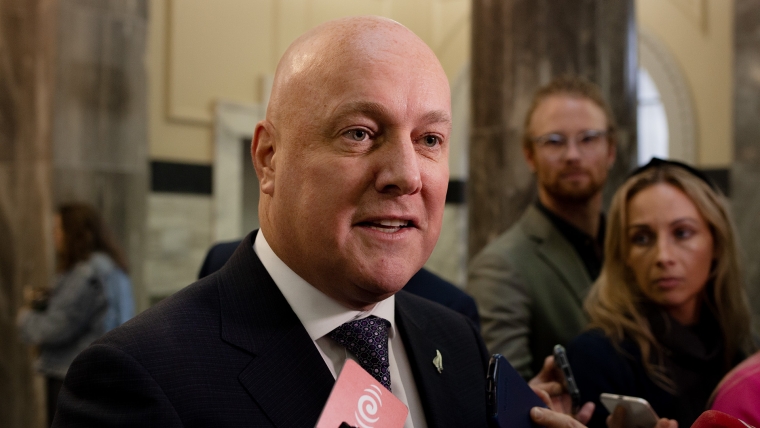
National Party leader Christopher Luxon says he would not be willing to form a coalition with the Māori Party after the October election.
In a press statement on Wednesday, he said the distance between the two parties' policy positions was too wide to bridge.
“Te Pāti Māori of 2023 is a very different party to the one National signed a confidence and supply agreement with three times from 2008”.
Te Pāti Māori reinvented itself after it was tossed out of Parliament in the 2017 election, when Māori voters became fed up with its support of the National government.
When led by John Tamihere and Debbie Ngarewa-Packer in the 2020 election, the party said it was still happy to work with National. But this was never tested, as Labour won an outright majority that year. The Māori Party’s Rawiri Waititi managed a narrow win in the Waiariki electorate and brought his co-leader Ngarewa-Packer into Parliament with him.
In 2021, the party announced its Mana Motuhake Policy which would give Māori more self-determination rights as they understand to have been enshrined in Te Tiri o Waitangi.
This policy included an aspirational goal of forming a Māori Parliament that could govern Māori issues, similar to how the Scottish parliament sits under the United Kingdom’s government.
Other policies are less transformative and more pragmatic. For example, the party supports removing GST from food and paying for the difference with a wealth tax.
Luxon said National was “deeply committed to improving outcomes for Māori, but doesn’t believe separate systems is the best way to do this”.
Snowball’s chance
National ruling out a coalition with the Māori Party could be seen as an attempt to shore up its voter base, which has been leaking into the Act Party.
This week Federated Farmers chairman Andrew Hoggard announced he would stand for Act, despite National being the party which has traditionally represented the farming community.
Current polling shows his party is highly unlikely to be in a position to form a government without support of Act, making a three-way coalition with Māori an improbable outcome.
Te Pāti Māori has previously said it would not be willing to enter a coalition with the libertarian-esque party, which has proposed a referendum to radically redefine the Treaty of Waitangi.
Politik has reported that National Party figures had discussed the possibility of helping New Zealand First back into Parliament to be a coalition partner.
On previous polling, the Labour-Green-Māori coalition would win a majority unless NZ First—which is polling under 5%—was able to win an electoral seat, in which case the outcome would flip to the centre right.
However, a new Taxpayers' Union-Curia poll released Wednesday showed a National and Act coalition in a position to form a government.
The poll had National down 0.9 points at 35.6% but ahead of Labour, which dropped 3.1 points to 33.8%. The Act Party picked up 3.2 points to poll at 12.7%, while the Greens were unchanged.
This result would give the centre-right coalition a slim majority with 62 seats in Parliament, against the left-bloc’s 58 seats. This assumes no other parties won new electorate seats.
Despite improving their share of the party vote, the centre-right party leaders’ favorability scores fell.
Christopher Luxon had his worst favorability rating at -7% and David Seymour fell to -11%.
Chris Hipkins's net favorability score also fell but remained well ahead of the opposition at 22%, although down from a peak of 33%.
Even among National Party voters, Hipkins had a positive rating of 7% compared to Luxon who has a score of -56% with Labour voters.
We welcome your comments below. If you are not already registered, please register to comment
Remember we welcome robust, respectful and insightful debate. We don't welcome abusive or defamatory comments and will de-register those repeatedly making such comments. Our current comment policy is here.