
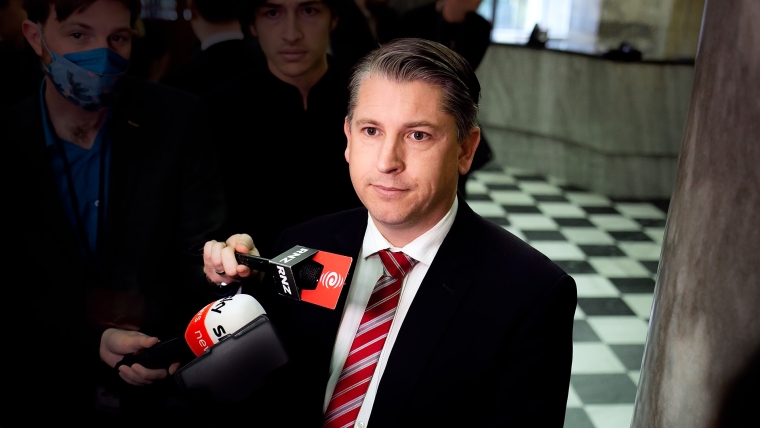
Prime Minister Chris Hipkins has accepted the resignation of his Transport Minister Michael Wood after discovering his trust held shares in other companies that were conflicts of interest.
The Minister had previously been in hot water over an undisclosed shareholding in Auckland International Airport which saw him stand down from the transport portfolio. Wood's now gone from all his cabinet roles and off to the back benches.
Hipkins had left the door open for Wood to return to the transport role, but it was slammed shut on Wednesday after it was discovered Wood's JM Fairey Family Trust held shares in Chorus, Spark and BNZ's parent National Australia Bank.
As Minister of Immigration, Wood was responsible for including telecommunications technicians on the immigration green list. This was something Chorus and other industry players had lobbied for.
Wood’s shareholding in Chorus is understood to be less than $10,000, but still represents a conflict which needed to be disclosed and managed.
As a cabinet minister, Wood was also involved in the discussion and decision to conduct a market study into the banking sector in the past few weeks.
These meetings occurred without him disclosing a greater than $10,000 shareholding in National Australia Bank.
Hipkins said it had become evident that the mismanagement of the airport shares was not an isolated incident and therefore it was not appropriate for Wood to remain as a minister.
“I don’t believe he has in any way been motivated by personal interest in any of the decisions he has taken. But he has had a conflict that he has failed to manage, and therefore the appropriate thing to do is to offer his resignation,” he said.
David Parker will become the Minister of Transport, while Carmel Sepuloni will take over as Minister for Workplace Relations and Safety, Andrew Little will become Minister of Immigration, and Kiri Allan will become Associate Finance Minister.
Hipkins said he was unable to accept Wood’s explanation that he was simply unaware of the assets within the trust, of which he is both a trustee and beneficiary.
“This is still an issue I don’t quite understand. I believe Michael to be an honest and decent person who has been a conscientious and hardworking minister.”
'I have not managed this effectively'
In a written statement, Micheal Wood said he’d found the assets as part of a detailed review of the trust after the problem with Auckland Airport shares.
The shares which created the conflict had been acquired before he was a trustee of the JM Fairey Family Trust — Fairey is his wife’s surname.
“There has not been a second of my political career where any of my financial interests have influenced my actions or even crossed my mind. In some respects my de-prioritisation of my personal financial affairs has led to this situation,” Wood said.
"That being said, I acknowledge the rules are in place for a reason and it is incumbent on Ministers to manage not just the reality, but also the perception of any conflicts. I have not managed this effectively, I take responsibility for it, and as such have submitted my resignation to the Prime Minister.”
Christopher Luxon, leader of the National Party, said Hipkins should've sacked the Minister on day one.
Act Party leader David Seymour said it was “mind-boggling” that someone had so many conflicts but did so little about it, for such a long time.
“I’m genuinely flummoxed because I’ve known Michael for almost 10 years, I think he is a decent and diligent person. I just can’t understand how he could be so reckless,” he said.
“[But] it is good that he’s gone because if decision-makers have a vested interest in the decisions they are making, it undermines all New Zealanders trust in public officials”.
Hipkins said he hadn’t given any thought as to whether replacing the Transport Minister would create an opportunity to reset priorities in the portfolio, such as Auckland light rail.
“I'm sure David Parker will be having discussions with Auckland, as Michael Wood was, about a way forward for Auckland. Clearly, it is a region with a lot of pressing transport issues”.
Parker said Wood had left the transport portfolio in good shape and he would progress based on “the solid foundations that he has left behind”.
“My focus in the coming months will be on urban issues in Auckland and Wellington, on cyclone recovery issues, and wider road maintenance issues we have in rural areas”.
New rules
In an effort to prevent similar conflict issues in the future, Hipkins has made five changes to the disclosure rules which apply to ministers.
The Cabinet Office will now report to the Prime Minister on ministerial conflicts every three months, instead of once a year, and any non-compliance will be escalated to the Prime Minister.
Annual conflict reviews will be held in person, instead of in writing, and ministers will nominate a staffer to help them manage and watch out for conflicts.
Finally, conflict disclosures will become a regular item at the start of each Cabinet or Cabinet Committee meeting.
“The Institute of Directors recommends maintaining an interests register as a standing board meeting agenda item but that has not been the past or current practice for Cabinet or Cabinet Committee meetings,” Hipkins said.
The Prime Minister has also asked for advice on implementing a full set of shareholding restrictions for ministers, like they have in Australia.
This could potentially limit ministers to owning only broad managed funds, or putting assets into a blind trust which they cannot see or control.
“Adopting this approach would be a significant change in the New Zealand position and requires further consultations, but it is my personal view it’s appropriate to take this step,” he said.
We welcome your comments below. If you are not already registered, please register to comment
Remember we welcome robust, respectful and insightful debate. We don't welcome abusive or defamatory comments and will de-register those repeatedly making such comments. Our current comment policy is here.