
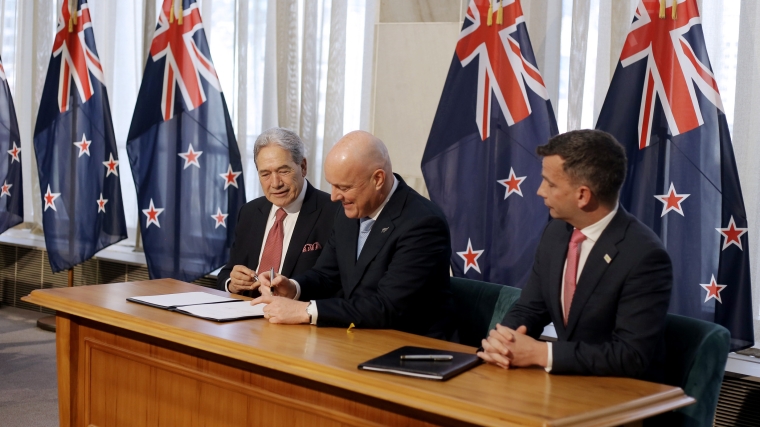
The coalition government is likely to lean on heavier spending cuts to fund the revenue shortfall in its tax policy created by ditching National's proposed tax on foreign homebuyers.
National’s tax proposal was heavily criticised during the election campaign for having overestimated the income that would be earned by lifting a ban on overseas property buyers and imposing a tax instead.
In the end, it was New Zealand First’s desire to stop foreign buyers from inflating the local housing market that resulted in the policy being scrapped.
The National Party and its support partners will now have to look elsewhere to find the money for tax cuts.
Kelly Eckhold, chief economist at Westpac NZ, said it could be partly funded by not increasing the Working for Families tax credit in 2026 and delaying when tertiary students are eligible for a year of fees free tuition.
“At the margin, this funding means that the overall fiscal stance of the Government will be slightly more contractionary than would otherwise be the case,” he wrote in a note.
Labour leader Chris Hipkins said dropping the foreign buyers tax was an admission that National’s numbers never added up and left a “$3 billion hole” in the plan.
“That most likely means additional borrowing to fund tax cuts, that means inflation will stay higher for longer, interest rates will stay higher for longer, and New Zealanders will pay more than they are likely to benefit from the tax cuts,” Hipkins said.
Sharon Zollner, chief economist at ANZ, said it was more likely that the lost revenue would be offset by deeper spending cuts — rather than additional borrowing.
The Council of Trade Unions, which led the opposition to National’s tax plan, said in a press release it was worried the multi-billion dollar shortfall would mean more spending cuts.
“We are highly concerned that they will fill the gap with even deeper cuts to essential public services like schools and hospitals. The government should provide transparency urgently as to how that gap will be filled,” said chief executive, Richard Wagstaff.
RBNZ mandate
As widely expected, the coalition government plans to remove supporting maximum sustainable employment from the Reserve Bank’s monetary policy mandate, leaving maintaining price stability its sole task.
Economists and monetary policy experts generally agree this change will have little-to-no impact on the current cycle, as the two goals are yet to contradict each other.
Zollner said it “slightly” smoothed the path to holding rates higher for longer, if appropriate, but it wouldn’t be significant.
“It’s essentially a different lens on the same job, and it is more likely to change the RBNZ’s communications than its monetary policy decisions,” she said.
The coalition agreement also promised to seek advice on setting a specific inflation target timeline and making the RBNZ governor the sole decision maker.
Zollner and Eckhold both said Treasury officials were likely to advise against both these options, as neither would be likely to improve the quality of policymaking.
“We think it is unlikely that a review of the monetary policy framework, drawing on international experience and best practice, would conclude that either of these changes is desirable,” Eckhold said.
ETS reviewed
The coalition agreement also pledged to stop the ongoing review of the Emissions Trading Scheme in an effort to restore confidence to the carbon trading market.
Susan Kilsby, an ANZ Economist, said this move would reduce uncertainty but open up another policy issue to be resolved for rural communities.
“The problem with the scheme as it stands is that it has encouraged offsetting of emissions (via sequestration, i.e. tree planting) rather than actually reducing emissions,” she said.
“Simply abolishing the review will not fix this problem, and at this stage it is not clear if any other supporting measures will be introduced to stem the flow of quality farmland into carbon forests”.
National MP Todd McClay has been given both the agriculture and forestry portfolios and will have to fulfil the party’s campaign promise to limit the conversion of productive farmland to forestry to protect local communities and food production.
We welcome your comments below. If you are not already registered, please register to comment
Remember we welcome robust, respectful and insightful debate. We don't welcome abusive or defamatory comments and will de-register those repeatedly making such comments. Our current comment policy is here.