
By Andrew Coleman*
Fifty years ago, successive New Zealand governments introduced and then scrapped a compulsory saving scheme. It was eventually replaced by the most unusual government retirement scheme in the world, New Zealand Superannuation. While New Zealand Superannuation has several attractive features, it also has several serious drawbacks. So, is it possible to design a better scheme? Without doubt, yes.
In this article I will describe a form of compulsory saving scheme - let’s call it KiwiSaver 2.1 - that younger Kiwis could adopt for themselves as a replacement for New Zealand Superannuation. It is designed to deliver most of the benefits of New Zealand Superannuation, plus more, without many of its disadvantages. The scheme is designed along the four basic dimensions highlighted in this series:
⦁ the extent it is based on a mixture of welfare and contributory principles;
⦁ the extent it is based on save-as-you-go or pay-as-you-go principles;
⦁ the extent it is funded from general taxes rather than from social security taxes or compulsory saving contributions; and
⦁ the extent that the earnings from private retirement savings are taxed on withdrawal (EET principles) rather than as they accumulate (TTE principles).
New Zealand Superannuation is so unusual because it takes extreme positions on most of these dimensions. It does not have any contributory component, and it is entirely funded from general tax revenues. No other countries do this. Moreover, it is largely funded on pay-as-you-go principles (the exception being the New Zealand Superannuation Fund) and the earnings of public and private retirement savings are all taxed on TTE principles. These extreme positions are the cause of many of the drawbacks of the current scheme. The good news is that most of the attractive features of New Zealand Superannuation can be achieved at lower cost with fewer distortions when these extreme positions are modified.
KiwiSaver 2.1 as it is described here is a type of compulsory saving scheme that replaces a part of New Zealand Superannuation while ensuring all New Zealanders will still get at least as much retirement income as they do now. It is not means tested, but as it combines contributory and welfare principles, those who contribute more have higher retirement incomes like normal saving schemes.
However, from a wider perspective, KiwiSaver 2.1 is primarily a set of tools or options that can be combined in different ways to achieve different payment and benefit combinations. The way they are combined depends on the preferences of the community. The combination discussed today is designed to improve upon New Zealand Superannuation while replicating some of its basic features, but it could be easily modified to achieve other outcomes if that is what younger people want.
The two most unattractive features of New Zealand’s scheme are (i) the disproportionately large costs it imposes on current and future generations, and (ii) the distortionary nature of the taxes that are used to pay these costs. The taxes we use are unnecessarily high, cause capital investment to be misallocated, and help generate artificially high house prices, creating inequality.
But there are other problems too. Because the current scheme only has welfare rather than welfare and contributory components, it provides little help to people who want to save additional amounts for their own retirements. Moreover, the scheme may be contributing to long run wealth inequality because the taxes people pay to fund New Zealand Superannuation during a lifetime of working cannot be bequeathed. All of these problems are tackled by KiwiSaver 2.1.
A scheme for people born after 1980
The proposal below is intended for people under 45. The scheme can be easily modified for people who are born in different years, so we shall start with people born after 2000 and note that contribution and benefit levels for people born between 1980 and 2000 can easily be adjusted. It is closely related to a scheme proposed by the Financial Services Council in 2013, except it would be compulsory1.
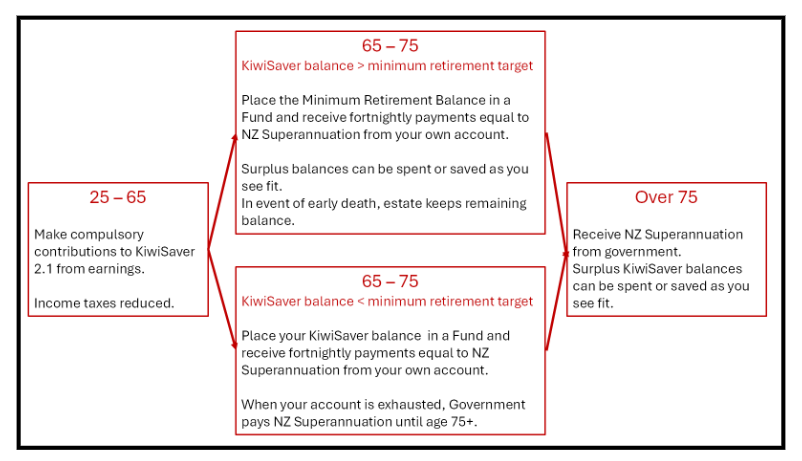
The scheme is a mixed contributory and welfare system. The contributory scheme is a compulsory saving scheme that funds the first years of a person’s retirement, and the welfare scheme funds the later years. To achieve this, there are two pension ages, the first for the compulsory saving scheme and the second for the welfare scheme. Say, for example, these are ages 65 and 75. The compulsory saving scheme would provide retirement incomes from age 65 to age 75, and the welfare scheme would provide retirement incomes from age 75 onwards. Both ages can be changed as individual cohorts wish.
When they are working, people and their employers would make contributions to private compulsory savings schemes, as they do in Australia, that can only be accessed in particular circumstances, primarily after age 65. The money in these accounts would remain the property of the individual or their estate if they die young.
Once people turn 65, they would make a deposit called the minimum retirement target with a public or private agency. This deposit would be enough to pay them a weekly amount at least as much as the government pension that is paid to people over 75. For example, if the pension were $25,000 per year, and interest rates were 3%, they would give the agency $220,000. (While $220,000 sounds like a large sum, if returns were 3% higher than inflation and people contributed for 40 years, this sum would be raised with annual contributions of $2000.) Any surplus money in their account could be used however they liked.
People without sufficient funds would be given a top-up that is enough to pay them the equivalent to the standard pension for people over 75. When people hit 75, they would get the standard government pension. If someone died between the ages of 65 and 75 the balance would be returned to their estate. This combination ensures the current welfare aspects of New Zealand Superannuation are maintained – everyone gets a minimum amount in old age – while enabling those who contribute more to their own savings accounts to keep the surplus.
The basic design has three main differences with the current structure of New Zealand Superannuation. First, it is a mixed save-as-you-go/pay-as-you-go system, so it will reduce the cost on future generations once the transition has occurred. The compulsory saving contributions are the save-as-you-go component, and the taxed-funded government pensions for people over 75 are the pay-as-you-go component. Future generations will be better off because they will be paying fewer taxes because the pay-as-you-go component of New Zealand Superannuation will be much smaller, and they will be able to enjoy the higher investment returns that are available from their contributions to the KiwiSaver 2.1 scheme.
Secondly, the compulsory saving contributions would be separate from income taxes and would allow income taxes to be reduced over time. This would enable New Zealand to adopt a less distortionary and more efficient tax system, as distortionary income taxes would be replaced by “incentive-compatible” contributions to personal savings accounts. General taxes would be smaller than the taxes needed under the current scheme because the population aged over 75 is less than half the size of the population aged over 65.
Thirdly, people who earn more during their working lives will have higher savings in their retirement accounts than those who learn less. Ideally, people who wished to purchase an annuity to obtain a higher regular retirement income would be able to buy them from the government at age 75. This option would allow those people who wanted a high regular retirement income to obtain one, while allowing those people who wanted to set aside some of their funds for expensive purchases or bequests or medical emergencies to manage the additional funds themselves.
Fourthly, the funds in the account would be taxed on an EET (Exempt – Exempt – Taxed) basis. Money placed in the account would be exempt from income tax when placed into the account, returns would be exempt from tax as they accumulated, but all withdrawals from the account would be taxed at standard income tax rates. This system, which is commonly used around the globe, increases returns and significantly reduces tax distortions, particularly with respect to owner-occupied housing.
This type of scheme will result in a different distribution of resources than the current scheme. The overall effects will depend on the way income taxes are changed to offset the introduction of compulsory saving contributions. In the United States, for instance, people pay social security taxes on their first dollar of income, but there is a large tax-free threshold before income tax is paid, so the total tax payments made by low-income people are low.
The scheme would have lower inequality if people who are married or in a long-term relationship make half of their contributions to each other’s accounts. This would automatically even out some of the income disparities between a couple, particularly if one person spends time out of the paid workforce to raise children. Because the amount remaining in the retirement account would be bequeathed in the event of an early death, the scheme may also reduce long run wealth inequality, by providing additional resources to the remaining partner if one person dies young.
The proposed compulsory scheme has some similarities to the Australian Guarantee scheme. However, rather the cut the amount of the government pension that higher income people receive, KiwiSaver 2.1 would replace the first 10 years that people receive a government pension. Rather than have a means-test for high income people, as occurs in Australia, there would be a “top-up” for people with insufficient savings to ensure that everyone gets the same minimum amount, but people who save more in their compulsory saving account keep the extra money.
The transition
As Peter Diamond made clear, any transition from a pay-as-you-go scheme to a save-as-you-go scheme requires some people to be worse off so that future generations can be better off. The transition has often been described as the “double pay” problem as it is typically assumed young people will be asked to pay taxes for the current and future beneficiaries of the existing scheme and make contributions to their own scheme. But young people do not have to be the biggest losers during the transition. As we have seen, one of the reasons to adopt a new scheme is to create a different distribution of the costs and benefits of a retirement scheme, as the current scheme requires young people and future generations to bear a disproportionately large fraction of the costs.
In fact, it is possible to design a transition path that shares the transition costs in any way a society wishes. The costs do not need to entirely fall on the transition generation of young people, by forcing them to contribute to their own pensions while still paying taxes to provide pensions to older people. Rather, older people could be asked to pay higher taxes or accept some reduction in their total pension bill to allow younger people to have a cut in their income tax rates to help fund their compulsory saving contributions.
Finding the right balance is the key political question.
Given that current generations of older people only had to support a relatively small number of elderly people when they were working age, many people will think it is reasonable for them to pay a bit more during the transition to reduce the tax burden on young people (Sinn 2000). As the survey evidence presented last week indicates, a majority of New Zealanders of all ages indicate they would be prepared to have a 2 percentage point increase in taxes now if it would allow the increase in future taxes to be reduced by 2 percentage points.
There are various ways taxes could be increased to fund the transition. One option would be to have a transitional social security tax on people aged over 45, introduced at the same time as a compulsory saving scheme for people aged less than 45, but designed to pay for a part of current and future government pensions while allowing a decrease in income taxes on younger people. This is somewhat similar to what happens in Switzerland. Alternatively, GST could be increased.
A more radical option would be to adopt a land tax to pay for pensions. Moreover, the funds in the New Zealand Superannuation Fund could be slowly reduced as the funds in KiwiSaver 2.1 accounts build up. Whatever the solution, the major point is that these solutions could be adopted to shift some part of the cost of the transition away from young people. The ultimate choice will depend on the political comprises people are willing to make to ensure that the taxes and opportunity costs on the next generations are not substantially higher than those we currently face.
Three other aspects of the transition deserve to be mentioned. First, if a scheme like this were introduced, the number of years that a person provides their retirement income from their compulsory saving scheme would depend on their birth year. This is straightforward to do: people born in 1980, for instance, might be expected to only contribute 5 years, whereas people born in 2000 might be expected to contribute ten years. In the future new cohorts might decide quite different combinations as they see fit.
Secondly, this scheme would be in addition to “voluntary” KiwiSaver, not a replacement for it. KiwiSaver 2.1 is designed to replace part of New Zealand Superannuation, whereas “voluntary” KiwiSaver is designed to provide a person with supplementary income in addition to New Zealand Superannuation. Depending on the mandatory contribution levels many people will decide, at least while they are very young, that they have no additional need for “voluntary” KiwiSaver. Others will want to use “voluntary” KiwiSaver to accumulate more funds for their retirement.
Lastly, contributions could be made by individuals or employers: ultimately, it makes little difference. Australia introduced its compulsory saving scheme in a particularly skilful way, by asking employers to gradually increase their contributions over a series of years as part of regular wage increases. If New Zealand were to introduce such a scheme, it could be done in this way, or in conjunction with reductions in income taxes.
As I hope to have made clear throughout the series, I believe that people under 45 years old should be able to design a new scheme for themselves, one suitable for the 21st century. No-one under 45 voted in the 1997 referendum and since it is clear that young people are bearing a disproportionately large share of the costs of the current scheme it seems reasonable that they should be able to design a scheme for their own generations.
KiwiSaver 2.1 demonstrates better designs exist. Other schemes are possible and could reduce many of the problems caused by New Zealand’s current scheme. The primary role of older people like me is not to dictate what younger people should want, but to find ways to help New Zealand fund the transition to a better, more affordable, and less wasteful future.
References
1) Financial Service Council (2013). Pensions for the Twenty First Century: Retirement Income Security for Younger New Zealanders. Wellington: Financial Service Council.
*This series and an accompanying paper are based on work I started in 2020 with Jeanne-Marie Bonnet while we were both at the University of Otago. I am very grateful for her assistance and insights. All errors remain my own.
(This article is part 12 in the series. You can find all other articles in the series to date here).
**Andrew Coleman is a visiting professor at the Asia School of Business. This article is his personal view of retirement policy in New Zealand, based on academic study.
Coleman is on extended leave from the Reserve Bank of New Zealand, while working overseas. The views expressed in this article do not represent the RBNZ and are unrelated to work conducted at the Bank, which has no responsibility for retirement policy in New Zealand.
We welcome your comments below. If you are not already registered, please register to comment
Remember we welcome robust, respectful and insightful debate. We don't welcome abusive or defamatory comments and will de-register those repeatedly making such comments. Our current comment policy is here.