
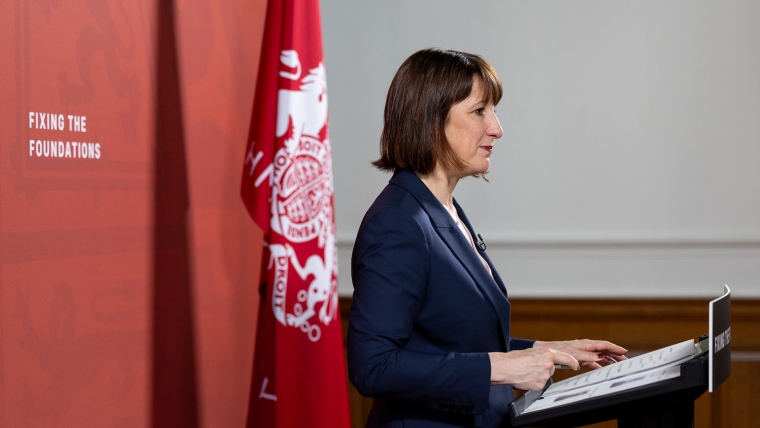
The new UK Labour Government delivered a tough first budget this week featuring hefty tax hikes intended to fund healthcare, education, and infrastructure spending.
While the party ruled out increasing taxes “on working people” during the campaign, it has increased businesses' social security contributions, tightened rules around inheritance tax, and lifted the capital gains rates to 18% and 24%.
Together these changes are the largest tax increase since 1993 and are expected to bring in roughly £40 billion, bringing the overall tax take to a historic 38.2% of economic output.
And yet, the United Kingdom isn’t alone in this. Data collected by the Financial Times shows taxes are at all time highs in many countries: the United States, Japan, Australia, you name it.
The thing about "the UK’s tax burden is now at a record high", is that this is also true for almost all countries 📈 pic.twitter.com/Is40bLZOdt
— John Burn-Murdoch (@jburnmurdoch) October 30, 2024
The likely reason for this is that the entire developed world has an ageing population which has been driving up governments’ healthcare bills — which is often a country’s largest single cost.
Simon Wren-Lewis, a professor of economics at Oxford University, wrote in a blogpost that health spending had been trending upwards in all major economies since 1970.
Longer life expectancies and advances in medicine—as well as lower birth rates—had contributed to this increase and almost guaranteed tax increases.
“If health spending is mainly paid for through taxes, then unless some other large item of government spending is trending in the opposite direction, taxes are bound to be at historic highs,” he wrote.
“I have heard journalists in the media say that UK taxes are at record levels countless times, but I have never heard them also say, but of course this reflects the steady increase in health spending as a share of GDP”.
Most highest taxes
Interestingly, New Zealand was not on the list of nations with a record tax burden. While the tax take has increased from 26% in 2014 to 29% today, it remains lower than it was in the 1980s and the late 2000s.
It doesn’t feel that way to everyone. Certainly not to the taxpayer who sent an official information request to the Treasury in September with the subject line: Paying High Tax.
“Can you please advise why is the average New Zealander paying the most highest tax in the world? It may be an idea just to add Breathing Tax to the list of everything else that is taxed,” they asked.
“My OIA request is not for the above, it’s just a kick in the guts statement, my request is for everything that has been taxed where has this money been spent and the reason why…”
The Treasury responded with links to financial documents showing where every dollar was or will be spent, but it could have pointed out that Kiwis pay relatively low taxes.
In 2022, NZ was already ranked 22nd out of 28 OECD countries with a below average tax take, and the Coalition Government has since cut taxes by about $3.7 billion annually.
But the country isn't immune to rising healthcare costs and is also on the hook for a universal superannuation programme which eats up about 13% of all spending.
Catching costs
Healthcare suffers from Baumol’s cost disease, a concept that explains why labour intensive services keep getting more expensive, even if the quality doesn’t improve.
This happens because wages in fields like healthcare have to rise to keep up with other industries, even though it’s hard to speed up tasks like patient care without losing quality.
Pensions are also indexed to wages, so even if a clever government successfully lifts productivity it still has to contend with proportionally high spending and therefore taxes.
Dominick Stephens, the chief economic advisor at the Treasury, gave a speech last month which warned even the “unprecedented” planned spending cuts would not be enough to prevent public debt levels from rising over the next few decades.
There are different views on whether allowing debt levels to climb would be tolerable or even desirable, but the Treasury's position is that net debt should be kept below 30% of output.
It is currently comfortably below this ceiling—despite the Covid crisis—at about 21% and is forecast to peak at 24% in 2026 after a few tight budgets.
Stephens said managing health spending was key to overcoming the long-term fiscal challenges as it was “a large and growing part of total government spending”.
Some savings could be made from reducing inefficiencies and doing more preventative initiatives but “substantive savings” would require “tough choices around entitlements”.
This is a polite way of suggesting some people would need to pay for more healthcare services out of their own pockets, instead of from taxes. This may reduce spending on health overall, if it reduces demand, or simply avoid having to sell a tax hike to voters.
The Marie Kondo method
Finance Minister Nicola Willis has said she will fund annual increases in healthcare by cutting other government spending instead of increasing taxes.
The amount of new spending in each of the next three budgets is just $2.4 billion and half of that has already been allocated to health, leaving just $1.4 billion for everything else.
In recent remarks, she reminded reporters that other policies can be funded by cancelling an existing programme or raising revenue. Although, she has ruled out any “big new taxes”.
One existing programme she sees as being ripe for reprioritization is superannuation. The National Party campaigned on raising the age of eligibility but gave it up to form a coalition with New Zealand First.
Willis recently said, while wearing her party spokesperson hat, the burden of superannuation would become proportionally much bigger in the future and would need to be addressed.
She would find support for that policy in a coalition with just the Act Party. It recently raised the idea of increasing the pension age to fund a boost in defence spending.
In its weekly newsletter, the party said each taxpayer would need to stump up an extra $1000 a year to raise enough money to hit the 2% target for defence spending.
It could do so by increasing the bottom income tax rate from 10.5% to 17.5%, or by raising the pension age to 67 over the next eight years.
There is little doubt that National and Act would look at some kind of pension reform if reelected without NZ First, staving off the need for tax increases.
Capital switch
On the opposition benches, the Labour Party doesn’t like the idea of raising the pension age or making healthcare less universal — and so, it has to look at tax increases.
It has promised to put in place a new tax which captures income earned from capital, and is expected to land on a specific policy at its conference at the end of this month.
A wealth tax proposal drafted while Labour was in government was structured as a tax switch which wouldn’t increase overall revenue. But Barbara Edmonds, the party’s finance spokesperson, isn’t sure if that will remain the case with a new proposal.
“It is politically more palatable to do it as a tax switch … but again with those [fiscal] challenges coming ahead, we need to have a discussion about whether that’s actually possible,” she told RNZ.
As the population ages, voters will have to decide whether they want to pay more taxes to fund existing healthcare and pension policies — or if they would rather cut entitlements.
Which would you choose?
We welcome your comments below. If you are not already registered, please register to comment
Remember we welcome robust, respectful and insightful debate. We don't welcome abusive or defamatory comments and will de-register those repeatedly making such comments. Our current comment policy is here.