
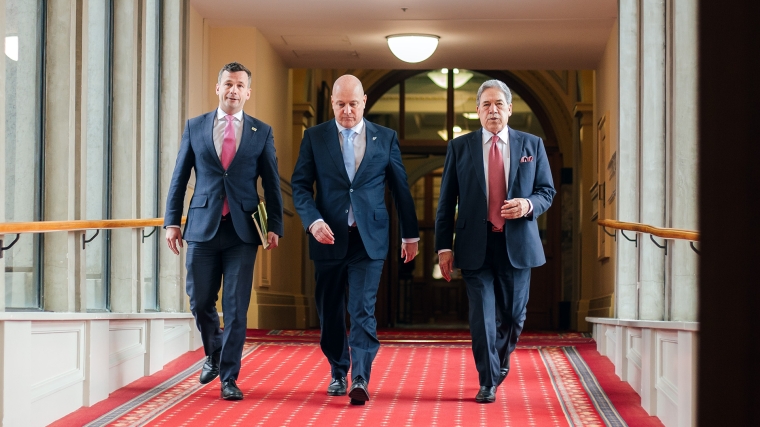
After months in a slow motion slide down the polls, the Coalition Government appears to have found some solid ground and won back some lost votes.
Three polls taken in late March show the Coalition back in position to form a government after briefly falling behind the left-leaning parties earlier in the month.
A quarterly RNZ–Reid Research poll last week showed the National Party on 32.9% and the Labour Party on 32.3%. On Friday the Taxpayers’ Union–Curia poll put the two parties at 33.5% and 29.8%, respectively.
The minor parties have held pretty steady since the election, despite a few outlier polls. The Greens generally poll about 11%, the Act Party at 9%, NZ First at roughly 6%, and Te Pāti Māori near 4.5%.
While the exact coalition mix moves around, these two most recent polls—plus the less reliable Roy Morgan—have shown the Government parties overtaking Labour’s allies.
Interest.co.nz’s DIY polling average shows the Coalition’s regaining a lead of 1.5 percentage points, an improvement on recent polls but still down from 11 points at the 2023 election.
It has always been assumed that National and its partners would benefit from falling interest rates and an improving economy in the second half of its term. While the economic recovery is still in its early stages, some indicators suggest the worst has passed.
Voters may have been spooked by the shock economic decline late last year, which corresponded with the maximum pressure of high interest rates and the winter electricity crisis. It looked to some that the Coalition had crashed the economy, rather than put it “back on track”.
However, the Reserve Bank’s interest rate cuts are beginning to take effect on the economy, which expanded in the final quarter of 2024. Unemployment has been creeping higher but is expected to peak at roughly its current levels.
RNZ–Reid Research data showed the percentage of voters who believed the country was headed in the wrong direction peaked toward the end of January and has since fallen ten percentage points.
A number of high profile issues have also dropped out of the headlines. An uneasy resolution has been reached on the Dunedin Hospital rebuild and progress made on buying new ferries.
The toxic Treaty Principles Bill has finished its select committee process and should be voted down at its second reading in the next couple of weeks. Inflation has also come under control and is steadily becoming less of a concern for voters.
Still, Prime Minister Christopher Luxon’s poor popularity ratings show little sign of recovering, perhaps due to his association with the even more unpopular Act Party leader David Seymour.
The Green Party co-leaders also received highly unfavorable ratings in the most recent TPU–Curia poll. Marama Davidson had a net-negative rating of more than 30% and Chlöe Swarbrick more than negative 20% — making them the most unpopular party leaders.
Labour leader Chris Hipkins was the only party leader with a positive net favourability rating at less than 5%. However, he trailed in the preferred Prime Minister poll at 18.9% to Luxon’s 21.9%.
We welcome your comments below. If you are not already registered, please register to comment
Remember we welcome robust, respectful and insightful debate. We don't welcome abusive or defamatory comments and will de-register those repeatedly making such comments. Our current comment policy is here.