
By Chris Trotter*
A clear path to victor in next year’s general election lies before Christopher Luxon. What the voting public will discover over the next ten months is whether or not the Prime Minister, his National Party colleagues, and their coalition partners can see it.
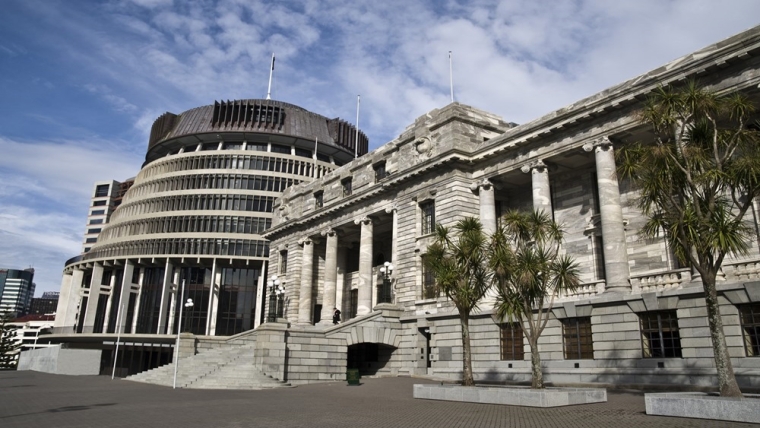
The question which this government – any government – needs to ask itself constantly is: “What is the purpose of Parliament?” The answer is very simple. Parliament, or, in New Zealand’s case, the House of Representatives, exists to protect the people from those with the power to do them harm.
This is a rather jarring revelation. Most of us do not conceptualise the state, or the society over which it presides, as containing individuals and groups (other than outright criminals) who are quite prepared to inflict harm on their fellow citizens. Indeed, social cohesion depends absolutely upon the overwhelming majority of citizens believing the opposite to be true. That, as politicians and journalists never tire of reassuring the population: “There is much more that unites us than divides us.”
Even the slightest indication that this may no longer be the case can prove highly corrosive of social peace. Uncontradicted by society’s political, cultural and economic leaders, claims that division and disunity are not only being tolerated, but encouraged, speed-up that corrosion.
The result is polarisation. Society begins resolving itself into antagonistic camps. Opponents become enemies. Social cohesion evaporates.
There are many, both here in New Zealand, and across the Western World, who would insist loudly that this is precisely how matters now stand. Our society is deeply polarised. Trust in key institutions is declining at an alarming rate. Public discourse has already degenerated into raucous and all-too-often harmful abuse.
The cures being advanced for this parlous state-of-affairs are frequently much worse than the complaints. Antagonists, spurning dialogue and conciliation, demand the outright suppression of their opponents. Hitherto impartial processes are weaponised against purveyors of ideas and/or practices deemed harmful to the common welfare. Institutions are exhorted to identify, exclude and punish all who chose heterodoxy over orthodoxy; personal integrity over group-think. Unsurprisingly, this only makes matters worse.
It is a situation that most people living in Western societies today find profoundly unsettling. But that is not the way our ancestors would have responded to such a description of the world.
Why not? Because this was the world they lived in.
Their masters paid lip service to the idea that the powerful were obligated to protect the powerless, but their actions and the structures of authority in which the powerless were enmeshed spoke very differently. Harm would most certainly ensue, and quickly, upon any serf who dared defy his feudal lord: flogging, branding, mutilation and, for repeat offenders, death, made it bloodily clear who had the power and who did not.
The clarity of the medieval ruling class’s world-view was made grimly explicit in King Richard II’s repudiation of the undertakings extracted from him during the Peasant’s Revolt of 1381:
“You wretched men, you who seek equality with lords are not worthy to live. Serfs you are and serfs you will remain. You will continue in bondage not as before but incomparably harsher. We will strive to suppress you so that the rigour of your servitude will be an example to posterity.”
Not much room for doubt there!
Nor was there much protection to be had from the Church. To those at the base of society it was pretty easy to see whose good opinions (and benefactions) the clergy were most concerned to cultivate. Those at the top of the religious hierarchy were the younger brothers of the local lords. As for the parish priest: he was a poker, a pryer, and a prurient connoisseur of the sins of his hapless flock. Worse still, the Church was the medieval equivalent of George Orwell’s Thought Police. Cross it, defy it, and very quickly people found themselves trussed-up to a stake in the town square, breathing smoke.
It required a civil war and the removal of a king’s head to convince those at the top that it might be wise to limit the amount of harm inflicted upon those at the bottom. What’s more, that pesky notion of equality that Richard II had been so keen to extirpate in 1381 had not gone away. In 1647, at Putney, just a few miles short of London, Oliver Cromwell’s “New Model Army” paused to debate exactly what sort of England it was fighting for. Colonel Thomas Rainsborough spoke for a great many of his “plain, russet-coated troopers” when he declared:
“For really I think that the poorest hee that is in England hath a life to live, as the greatest hee; and therefore truly, Sr, I think itt clear, that every Man that is to live under a Government ought first by his own Consent to put himself under that Government; and I do think that the poorest man in England is not at all bound in a strict sense to that Government that he hath not had a voice to put Himself under.” [Original spelling – C.T.]
It would require three more centuries to place the “shees” alongside the “hees” in the making and unmaking of governments, but ever since Putney the direction of travel has been clear. Out of its great Seventeenth Century struggle with the English crown the English parliament emerged supreme. But the supremacy of the poorest hees and shees would only be achieved in the Twentieth Century when, finally, they mastered the means of making Parliament their own.
Matters moved with more speed and purpose in Great Britain’s colonies. New Zealand led the way in offsetting the power of its wealthiest citizens by minimising legislatively the amount of harm they were able to inflict. Factory acts; industrial conciliation and arbitration; publicly-provided housing, healthcare and education; compulsory union membership; state ownership of natural monopolies; regulatory measures of all kinds were enacted to keep the New Zealand population as free from harm as possible in a world that can never be made entirely safe.
In the 1980s, however, the people’s forward march against preventable harms was halted and with astonishing speed all the old problems reappeared. The subversion of the people’s political parties had freed the people at the top of society from the strict parliamentary oversight which had restrained them for more than half-a-century. Elite power and influence expanded rapidly, along with the greedy throngs of hangers-on and enablers with which the powerful have surrounded themselves throughout history.
By the twenty-first century this new political, economic, and social order had resolved itself into the society we know today. As harms multiply, and the hard-won protections set in place by previous parliaments have been either attenuated or abandoned, a new kind of feudal order is emerging.
Replacing the lords and their armed retinues are the corporations and their professional defenders – the law firms, lobbyists, public relations flacks and tame journalists. Replacing the medieval church is a new clergy comprised of judges, academics, public servants and the media, whose new role is to explain and justify the ways of the powerful to the powerless.
Curiously, the way they do this only seems to divide and enrage the powerless even more. Those attempting to stay afloat in an ever-increasing deluge of economic, social and cultural pain have opted to redistribute it among themselves.
They have forgotten what parliament is for and, more importantly, they have forgotten how to take control of it. The way is thus clear for a party, or parties, to present themselves as the people’s champions. To promise stern parliamentary action against those who attempt to usurp the will of the majority, and to reflect back with genial generosity the majority’s moral convictions and material needs.
Before coldly informing them that he would repay their bid for freedom with perpetual subjugation, Richard II had defused the Peasant’s Revolt by riding along the ranks of the suddenly leaderless rebel army crying: “Follow me, I will be your captain now!” (Wat Tyler, their true commander, lay dead upon the field, run through by the swords of the King’s entourage.)
From the Plantagenets to Donald Trump, that’s how populism works. If Christopher Luxon wishes to keep his crown, then he must pretend to set it upon the head of a populist Parliament. By delivering the angry voters a few pointy-heads on pikes – he can keep his own.
*Chris Trotter has been writing and commenting professionally about New Zealand politics for more than 30 years. He writes a weekly column for interest.co.nz. His work may also be found at http://bowalleyroad.blogspot.com.
We welcome your comments below. If you are not already registered, please register to comment
Remember we welcome robust, respectful and insightful debate. We don't welcome abusive or defamatory comments and will de-register those repeatedly making such comments. Our current comment policy is here.