
By Chris Trotter*
Singling out a single individual and crowning them “Politician of the Year” indicates a fundamental misunderstanding of political life. Above all else, politics is a collective endeavour.
Politicians who attempt to follow Shakespeare’s advice: “This above all: to thine own self be true” are condemning themselves to heartbreak and failure. “Thine own self” is a meaningless cipher in the games of power.
Power is other people. What they can do for you. What you can do for them.
By this measure, the “Politician of the Year” should always be the Prime Minister. As any given year draws to a close, the person occupying the highest office in the land is clearly demonstrating that enough people, in enough places, remain convinced that there is, at least, just a little bit more s/he can do for them. Accordingly, they will continue to do what is necessary to keep the Prime Minister in power.
To hear some people tell the story, not only had Christopher Luxon nothing more to do for his colleagues, but he had also contributed so little to the governing coalition that his deposition was a matter of urgency. The governing coalition, it was argued, would be a one-term government if Luxon remained in charge. He had to go.
And yet, Luxon will celebrate the New Year as his country’s prime minister, and Chris Bishop, the man long touted as Luxon’s replacement will not. Somewhere along the way to the “inevitable” leadership spill the calculations of a crucial number of the plotters ceased to identify Bishop as the answer to National’s problems.
In part this reflected National’s solidification in the polls. The voters may not have been enthusiastic about Luxon and his party, but they had declined to give up on National in 2025 the way they had given up on Labour in 2023. Alongside its Act and NZ First allies, Luxon’s party had won more often than it had lost in the pollsters’ putative elections. Changing horses in midstream made no political sense.
Putting together the numbers for a successful leadership bid in the National Party was equally challenging for reasons that went way beyond testing the patience of conservative voters unnecessarily. Luxon had been elevated to the National Party leadership for the very reasons his critics were now insisting he should be deposed.
In 2021 Luxon was a bland and profoundly uninspiring “cleanskin”, unbloodied by the vicious leadership battles that had left the party’s antagonistic factions ideologically and politically exhausted. After Bill English, Simon Bridges, Todd Muller and Judith Collins had demonstrated sequentially how little they could do for the conservative cause, a non-rebellious candidate without a cause was exactly what the party needed.
Those proposing to replace Luxon with Bishop could not avoid the near certainty that the successful elevation of National’s “chief engineer” would reignite the factional struggles between the party’s “liberal” and “conservative” wings. Worse still, this traditional rivalry ran the risk of escalating into the even more bitter conflict between “elitists” and “populists” currently tearing the Right apart worldwide. Were that to happen, National’s coalition partners would not be able to stand aloof. The entire edifice of conservative ascendancy in New Zealand would have been threatened.
Viewed from this perspective, Luxon’s laissez-faire approach to coalition management represents a considerably more sophisticated leadership style than his political and journalistic critics have been willing to acknowledge.
The notion that a party which has secured less than 40 percent of the Party Vote should exercise absolute power over coalition partners representing 15 percent of the Party Vote reflects an infantile understanding of the politics of proportional representation. Constantly urged to slap-down his coalition partners for their egregious breaches of elite orthodoxy, Luxon has patiently – and rightly – reminded his critics that New Zealanders are living under MMP not FPP.
If power is other people – your people – then riding roughshod over their preferences is the fastest way to lose it.
Another reason for keeping Luxon exactly where he is must surely be the sheer volume of wins which the Prime Minister’s coalition management-style has delivered to the New Zealand Right. It has overseen a division of labour that allows all the various and often competing political and ideological forces to produce a sum of economic and social reform greater than its contributing parts. Taken as a whole, the National-Act-NZ First Coalition has generated more change than any New Zealand government of the last 30 years. The Right as a whole has no compelling reason to get rid of Luxon.
Some would argue that all of these observations add up to only one conclusion – that Christopher Luxon should be named Politician of the Year. But that would miss the point entirely. Prime Ministers are merely corks bobbing about upon the restless political sea made up of individuals and interests dedicated to sustaining collectively their respective leader’s buoyancy.
Though we are constantly encouraged to believe the opposite, our political leaders are not in fact in charge. As the French revolutionary leader, Alexandre Auguste Ledru-Rollin (1807-1874) quipped, upon observing a crowd of angry Parisiens surging through the streets: “I am their leader, I must follow them.”
In between those rare moments (not so rare in France it must be admitted) when the citizenry decides to intervene directly in the political life of the nation they generally prefer to delegate that role to the men and women they elect to local and central government.
Very few of us understand the lives of these politicians or have the slightest idea of the complexities of the profession they have chosen. The political discussions and debates we tire of so quickly are their lingua franca. The grim registers of slight and compliment; loyal defence and rank betrayal; favours bestowed and favours owing: the ancient currency of politics of which most of us remain blissfully ignorant, is what politicians are required to bank and spend every day.
These are the men and women who make and remake the world on our behalf. And in the case of all but a handful of shameful exceptions these politicians earn their salaries. Most of us would quit the job in disgust after just a few legislative efforts. As Count Otto von Bismarck, Imperial German Chancellor from 1871 to 1890, joked: “Laws are like sausages. It is best not to see them being made.”
We pour out our praises upon police officers, firefighters and ambulance staff for rushing forward where nearly all of us would hang back. When it comes to politicians, however, we pour out nothing but scorn. It simply isn’t fair, because the thought and careful calculation bound up with a decision to pass a law or discard a leader, and the courage required to back that decision with a vote, is not an easy process. Most people would rather stick needles under their fingernails.
We have examined what it took to keep Christopher Luxon in place, but a very similar set of calculations would have been made on the left of New Zealand politics. Similar and probably harder, because if there’s one job harder than being a government politician it’s being an opposition politician. Undoubtedly, keeping Chris Hipkins in power required just as much number-crunching and argument-weighing as keeping Christopher Luxon at the top of the greasy pole.
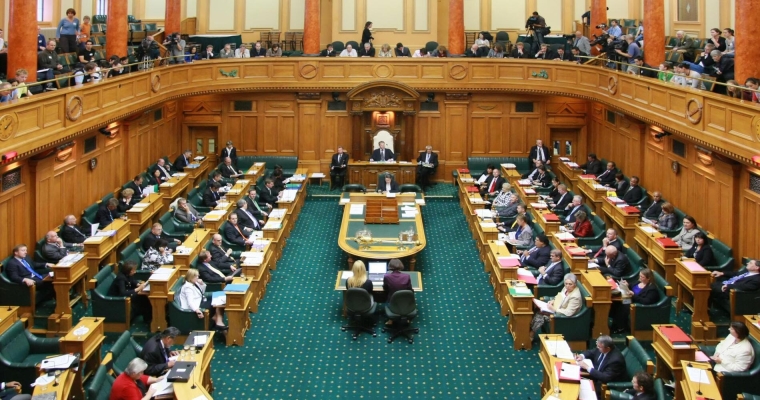
President Abraham Lincoln (1809-1865) described democracy as “government of the people, by the people, for the people.” The reality, however, is that the people are happy to elect politicians to carry out the fraught business of governing for them. Which is why, in a parliamentary democracy such as ours the title “Politician of the Year” rightfully belongs to all the people’s representatives.
Collectively, they have earned it.
*Chris Trotter has been writing and commenting professionally about New Zealand politics for more than 30 years. He writes a weekly column for interest.co.nz. His work may also be found at http://bowalleyroad.blogspot.com.
We welcome your comments below. If you are not already registered, please register to comment
Remember we welcome robust, respectful and insightful debate. We don't welcome abusive or defamatory comments and will de-register those repeatedly making such comments. Our current comment policy is here.