
sign up log in
Want to go ad-free? Find out how, here.

Stephen Roach thinks effective diplomacy will be impossible so long as the current US president is in office

Public Policy / opinion
Stephen Roach thinks effective diplomacy will be impossible so long as the current US president is in office
Trump will fade

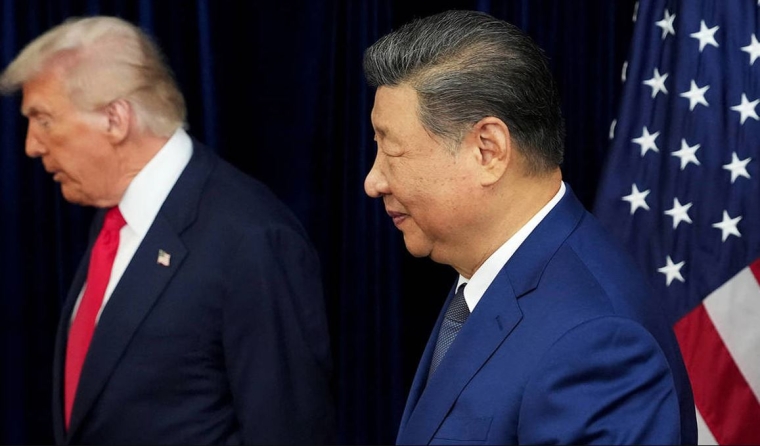
With the United States in the hands of an unstable president, diplomacy is not the answer for a conflict-prone US-China relationship. The striking contrast between US President Donald Trump’s intrinsic volatility and Chinese President Xi Jinping’s strategic resolve plays to China’s great advantage – and means that effective conflict resolution is a task for the post-Trump era.

It wasn’t always this way. Diplomacy was at the forefront of Sino-American engagement in the early 1970s. Well-practiced in the art of grand strategy, Henry Kissinger and Zhou Enlai, answering to President Richard Nixon and Chairman Mao Zedong, masterfully crafted a Cold War triangulation that redefined great-power relations. In the intervening years, leader-to-leader summits became the template for maintaining bilateral ties.

But the rise of politically constrained, egocentric leaders – often deluded into believing that they possessed superior skills of personal persuasion – made disputes between the two superpowers exceedingly difficult to avoid, let alone resolve. Neither side could afford to be seen as weak, and Sino-American conflict resolution became an exercise in saving face.

The emergence of new strains of nationalism in the US and China has also hampered diplomacy, which derives its legitimacy from domestic politics. The US is in the grip of a destructive Sinophobia. Notwithstanding America’s corrosive polarization, anti-China sentiment enjoys broad bipartisan support. The US diplomatic agenda reflects this increasingly strident bias.

Despite its one-party system, political considerations are equally important in China. Xi’s power rests on his promise to achieve the Chinese Dream, or “the great renewal of the Chinese nation.” But without sustained economic growth, Xi risks failing to keep that promise and facing a wave of public and party anger. That makes China’s growth shortfall, which partly stems from its ongoing conflict with the US, especially concerning. The economic ramifications of a mounting “rejuvenation deficit” have undoubtedly constrained Chinese politics.

Fragile egos exacerbate the problem. Rhetorical miscues are blown out of proportion. When leaders lack the self-confidence to shrug off criticism, the hair-trigger reactions of personalized diplomacy backfire. Still, many cling to the belief that leader-to-leader summits – the pinnacle of such diplomacy – hold the key to US-China conflict resolution. Nothing could be further from the truth.

There have been 22 such summits since the breakthrough Nixon-Mao meetings in 1972. Most of them, apart from the 1979 summit between Deng Xiaoping and Jimmy Carter that established formal diplomatic relations, have accomplished very little. Two glitzy summits between Xi and Trump in 2017 – a formal dinner at Mar-a-Lago and a ceremonial gathering in Beijing’s Forbidden City – were followed quickly by the onset of tariffs and the first wave of the US-China trade war in 2018-19.

Trump and Xi risk repeating the same cycle in 2026. After a brief meeting in October on the sidelines of the Asia-Pacific Economic Cooperation forum in Busan, South Korea, they have tentatively agreed to hold two leader-to-leader summits in 2026. Yet without clearly defined agendas, these summits are unlikely to reshape bilateral relations. The best that can be hoped for is stasis on the contentious issues of trade, technology, people-to-people exchange, and Taiwan. But even that might be optimistic: The Trump administration’s new $11 billion arms package for Taiwan could be a fresh source of Sino-American instability.

As long as a belligerent Trump, or one of his acolytes, remains in power in the US, there is very little chance of a sustained resolution to the Sino-American conflict. On-again, off-again “deals” offer no hope for lasting stability, not least because of their reliance on the conflicts they purportedly aim to resolve – without conflict, there can be no deals. At the same time, China is far from a white knight providing stable political leadership in a tumultuous world.

This suggests that a major shift in the political winds is the best hope for US-China diplomacy. Of course, Xi has consolidated power, making such a shift practically impossible in China’s one-party system. Political change may prove equally challenging in the US, which is under the spell of Sinophobia and riven by Trump’s MAGA movement.

That doesn’t mean America can’t rediscover its magnanimous spirit and once again embrace the mantle of global leadership, as it did after World War II by supporting its defeated enemies and rebuilding Western Europe with the Marshall Plan. Avoiding kinetic conflict with China will depend on the US living up to its reputation as a “shining city upon a hill.” But to get from the chaos of today’s polarized America to a new era of coherence, civility, and conflict resolution may require nothing short of a political watershed.

For many Americans, such a shift currently seems improbable as Trump tightens his grip on government. But since the mid-1850s, presidential party affiliation has changed hands between Republicans and Democrats in 19 of 44 elections; since the end of WWII, the frequency of party turnover has been even higher. The same applies to control of both the House and the Senate.

All this points to the likelihood that MAGA will not dominate America’s future in the long run. For that reason alone, it is not too early to start thinking about rapprochement with China as a key feature of a post-Trump foreign-policy agenda, especially as pulling it off will most likely require a new architecture of engagement.


*Stephen S. Roach, a faculty member at Yale University and former chairman of Morgan Stanley Asia, is the author of Unbalanced: The Codependency of America and China (Yale University Press, 2014) and Accidental Conflict: America, China, and the Clash of False Narratives (Yale University Press, 2022). Copyright: Project Syndicate, 2025, published here with permission.

We welcome your comments below. If you are not already registered, please register to comment

Remember we welcome robust, respectful and insightful debate. We don't welcome abusive or defamatory comments and will de-register those repeatedly making such comments. Our current comment policy is here.

14 Comments

 it is not too early to start thinking about rapprochement with China as a key feature of a post-Trump foreign-policy agenda, especially as pulling it off will most likely require a new architecture of engagement.

But will he leave the scene or simply refuse to acknowledge any limitations on his time in office? His contempt for the checks and balances built into the system of government is clear. If failing health forces him out, why should he not seek to simply anoint his successor? Why bother with the messiness of an election the result of which he would not necessarily accept?

Up
1

Thankfully he's 79 and not 59. If he can demolish part of the Whitehouse and get away with it, I'd hate to think what he could achieve with more youth on his side.

Up
4

In one year President Trump has given the rest of the world a lesson that the USA is neither the dormant nor ineffectual military force that quite a body of international opinion often proclaims. The attack on the Iranian nuclear site detonated without any detection arrival or departure.  Now an efficient smash and grab taking the leader of a sovereign nation. Again in and out with infinite ease. In between time Russia and others, have been obliquely reminded that the US Navy has continually on patrol more nuclear subs than the rest of the world combined, deep water, whereabouts undisclosed. Not saying in any way that this is either good or desirable policy in terms of global stability and more, but the above are new and stark facts on the scene that were not present 12 months ago.

Up
3

Notwithstanding Trumps hubris, its a bit wearying listening to the usual suspects (UN, Helen Clark, academics etc) hypocritically sniveling about respecting "rules based international order" - rules which have  permitted Maduro & many other autocratic undemocratic despots (incl members of the UN) to abuse & impoverish nations & murder countless numbers of people for decades.

The real question: is the world a better place without Maduro? Probably. It remains to be seen, the USA have an almost perfect failure rate in other countries regime change.

Up
4

Not so quick.

The fall of the USSR in 1989 was a 9 year effort at Regime Change by a daring and defiant US President who set out with passion and resolve to unchain the Iron Curtain.  President Reagan disregarded what the "Deep State" was telling him throughout-CIA, State Dept, you name it-(reckless foreign policy from a B grade former Movie Star they thought).

Trying to keep up with US military spending (strategic Reagan)  doomed the 4 rulers of the USSR who waived the hammer and sickle from 1980 to 1989.  Without the relationship Reagan developed with Gorbachev the collapse of the USSR could have turned tumultuous. How many countries were freed from the Baltic to the Mediterranean when Reagan stood in Berlin and proclaimed "Tear Down this Wall Mr Gorbachev".  What do you call it if not regime change.

The Evil Empire is a far smaller Empire in 2026 than it was in 1989. How malevolent was the US then.  Well when Reagan started on the "regime change" in 1981 this was the reaction:

12 Nov 1981.  AMSTERDAM, Netherlands -- Half a million people crushed into Amsterdam Saturday to protest nuclear weapons and the Reagan Administration's arms policies in the largest demonstration in Holland since its liberation from the Nazis in 1945.

In 1981 from Rome to London and everywhere in between it was the same.  They were wrong about Reagan and this week I think the negative reaction does not see the future for the Venezuelan people with Trump.  Here's hoping "She'll be right" once again. This is not the Bush/Obama action in the Mideast-this is the revival of the Monroe Doctrine 

Up
0

When I think of "a shining city upon a hill" I think of Rome or Athens at their zenith. Literally shining cities built on hills.

Attractive and world leading but not entities that turn the other cheek or show magnanimity toward undefeated foes. It's more like, Carthago delenda est!

After WW2 the US was magnanimous toward thoroughly crushed and defeated enemies but still maintains military bases within their borders today.

Trump is more like a modern day Caesar. A defeated and humiliated enemy has just been brought back in chains to New York, the most prestigious city of the empire.

He no doubt views Putin, Xi and even Kim Jong Un as Caesar-like rivals.

It must be admitted that he has been enormously successful so far. His amazing first presidential win followed by an almost Napoleonic comeback four years after his defeat. One year into his second presidency he has notably expanded US hegemony and prestige, the markets have flourished, illegal immigration has practically stopped and US military power is demonstrably unrivaled.

Up
3

 "....he has notably expanded US hegemony and prestige,..."

or the opposite

Up
2

2026 may well be an amazing year. If the Venezuelans are sensible they will work with the US to develop their oil infrastructure. The Islamic Republic of Iran is on the brink. Their people, especially the young, appear to want to be more Western and have a decent standard of living. Even Cuba could be persuaded to throw out their leaders and embrace the West. These will all be perceived as wins for Trump and for the common people of those countries. Let's wait and see.

Up
4

"Even Cuba could be persuaded to throw out their leaders and embrace the West."

Embrace??....and at what cost?. The US gains access to the resources/markets of Cuba at the expense of willing access of the bulk of the western world....great trade.

Up
1

The framing of Trump that I found useful is as a mob boss. Any disrespect from within his own family (country) is unacceptable, everyone must bow to him. Subordinate families (traditionally allied nations) must also bend the knee. But Putin and Xi etc are the bosses of rival mob families, and they must be treated with the respect that entails. 

Helped me understand why Trump might be so deferential to Putin while being so openly scornful of what were allied countries in Europe or Canada. Not to say I think it's a morally defensible position, of course. 

Up
4

Trump can only act the way he does while he has the energy resources to fund the countries military. The shale boom was forecasted to be short lived and peak 2027, therefore he couldn't afford not to intervene in Venezuela given their proven oil reserves. As PDK has said previously, he who brings the most energy to a large scale conflict usually comes out victorious, and the access to Venezuelan oil will make countries think twice about conflict against the USA now they have vast swathes of oil to exploit once again. 

Up
1

There are more pros than cons for Venezuela to cooperate with the US. Venezuelan oil is more difficult to process as it is mostly heavy and extra heavy crude. About 50% of the known reserves may not be able to be extracted. The US has the best knowhow and technology for processing this crude oil. The US would also be a much more reliable defense partner. Obviously the US would need to benefit from this arrangement as well.

Up
1

Here is why-It's not being differential to Putin as much as it is being a realist in how to stop the Ukraine War. Giving up the "Russian speaking" regions of Ukraine is how this War will end-until now Trump was the only realist who could see that--for that he was condemned as a Putin ally.  Thinking this is 1938 Munich is not right.  Then UK and France had no power to match Germany. Making a settlement in 2026 to give away land for peace is in no way the same. The greatest outstanding issue now is getting Russia to agree as to what happens in the case of a violation of a Treaty, and until then Russia continues using  WWI tactics of soldiers rushing the front lines.  He will keep buying more troops to fight for years to come.  Time to settle an unwinable war the same as the Allies did in Korea some 70 years ago.

Up
1

And don't forget Maduro was "indicted". That means a Grand Jury of 33 citizens in New York listened in secret for days to the facts presented by a US Attorney and only then voted to Indict him to stand trial. He will have his day in Court and then all the facts will be public.

Up
0