
The United States and China have long been the most prominent representatives of two opposing systems: democracy and socialism. But they increasingly share one crucial characteristic – personalised leadership – that blurs the otherwise sharp distinction between the two. This raises the important question: which country is truly exceptional?
American exceptionalism is, of course, taken for granted. There is no formal definition of this lofty state of national supremacy, nor are there any qualifying metrics. To borrow from former US Supreme Court justice Potter Stewart, “I know it when I see it.” Personal freedoms, the rule of law, and economic primacy are often cited as the main reasons why America is the world’s “shining city upon a hill,” as former US president Ronald Reagan famously proclaimed.
By contrast, China hardly comes across as exceptional, at least as it is understood in the West. Notwithstanding its mounting economic strengths, China is quickly disqualified by its lack of personal freedoms – not just of expression, but also those associated with a democratically elected representative government.
Leadership is also an important element of American exceptionalism. That’s not because US presidents have been unusually brilliant or decisive, with magnetic personalities and extraordinary communication skills, but because they have embraced, if not celebrated, democratic principles. The very concept of American exceptionalism is predicated on the belief that US leaders are wedded to a free and open society, the rule of law, and a capitalist economy.
Until now.
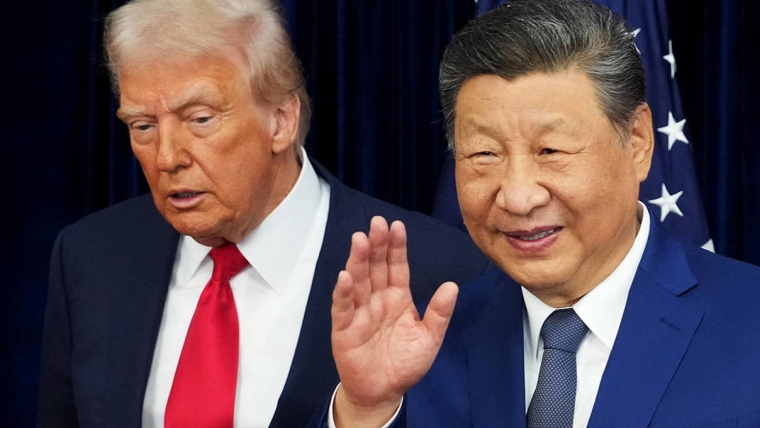
President Donald Trump has abandoned many of these values, raising the distinct possibility that the US is no longer as exceptional as it might think. By contrast, Chinese President Xi Jinping has risen to the status of “core leader” – a designation last given to Mao Zedong. Yes, Xi is an authoritarian president in a one-party system. But from China’s perspective, he is just as exceptional as the generic American president used to be.
The role of leadership bears critically on the Sino-American relationship, and especially on their growing conflict. One problem is that the onerous task of managing the relationship has been left to personalised leadership and diplomacy. This forces us to think about US-China leadership in relative terms – not merely comparing Trump and Xi, but also assessing more generally how each country understands the leader’s role in the opposing system.
This is particularly difficult for Americans, who have been conditioned to abhor anything with a whiff of socialism. Few in the West dare think otherwise. Scathing Marxian critiques of capitalism as a system of exploitation disguised as freedom have gained little purchase, and the former Soviet Union’s appalling disregard for humanity cemented the aversion.
The Chinese people, unlike their ideologically conditioned Communist Party leaders, appear more accepting of the US system. But they stop short of recognising American exceptionalism, owing to a growing sense of nationalism fueled by Xi’s espousal of the Chinese Dream. This growing patriotic fervor has brought China’s citizenry close to believing in some form of Chinese exceptionalism.
The Chinese understand the recent about-face of American leadership and the hypocrisy underpinning it. Unfortunately, so do many of America’s most steadfast allies. That became glaringly evident at the recent World Economic Forum in Davos, where Western leaders pushed back against Trump’s ridicule, hostility, and condescension.
Many Americans, especially the MAGA-controlled Republican Party, were inclined to shrug off his performance at Davos as “Trump being Trump.” Such indifference to a potentially seismic shift in the character of American leadership may come back to haunt the US. While the case for one exceptional country is compelling in a unipolar world, it is less so in a bipolar or multipolar world.
A big question for American exceptionalism is whether Trump is an aberration or a sign of where the US is headed. Ultimately, only Americans can answer this question, expressing their preferences through the free and fair elections that are the cornerstone of US democracy (and yet surprisingly fragile, as demonstrated by Trump’s attempts to overturn the 2020 presidential election). For China, the question of its exceptionalism may ultimately hinge on that same electoral process.
All this could be decisive in shaping the trajectory of the US-China relationship. Steeped in denial, America is unwilling or unable to differentiate between the personalisation of conflict-prone policies and the moral underpinnings of democratic values. A deep-rooted intolerance of other systems, as well as their leaders, makes it even more challenging for the US to navigate the complex dynamics with China.
Chinese leaders are also guilty of personalising the Sino-American conflict. They constantly frame the superpower rivalry in Marxian-like terms: “the East is rising, the West is declining.” Xi was more direct at the National People’s Congress in 2023, explicitly blaming the US for embracing a policy of Chinese containment.
Trump, fixated on striking a deal with China at the upcoming summit in April, has turned the other cheek, touting his personal friendship with Xi. Yet Sino-American conflict resolution requires more than superficial claims of camaraderie between leaders of two different systems.
In the end, history asks far more of exceptional nations. Nothing is more important than a willingness to understand and tolerate other countries with different systems.
*Stephen S. Roach, a faculty member at Yale University and former chairman of Morgan Stanley Asia, is the author of Unbalanced: The Codependency of America and China (Yale University Press, 2014) and Accidental Conflict: America, China, and the Clash of False Narratives (Yale University Press, 2022). Copyright: Project Syndicate, 2025, published here with permission.
We welcome your comments below. If you are not already registered, please register to comment
Remember we welcome robust, respectful and insightful debate. We don't welcome abusive or defamatory comments and will de-register those repeatedly making such comments. Our current comment policy is here.