
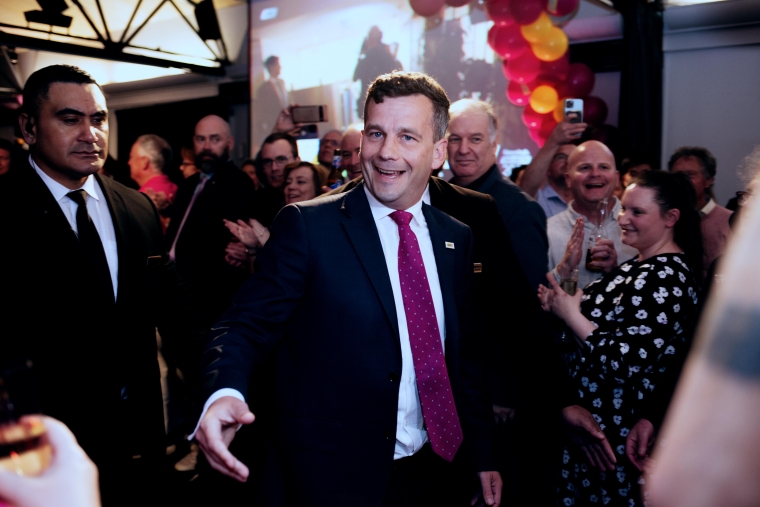
The ACT Party will be campaigning for a Government that has no more than 20 ministers who all sit in Cabinet and no more than 30 departments.
ACT leader David Seymour made this announcement as part of his State of the Nation speech in Christchurch on Sunday. But this proposal is not a surprise, with Seymour initially bringing up the concept of a smaller Government in a speech to the Tauranga Business Chamber in May.
Seymour says New Zealand is “over governed” and questions why a small country has such a large Government.
Currently, there are 28 ministers, two under-secretaries, 81 portfolios (77 ministerial portfolios and four other ministerial entities like Child Poverty Reduction, Auckland, Ministerial Services and South Island) and over 40 departments.
“Norway, a similar size to us, governs with 20 ministers across 17 coherent ministries, each clearly aligned to a broad policy domain,” Seymour says.
“The whole structure is set up to preserve itself. Why are there barely fewer bureaucrats than when we started trying to cut the numbers two years ago? Because the structure is set up so nobody is completely in charge of anything.”
Seymour says one department, the Ministry of Business, Innovation and Employment, works with several ministers and some ministers have several portfolios.
“Nobody is solely responsible for getting a set of outcomes for a budget.”
And some ministers exist without any department at all, he says. “Labour appointed a Minister for Auckland without any actual budget, department, or responsibility. I call them vanity portfolios.”
Seymour says the net results of this are “unsatisfying” results, “running all these agencies costs one third of the economy” and “the regulatory activity and interference from these agencies puts another layer of costs onto New Zealanders”.
“We’ll never balance the budget, raise wages, or restore trust in democracy when Government is so large, inefficient, and unaccountable to New Zealanders.”
As part of this proposal, Seymour says there would be:
- No more than 20 ministers who all sit in Cabinet
- No more than 30 departments so most ministers have only one
- No department answers to more than one minister
- No minister has a portfolio, there are only departments with budgets to manage
“Instead one minister will be solely accountable for getting results for their budget of taxpayer money from their department,” Seymour says.
He says there would be “no more vanity portfolios designed to appeal to a group of people”.
“Reducing the number of ministers will save money, but it will also change the point of being a minister.”
Seymour says with a smaller Government, “a small business owner will spend less time and money battling paperwork and bureaucracy - an immediate productivity boost”.
“Over time, they’ll benefit again as the Government takes less of what they earn, returns to surplus sooner, and needs less of their taxes to sustain itself. More productivity, more jobs, higher wages – all the Government needs to do is less.”
“The Public Service Commissioner has said he wants to see a consolidation. The Government actually has merged Environment, Housing, Local Government, and Transport into one Ministry,” Seymour says.
“This is an idea whose time has come, and we will be campaigning to ensure it happens completely.”
'That starts at the top'
During his speech, Seymour also talked about how the cost of living crisis was also a productivity slump, the Government not balancing the books, people losing faith in institutions, and his party's views on an "inclusive" New Zealand society and identity.
“If we’re going to make life affordable again, raise productivity, balance the budget and restore faith in our democracy, we need to take three key steps," Seymour says.
“We need an inclusive and uniting story about ourselves as pioneers and adventurers. The good news is, that’s a pretty good description of our actual history. We just need to tell it.
“We need to stop reaching for easy fixes, and finding a different group to blame each time there’s a problem. The good news is that our pioneering history sets us up well to navigate a fast changing world and find those smart fixes.
“We need a smaller, more efficient government, that frees up people’s time and money to provide for themselves and their families. That starts at the top.”
69 Comments
Singapore has ~16 Ministries & ~20 Ministers
It is well overdue for a hard look at the structure, operation and size of public service in general. Even more so since the huge influx of staff numbers orchestrated by the sixth Labour government which the present government has scarcely addressed. Perhaps the thinking is that if the numbers cannot be individually reduced as as easily as they were employed then scrap entire departments. Theme music from Roger Hall’s TV series Gliding On, playing in the background.
What do you think would happen to the NZ economy if you reduced the size of the government by cutting back significantly on the public sector workforce and spending in general? Would we see more economic activity for business and more employment opportunities for NZ workers as a consequence? Would the lower taxes we would pay deliver the boost demand needed by the retraction of government spending? Would the additional costs put onto the private sector be helpful or damaging to the NZ economy? Would our quality of life be improved by the necessary reduction in infrastructure and welfare spending or would it become harsher and more disruptive for ordinary NZer's?
Can you find an example of a country any where in the world that operates with a very small government and still provides a decent standard of living and a resilient economy?
"What do you think would happen to the NZ economy if you reduced the size of the government by cutting back significantly on the public sector workforce and spending in general? "
Probably nothing - judging from the insignificant improvement achieved when Labour increased the size of the public service by 18000/40% between 2017-2023. At average over $100k each that's ~$2 Billion pa of jobseeker / jobsworth / make work support that could be better spent.
That is $2 billion dollars going into the private sector. Where do public sector employees spend their money? Do they have some special government access to non-private sector resources? No they don't. All of those incomes are being spent on groceries, mortgages, cars and clothes - all in the private sector.
This is debt free new money being injected into the economy and it has a significant multiplier impact across the private sector.
If you're making money out of thin air (rather than taking on a loan), and the money is being spent on something that adds little to no value, aren't you depreciating the value of all money?
If it works like you say, why are countries like Sri Lanka in so much trouble?
Those countries can't have read the Magic Money Tree operating manual 🤣
I actually feel like most people calling themselves Keynesians are more disciples of Modern Monetary Policy. Keynes called for balanced budgets and not just endless deficits where money is spent for the sake of it.
Keynes did not call for balanced budgets...he rather called for countercyclical spending (predicting the cycle is the problem)....a recognition that private credit was a temporary phenomenom.
Keynes did not call for balanced budgets...he rather called for countercyclical spending
He did both. He called for countercyclical spending (although not just on anything), and a balanced budget in the long term.
He did not advocate endless deficit spending or public debt to become oversized.
"In the long run we are all dead"
No he didnt call for both, indeed he was quite explicit.
John Maynard Keynes believed in the importance of maintaining fiscal sustainability over the long term, despite his famous focus on short-term fixes during economic crises. While he advocated for deficit spending to combat recessions, he viewed these deficits as temporary, counter-cyclical measures that should be reversed during economic booms.
Keynesian fiscal theory emphasizes that long-term sustainability is achieved not by avoiding debt entirely, but by ensuring that borrowing is used for productive investment rather than just consumption, and by ensuring that the debt-to-GDP ratio remains manageable over the business cycle.
Aint AI great.
Heres a better explanation that dosnt suffer hallucinations...
"Keynes wrote this in one of his earlier works, The Tract on Monetary Reform, in 1923. It should be clear that he is not arguing that we should recklessly enjoy the present and let the future go hang. He is exasperated with the view of mainstream economists that the economy is an equilibrium system which will eventually return to a point of balance, so long as the government doesn’t interfere and if we are only willing to wait. He later challenged that view in his most important work The General Theory of Employment, Interest and Money (1935). arguing that the economy can slip into a long term underemployment equilibrium from which only government policy can rescue it."
https://www.simontaylorsblog.com/2013/05/05/the-true-meaning-of-in-the-…
Even your own link quotes:
He cherished a high quality of life and wanted to preserve a capitalist system capable of delivering this against the danger of a collectivist tyranny
This does not sound compatible with an economy being able to deliver that high quality of life by running permanent deficits just to create government jobs.
And that is why I never claimed that he did.
He did however try to educate that it is the power of gov spending that ultimately controls the economy (within the bounds of available resources)....much as MMT does. Private credit creation is considerably more limited and temporary.
The operating manual you have been under for decades.....whether you recognise the fact or not.
The fact it hasnt been utilised to its potential is an example of hierarchy, or self interest if you prefer.
The operating manual you have been under for decades.....whether you recognise the fact or not.
No I do. I can see it's not done us any favours. And yet I'm being told if we just did it a bit more, we'd get a different result.
Not a bit 'more'....with a different objective.
So we're actually wanting fairly significant political reform, not just pushing an economic theory
You have heard of political economy?....the two are indivisable.
Your argument seems to be that the framework is actually right but the application/method is the problem.
The frame work is society....how we organise it and its resources are application/ methodology. We could I guess organise things as individuals.....oh, wait.....
Hmm, this is sort of bouncing all over the map.
I have tried to be a student and witness of societies done as many ways as possible. The hierarchical tendency of larger civilizations is seemingly universal. There is however some level of error checking or validation that a free and open democracy, and some level of a free market provide. Most centrally controlled ones trend more towards total authoritarianism, less efficiency and worser overall outcomes - we can obviously find exceptions and outliers to all of the above.
I am not convinced what you wish for can occur without some fundamental shifts to philosophy and psychology of entire populations. Much of our existence is counter intuitive on so many levels. The setup is all wrong.
This may be all self correcting however. There was a framework set up in the mid 20th century, that will only be afforded to maybe one generation. Those following won't have the same means or motivations so we may find traditional institutions like consumerism dieing on the vine.
"There was a framework set up in the mid 20th century, that will only be afforded to maybe one generation."
Id suggest two...and it may have been more if the greedy hadnt seized their opportunity. I agree that history dosnt support a prolonged period of (relative) equalty however is that a reason to abandon the seeking?
It may all be moot in any case as i doubt the system will see out another generation and if and when we (not me) pick up the pieces there will be considerably less to work with which makes the lack of foresight so frustrating....we could be using this time of relative plenty to prepare.
Stupid is as stupid does.
Id suggest two...and it may have been more if the greedy hadnt seized their opportunity
It was never going to work. Introduction of a huge range of state services. On a pay as you go basis. Works great while you have rising populations and economic growth.
I don't think there's an economic model that can have such a large amount of people live to such an expensive old age, and have generated enough resources to self fund it.
I agree that history dosnt support a prolonged period of (relative) equalty however is that a reason to abandon the seeking?
We're trying to obtain it on an individual level, using a state apparatus (or a market one). Everything Ive gleamed for the ultimate state of human being is to be actively involved in a larger social group, not onesy twosie as has become the norm.
I think there's an answer but it lies outside of politics and economics.
"I don't think there's an economic model that can have such a large amount of people live to such an expensive old age, and have generated enough resources to self fund it."
Funding is not the issue...access to real resources however is. There is no reason a steady state economy (steady in terms of population and resources) cannot provide, the trick is identifying what can and cannot be maintained and acting accordingly....the complication is that even if we succeed say here in NZ it can be undone by actions without.
Whet do you mean by 'adding value'? Taking care of the sick and elderly through the welfare state and public healthcare is economically in-efficient and provides no ROI to private sector investors. But does it add value? Providing school lunches by commissioning small scale, local catering firms is also economically inefficient when it can be done cheaper by a foreign owned multi-national. Which one adds more economic and social value to NZ?
Paying social workers to engage with troubled families and individuals to help them live more stable lives is done to serve those people and the wider community. There is no product or service that is delivered it is all spent on fuzzy things like well being and harm minimization. Does it add value?
Whet do you mean by 'adding value'?
Well, you've just listed a range of social services, where there's some sort of measurable outcome.
So in the context of this discussion, we're talking about the government making new jobs that don't make any discernible improvement to the outcomes of those core functions.
So like the last government. Heaps of new jobs, and the quality of all of our core services, went sideways or down.
Consider that they're measuring wrong
So they actually made some awesome improvements, and that their reporting and measurement efforts were the problem?
If that were so, they'd still be in charge.
Poor comment, because it doesn't recognise time scale implications. So for example, the last government put a heap of jobs/energy/money into improving the dire state of health sector information systems, upgrading, improving and rebuilding if needed. These are systems that have been kicked down the road and bootstrapped to hell, because previous administrations didn't want to pay for them, they prioritised underfunding the health system. These are programs of work that take years to perform, up to 5 or 10 years even for complex medical systems. They were starting with some things that had huge security gaps, like some systems still using Windows XP, other systems with huge security vulnerabilities all over the place. These were in-process when this government came to power... who abruptly stopped many upgrades and made heaps of these IT workers redundant.
Now we see almost monthly health security incidents where peoples data is getting leaked and hackers are ransoming peoples private data. Now I aren't saying these two things are linked but I did warn that this would happen when they threw out all the IT people trying to fix the dire state of NZs health IT systems...
Paying social workers to engage with troubled families and individuals to help them live more stable lives is done to serve those people and the wider community. There is no product or service that is delivered it is all spent on fuzzy things like well being and harm minimization. Does it add value?
If a reduction in family violence and better budgeting abilities learned through the use of the social workers is classed as fuzzy, then perhaps this is what we need more of. Lower family violence will lead to less childhood trauma, more productive children and arguably a lower likelihood for these kids to end up in the criminal justice system, and have the ability to break the cycle of family violence by being more reflective on their own behaviour.
From years of experience I am a firm disciple of Northcote Parkinson’s theory that work creates and expands itself relative to time made available. To which can be added - and staff available. Appreciate your points but it does not address the conditions of empire building, shirking, duck shoving, unaccountability and sheer inefficiency that the presence of unnecessary numbers of staff will inevitably produce in any work environment..
Of course, human nature being what it is at the micro-economic level there are inefficiencies and poorly designed workflows in every organization - public and private. The COVID period probably distorts things a little and as the private sector was effectively stopped in it's tracks from a macroeconomic and Keynesian perspective it makes sense to provide demand for labor through the public sector at that time.
Is 'efficiency' actually a valid end goal for businesses and government organizations? Shouldn't the end goal be the delivery of a particular product or service for which there is need or demand? Efficiency is one of the tools that can be used to help that delivery process - it isn't an end goal in and of itself.
Is 'efficiency' actually a valid end goal for businesses and government organizations? Shouldn't the end goal be the delivery of a particular product or service for which there is need or demand? Efficiency is one of the tools that can be used to help that delivery process - it isn't an end goal in and of itself.
Assuming you've only got so many resources
The less efficient you are
The less stuff you get to use/procure
The ancient English poem Pearl coined the phrase - the more the merrier. And it went on to say - the fewer the better fare, a direct acknowledgement of the consequential thinning out of the relative resources. So yes the public service, from all accounts of some comment on here today, are right onto the first part but obviously, oblivious to the second.
Singapore is a great example. The welfare state is funded through compulsory savings and insurance:
- The 3Ms Framework:
- MediSave: A mandatory health savings account where residents set aside a portion of their income to pay for personal or family medical expenses.
- MediShield Life: A mandatory, low-cost national health insurance scheme for large hospital bills and selected costly outpatient treatments, designed for all citizens and permanent residents.
- MediFund: A government-provided safety net for needy citizens who cannot cover their bills even with Medisave and MediShield.
Singapore housing is almost completely state controlled - if Act get on board with this we might be getting somewhere:
"Singapore's housing policy, primarily managed by the Housing & Development Board (HDB), provides affordable, 99-year leasehold flats for over 80% of residents, with ~90% homeownership. It utilizes mandatory Central Provident Fund (CPF) savings, Build-To-Order (BTO) schemes, and significant subsidies (up to $120k–$230k+ for first-timers) to ensure stability, fostering a property-owning society with strong family-oriented priority and social integration. "
Note the phrase 'social integration' - housing developments in Singapore have to be inclusive of a wide range of income levels to prevent ghettoization and gated communities. A bit like Kainga Ora used to do.
Singapore is a city not a country.
Factually incorrect
You know what I mean.
The entire premise of Acts economic policy is built on a misunderstanding of the true nature of government spending and how it functions in an economy.
Firstly, taxes do not pay for government spending. In the first instance the government - via parliament - declares it's budget and the money to meet this is created by the RBNZ out of thin air. Government spending is created with a keyboard and typed into accounts that commercial banks have with the reserve bank. From there deposits are made directly into private sector accounts.
Counter-intuitively, smaller government leads directly to a smaller economy. The private sector alone is not capable of using all the capacity in an economy and government spending is required to make up the difference. This explains why the current government is borrowing more - not less than the previous government. They butchered existing fiscal flows into the economy and as a consequence the economy shrank dramatically and then stagnated for 2 years.
Automatic stabilizers like the unemployment payments have increased while tax revenue from a contracting private sector have decreased - creating much higher operating deficits and 'borrowing' (bond issuance for savers)
Counter-intuitively, smaller government leads directly to a smaller economy
Does it though? Our public sector is 50% larger than Germanys, yet their GDP/capita is larger than ours. Cuba and Liberia are both very poor and have much larger public sectors.
It would appear there is far more nuance to much of this than you like to make out.
Being a nation of DIY'ers, community volunteers and helpful neighbours is no good for GDP, maybe we should put a stop to all this too.
Really its just a number and forcing it upward should not be the ultimate goal of society.
Country comparisons are difficult - there is probably much more spare capacity in the NZ economy that needs to be absorbed. This is in part due to Germany being a manufacturing and exporting power house with a broad demand for labor. Germany is also one of the few countries that runs government surplus due to its large trade surplus that injects new money into their economy.
So is the public sector supposedly of a size to meet the needs of a population, or as a job creation outlet for excess labour?
Germany a net exporter (oddly enough not all countries can be)...Liberia is a near failed state recently subject to a civil war (not great for business) and Cuba has been subject to US sanctions for decades and most recently a blockade.
Nuance?
I wasn't the one that made up a rule that doesn't marry reality.
Saudi Arabia is a net exporter and 1/3 of their labour force are public servants.
So there's really little relationship between the prosperity of your economy and how many people are working for the state.
You may wish to check those stats...Saudi 'citizens' make upr approx 30% of government work force....about 1.2 million of them....but they have over 18 million total workforce, including 'guest workers'
Uhhh, ok, Japan has half that of Germany.
Regardless, the statement
Counter-intuitively, smaller government leads directly to a smaller economy.
Is really not true. In fact Keynes counter is that someone like Germany has such a big economy, it has no need or ability for a larger government.
I'll let 'Keynes' speak for himself, but my understanding of his thrust is that ultimately all credit creation is from the state....they after all provide the mechanism for private credit creation...ipso facto, without that mechanism then the economy would be substantially smaller than otherwise.
It is difficult to see how that could not be so.
Some more efficiency would be nice: how does Simplicity living produce housing for around 35% less per sq metre than government is able to?
The government builds homes to a much higher quality and life span than the private sector because it is serving people with high needs directly and over lifetimes and generations. The government is not trying to make a quick buck on the back of cheap materials and rushed workmanship.
With respect, you are completely wrong with this comment if you are responding to Simplicity Homes.
the intention for them is to hold the rental property forever. I understand they are well built.
We seem to have many middlemen and price gouging and poor project management and consenting processes. Simplicity seems to have a system to overcome those problems
The government builds homes to a much higher quality and life span than the private sector because it is serving people with high needs directly and over lifetimes and generations
No, they don't. They have double the layers of management who aren't really ofay with building and are more professional managers. Work is usually farmed out to the lowest bidders and the jobs are carried out in such a way that they take longer, and cost more for a worse result.
They're often more bespoke even than private builds, rather than come up with half a dozen or so designs and take advantage of economies of scale.
Simplicity build to have a 150 year service life from permanent materials. https://www.simplicityliving.kiwi/
The government builds to NZ code, which specifies 50 year life, and many of the buildings are built to the minimum standards.
Government procurement is a slow motion trainwreck, notorious for: endless processes to be navigated for no clear purpose, specification changes to work in progress, poor procurement discipline, ineffective leveraging of volumes, pooe benchmarking, abrupt policy changes...
The procurement rules alone run to 120+ pages - https://www.procurement.govt.nz/assets/procurement-property/documents/g…
A government deficit is a net positive to the private sector - the deficit is created by taxing less than the government spends which leaves additional new money in the economy and adds to the money supply in the private sector. It is not a cost and is standard for most countries - look at historic economic data across modern economies - surplus is rare and happen as a result of strong economic growth, not government prudence.
Exceptions are countries that have very large trade surplus where new money is added to the economy from exports and foreign exchange - the conversion of another countries currency into the local currency adds to the money supply.
An election yet not a word about AI?
I have a trifle of regard for the idea of curbing the powers of bureaucracy, but like many of the statements from all politicians, mostly he is hot air.
He says there would be “no more vanity portfolios designed to appeal to a group of people”.
I would also like to see this applied to all councils.
Is he referring to the Ministry for Regulation?
And the road cone helpline
I guess that the rate payers of Wellington ( and not just Wellington) agreed with you the past couple of decades.
As somebody is wont to note...we cannot afford ourselves.
A question that someone that knows how this works in other countries may be able to answer. If there are just 20 MPs that run the whole country, how do you get experience? One day you are just an average person who decides to run for government, the next you run 1/20th of the country.
You could say on a smaller scale this happens in local govt. I know someone who was elected to council then handed the roading portfolio when they knew bugger all about roading maintenance etc. Suddenly they were in charge of swathes of funding and allocation of resources without the knowledge to do so efficiently. Scary when you think about it. We seems to all want someone else to fix all of our problems yet fail on a grand scale to turn up to the voting booths or get involved in helping the wider community.
Funny how we can’t have a minister for Auckland, but we can have a minister for Epsom, David Seymour. Imagine if we cut all that red tape like housing rules and school zones and anything else that would annoy the good residents of Epsom
Yes. They aren’t a true ‘less regulation and freer enterprise for all’ party. More the political arm of the Epsom old boys club. Regulation that suits and protects their interests.
Seymours coming from a libertarian mindset, from that perspective, he makes sense. But its a political system which has been tried truly once only. Read Galt's Gulch Chile and see how it worked out.
We welcome your comments below. If you are not already registered, please register to comment
Remember we welcome robust, respectful and insightful debate. We don't welcome abusive or defamatory comments and will de-register those repeatedly making such comments. Our current comment policy is here.