
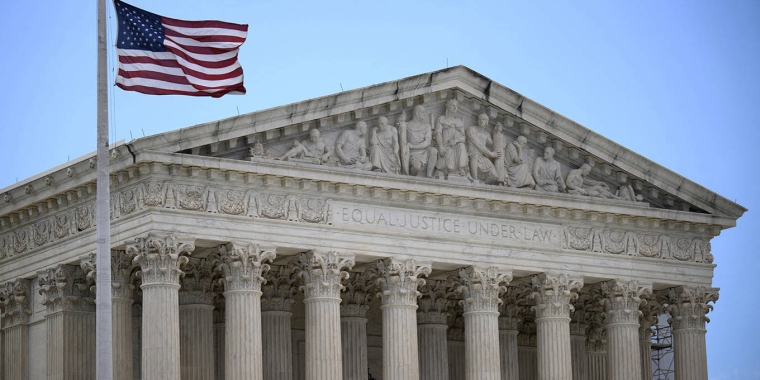
The US Supreme Court did the right thing by ruling that the International Emergency Economic Powers Act of 1977 (IEEPA) “does not authorize the President to impose tariffs.” Half of the Court’s conservative majority has, at long last, stood up to US President Donald Trump’s brazen overreach of executive power.
The Court, claiming “no special competence in matters of economics or foreign affairs,” stayed in its lane, as dictated by Article III of the US Constitution, and focused solely on the legality of Trump’s signature tariff policies. Its 6-3 decision, with three conservatives joining the Court’s three liberal justices, effectively positioned the rule of law as the ultimate arbiter of terrible economic policy.
The Court’s argument is based on a simple principle that Americans learn early in their education: Under the separation of powers doctrine, the Constitution grants taxing power solely to Congress. The corollary is that, notwithstanding the Trump administration’s absurd protestations, tariffs are indeed taxes on US companies and households. As Chief Justice John Roberts wrote in the majority opinion, the Court was not about to allow such a “transformative expansion of the President’s authority over tariff policy.”
Claiming no special competence in legal matters (apart from having a small office at Yale Law School), I am compelled to weigh in on the ruling’s economic implications, which align with the Court’s underlying reasoning for three key reasons.
First, trade deficits are not the “emergency” that Trump claims – his justification for invoking the IEEPA and recklessly wielding the tariff cudgel. The United States has run annual trade deficits in manufactured goods since 1976. Last year, despite the sharp increase in Trump’s now-illegal tariffs, the US trade deficit in goods hit a new record of $1.2 trillion.
The real emergency is America’s extraordinary lack of savings. The net domestic saving rate fell to an estimated 0.2% of national income in 2025. Without domestic savings to fund economic growth, America must import surplus savings from abroad and run outsize balance-of-payments and trade deficits to attract this foreign capital. Owing to massive, persistent federal budget deficits, aided and abetted by Trump’s own policies, an anemic savings trajectory promises huge trade deficits in the years to come.
Second, tariffs hurt US businesses and consumers. Despite Trump’s ridiculous claims to the contrary, tariffs are not paid by foreign countries; they are duties paid by importers for goods upon arrival in the US. The principal dissent to the majority opinion, written by Justice Brett Kavanaugh, claims that “Congress ordinarily seeks ‘to give the President substantial authority and flexibility to protect America and the American people.’” Trump’s tariffs have done the opposite.
Recent research by economists at the Federal Reserve Bank of New York found that nearly 90% of the tariffs’ economic burden has fallen on American consumers and firms. While this research was unfairly trashed by National Economic Council Director Kevin Hassett, that is more a reflection of Hassett’s sycophantic character – a common trait among Trump’s top economic officials. In reality, the Fed’s conclusions are consistent with what most other serious studies assessing the impact of Trump’s tariffs have found.
Lastly, there are important global implications to consider. Not only is Trump highly critical of globalization and those “globalists” who support a rules-based world trading system, but his “America First” mantra has taken dead aim at the alliances that have long been so beneficial to the US. Europe and NATO are his primary targets (his tirade against them at this year’s Davos gathering was merely the most recent), but they are not the only ones. Trump is also threatening to unwind the US-Mexico-Canada Agreement that he celebrated as a major policy win in his first term.
Fully 54% of US trade flows in manufactured products are with Europe, Canada, and Mexico. The US trades with these countries out of necessity, not because, as Trump insists, the globalists have a secret plot to undermine America. The US must pay the price for foreign capital if it wants to keep growing, and that price shows up in terms of cross-border trade, including the powerful efficiencies of global supply chains.
Trump’s tariffs have been a shock to the world trading system. While they have shifted the mix of the US trade deficit away from highly tariffed countries like China, the overall deficit remains at a record level, weighing on US manufacturers and workers. But unwinding linkages with Europe, Canada, Mexico, and China is not the answer. It would only divert their trade flows elsewhere, thereby reducing the efficiency and security benefits that have accrued to America. Predictably, in a fit of anger after the Supreme Court’s ruling, Trump imposed a new temporary global tariff of 10%, which he subsequently upped to 15%.
The Court did not address these economic considerations when ruling on Trump’s sweeping tariff regime, nor did it attempt to assess the validity of the so-called emergency required to trigger an IEEPA action. Still, the narrow finding that IEEPA-based tariffs are unconstitutional sends an important message to the American body politic and the rest of the world: US policies may not be personalized by the whims of a vindictive and uninformed wannabe autocrat.
In the end, Roberts put it best: “What common sense suggests, congressional practice confirms.” The Court drove that point home by standing up for the rule of law. When will the US economy and financial markets render a verdict of their own?
*Stephen S. Roach, a faculty member at Yale University and former chairman of Morgan Stanley Asia, is the author of Unbalanced: The Codependency of America and China (Yale University Press, 2014) and Accidental Conflict: America, China, and the Clash of False Narratives (Yale University Press, 2022). Copyright: Project Syndicate, 2026, published here with permission.
We welcome your comments below. If you are not already registered, please register to comment
Remember we welcome robust, respectful and insightful debate. We don't welcome abusive or defamatory comments and will de-register those repeatedly making such comments. Our current comment policy is here.