
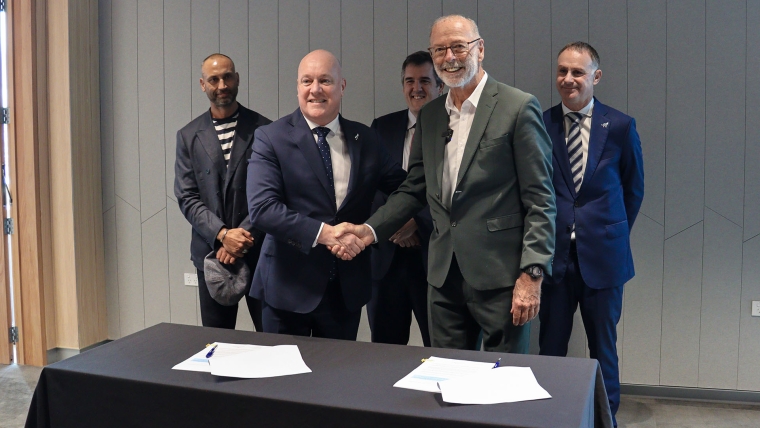
Plans to cap council rates remain a contentious point between the Government and Auckland Council. Left out of Auckland's 'city deal' after they "agreed to disagree" on the matter, Prime Minister Christopher Luxon has signalled the possibility of exemptions while Auckland Mayor Wayne Brown continues to dismiss capping as ill-conceived.
The Government and Auckland Council signed Auckland's 'city deal' on Friday - a 10-year city and regional agreement between local and central government, with an aim to progress growth, housing, better management of local assets and a way to close the infrastructure deficit.
An ongoing gripe between the parties has been the government’s plan to introduce a rates cap - which was not included in the deal. Rates capping has drawn criticism from some councils. RNZ reported Mayor Wayne Brown describing it as a "fascinating piece of nonsense from Wellington".
Asked about this on Friday, Prime Minister Christopher Luxon cooled expectations - saying the Government, while working its way through the rates cap implementation, had “already put in place the idea that there will need to be exemptions for certain activities and things that happen”.
Brown followed up by saying rates capping was not in the deal because they did not agree on it, as it was something “that's arrived without any input from us”.
“If we [had] known it was coming, I'd have pointed out that I didn't think it was a particularly clever thing to do.”
Brown said there would be “a debate about it, because these guys are in a scrap with other political parties, and they've got to come up with things which sound better than what the other guys [have]”
“I'm not in that scrap. And so it's probably quite a good idea to include us..."
Brown said Auckland was “the biggest lump of local government, to do it without actually working out what is the actual implications here… they still have the ability to do those sorts of things as well".
"But, I mean, there are things you could rates cap. Electricity prices would be pretty cool.”
Local Government Minister Simon Watts took a different approach.
“I think what this shows is that mutual respect," he said. “We've agreed to disagree on this matter. It's not [in] the deal, but we're going to work our way through that.”
Watts said they would “absolutely” still be pushing ahead with capping. “But the reality is, in this deal structure, we've agreed to disagree around inclusion within the deal.”
Watts said the commitment around rates capping was “very simple, make sure that we've got a mechanism of increasing rates that is affordable for rate payers”.
“I don't think there's any disagreement around the reality that across the board, 20% increases year on year is not affordable."
The government first announced it would be progressing a rates cap for local councils in December, and suggested a target range of 2% to 4% increases, per capita, per year.
“Actually, when you look at the Auckland profile of rate increases, actually [it’s] within range,” Watts said.
We welcome your comments below. If you are not already registered, please register to comment
Remember we welcome robust, respectful and insightful debate. We don't welcome abusive or defamatory comments and will de-register those repeatedly making such comments. Our current comment policy is here.