
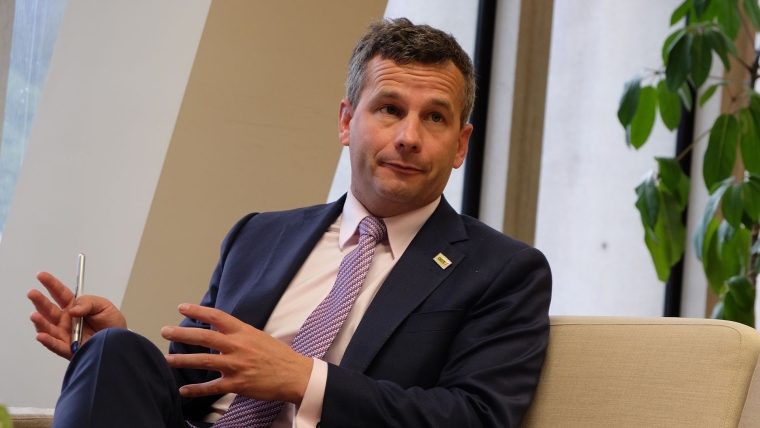
ACT leader David Seymour has long pushed to cut the public service back to 2017 levels, but when it comes to shrinking government, he says reform should start at the top.
Seymour in February cemented the view he first floated more than a year earlier - calling out what he described as "vanity portfolios" such as the establishment of the Minister for Auckland, and promising no more than 20 ministers and no more than 30 government departments.
Speculation around the reduction of public service agencies circulated widely last year, with the outcome that eventuated being a merger of Ministry of Transport, Environment and Housing and Urban Development.
Expanding on his policy proposal, the Deputy Prime Minister told Interest.co.nz, “MMP has led to this proliferation of ministers and portfolios."
“As soon as you're a minister, you start producing Cabinet papers. Now you imagine a Cabinet of 10 people. Maybe they average a paper a week. So you've got to read 10 papers.
“But once you get 28 ministers, if they all produce a paper every week, then that's an average of 28 papers,” sometimes getting up to 50 a week going through government.
“My challenge is, can any government… really say that it's fixing what matters when you just get this mass proliferation?”
Then there’s the number of departments, he says.
“A lot of ministers are, in theory, controlling multiple departments.
“But then… actually a lot of departments have multiple ministers. So you look at the Ministry of Business, Innovation and Employment (MBIE), there's 23 different ministers that the chief executive of MBIE theoretically answers to.”
Seymour said he was in the minority of one of about five ministers who are not part of MBIE.
“In that environment, can you say that you've got a minister with a budget of taxpayers' money, a contract with the department to deliver certain services and strong... accountability?
“If you really bring in the focus, then I think you can get a lot better results. Because at the moment, I think there's a frustration on both sides of politics - we just put all this cash in, and the results don't come.”
On how he would logistically propose to reduce government, Seymour said it was “surprisingly easy to establish or disestablish a department.”
“I would start, and this is what we'll campaign on, 20 ministers all in the Cabinet.
“No department has more than one minister, no minister has more than two departments. If you did that, I think you'd very quickly focus the mind of those ministers on how do we crunch down and focus on what matters most?”
It's Seymour's long-held belief that has drawn criticism from the Public Service Association (PSA) - calling his proposal in February as being "straight out of the hard-right playbook - slash and burn now, worry about the consequences later."
PSA national secretary Fleur Fitzsimons called the "lazy politics."
"The truth is New Zealand needs a capable, well-resourced public service to tackle the challenges ahead. Seymour's slash-and-burn approach would leave us weaker, less prepared, and less able to protect New Zealanders when they need it most."
14 Comments
I'm wary of these kinds of proposals. The flip side is that we end up with to few people (sometimes the wrong people) with too much power.
The current occupants of the Whitehouse for example.
“Work expands so as to fill the time available for its completion.” So theorised Northcote Parkinson quite some time ago. He added that the same applies to people available. In addition to that you get the practice of empire building. The more staff I have the more I can elevate myself and increase my package.It is rife and absolutely counterproductive and by no means limited to the public service. The introduction and innovation of increasingly superior computer services should have reduced time and increased efficiency of communication, research and records but it hasn’t which tends rather support Mr Parkinson.
There was enough surplus energy going into the NZ (and global First-World) system, for us to indulge in specialisation to a degree never seen before. That is well documented: Surplus Energy Economics | The home of the SEEDS economic model – Tim Morgan
and that site is worth a few hours thoughtful perusal.
What we are now doing is entering a period of increasingly less surplus energy - showing up in deferred maintenance physically, and as debt (which is a demand on future energy. The squeeze is showing up un hithertofore 'fundable' things like Local Body infrastructure (needs built and maintained), Health (ditto) Education (student debt increased and prolonged Professorial incomes, but if there are no jobs to do the repaying?).
It is hitting everywhere, everyone, all at once - a sinking lid on discretionary activities, and we'll hold on to the basics as it lowers.
Complexity having been a feature of the surplus energy period, it is predictable that simplification will follow on the way down.
Seymour is a flea on the page, in that regard; a tout for a small section who wish to advance themselves, vis-a-vis the rest. But he raises a valid question: What can we maintain? What should we maintain? And how do we do that?
Start by making your own life a bit simpler., before you have to. If you are food and energy (solar / wind) self sufficient you life will be easier going forward. Do maintenance now , paint the roof. Quotes are competitive now, take advantage of that.
Plant a Vege Garden, food prices will not get cheaper ever again. Make friends with locals who have horses, the fertilizer is free. Ask friends what they grow, whats easy and whats hard.
Horse poo tea is a nutrient-rich, organic liquid fertilizer made by steeping aged horse manure in water for 1–2 weeks, usually at a 1:5 ratio (manure-to-water). It provides nitrogen, phosphorus, and potassium, improving soil health without salt buildup. Dilute the tea to a light brown "weak tea" color before applying to plants. Buy a couple of those big blue bins (I was given 10 many companies want to dump them), rinse out then drill a small hole and cut in half with a jigsaw (takes 2 mins).
https://www.kingsseeds.co.nz/?srsltid=AfmBOoo_VX65VWOZT4yzC612wUj_IjPmp…
Quotes are competitive now, take advantage of that.
Not sure on that front in all areas. A friend of mine recently got quoted $12k for 17m of fence. Ended up doing it himself for under $2k of materials and some time.
His idea on paper sounds good but in practice is very likely to result in much reduced services. Like most politicians I'm convinced they do very little leg work on ideas they sprout forth on. Require the civil service to do it for them or employ outside consultants when they're in office. Some where in between the current excess of ministers, number of departments and civil servants and DS's idea is the answer. A large study needed to evaluate this. I've always wondered if the MPs of a party who are not a minister or associate minister do any leg work for their minister/s.
I know of a 'ready to export' framework [used by MNCs and public-sector trade offices outside Aotearoa] that is being adapted for AI implementation. Such tools would remove the need for many MBIE / NZTE employees.
Many countries manage to get things done with fewer ministries. At a federal level, Germany has about half as many as New Zealand. Little Switzerland has seven. And it's not badly run.
MBIE the whipping boy again
Organizations can do much to stifle the potential of the people who belong to them. And those people whose vision is only shaped by unproductive organizations are probably in a worse position.
They are a massive department and had large expansion in employees from 2020 under the previous govt. So many 100k+ roles going at the time and one only needed less than half the experience needed given the worker shortage back then.
I would start with a review of our MMP Electoral system.
Too many unelected MP's. We need a time and motion analisy's on what they actually do.
Other than looking for irrelevant problems to solve.
Then we can down size the Public Service as necessary
I wonder if there's a correlation between the number of bosses and staff churn.
23 ministers with an interest in MBIE's running is just impossible to manage, and looks like an organisational 'no show without my say so' game where people fearful of being left out have elbowed their way in over the years: a kludgeocracy.
We need much greater clarity in areas of responsibility to improve functionality before anything else.
a kludgeocracy.
Like this word.
Not my neologism, but so applicable to so much of what gets done here.
Time to stop printing PSA news releases. Fleur Fitzsimmons just says the same thing. Four times a day.
Let's get rid of policy advisors and analysts. 100 people writing papers to each other and redrafting policy do poorer work than two people drafting up stuff they are accountable for.
Not entirely so. Ministerial advice is collated from the analysis etc of these sorts. Whether they actually read it, and again if they make decisions supported by it is another story entirely. Treasury seem to have had some reasonable advice over the last 6 years that hasn't been acted on or considered seriously enough.
We welcome your comments below. If you are not already registered, please register to comment
Remember we welcome robust, respectful and insightful debate. We don't welcome abusive or defamatory comments and will de-register those repeatedly making such comments. Our current comment policy is here.