
sign up log in
Want to go ad-free? Find out how, here.

ACT Party leader David Seymour says New Zealand is ‘over governed’, announces his party will be campaigning for a ‘smaller, more efficient Government’

Public Policy / news
ACT Party leader David Seymour says New Zealand is ‘over governed’, announces his party will be campaigning for a ‘smaller, more efficient Government’
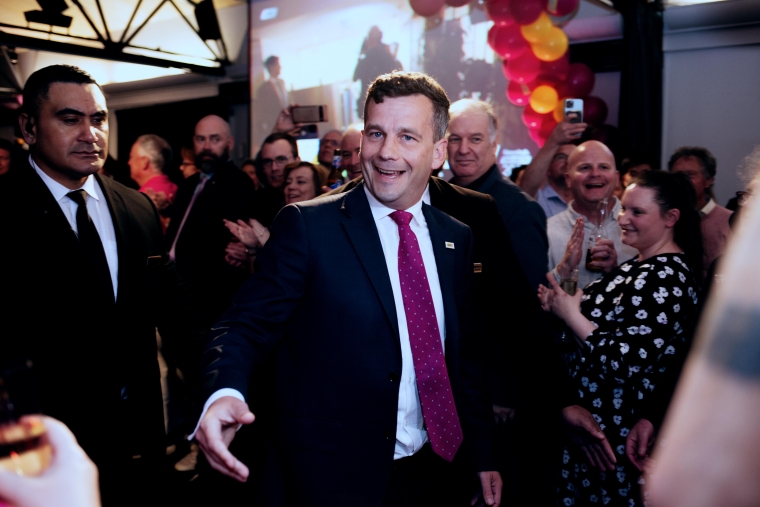
Act Party leader David Seymour celebrates winning two electorates and eleven seats in Parliament
Act Party leader David Seymour celebrates winning two electorates and eleven seats in Parliament in 2023. Image source: Dan Brunskill

The ACT Party will be campaigning for a Government that has no more than 20 ministers who all sit in Cabinet and no more than 30 departments.

ACT leader David Seymour made this announcement as part of his State of the Nation speech in Christchurch on Sunday. But this proposal is not a surprise, with Seymour initially bringing up the concept of a smaller Government in a speech to the Tauranga Business Chamber in May.

Seymour says New Zealand is “over governed” and questions why a small country has such a large Government.

Currently, there are 28 ministers, two under-secretaries, 81 portfolios (77 ministerial portfolios and four other ministerial entities like Child Poverty Reduction, Auckland, Ministerial Services and South Island) and over 40 departments.

“Norway, a similar size to us, governs with 20 ministers across 17 coherent ministries, each clearly aligned to a broad policy domain,” Seymour says.

“The whole structure is set up to preserve itself. Why are there barely fewer bureaucrats than when we started trying to cut the numbers two years ago? Because the structure is set up so nobody is completely in charge of anything.”

Seymour says one department, the Ministry of Business, Innovation and Employment, works with several ministers and some ministers have several portfolios.

“Nobody is solely responsible for getting a set of outcomes for a budget.”

And some ministers exist without any department at all, he says. “Labour appointed a Minister for Auckland without any actual budget, department, or responsibility. I call them vanity portfolios.”

Seymour says the net results of this are “unsatisfying” results, “running all these agencies costs one third of the economy” and “the regulatory activity and interference from these agencies puts another layer of costs onto New Zealanders”.

“We’ll never balance the budget, raise wages, or restore trust in democracy when Government is so large, inefficient, and unaccountable to New Zealanders.”

As part of this proposal, Seymour says there would be:

  • No more than 20 ministers who all sit in Cabinet
  • No more than 30 departments so most ministers have only one
  • No department answers to more than one minister
  • No minister has a portfolio, there are only departments with budgets to manage

“Instead one minister will be solely accountable for getting results for their budget of taxpayer money from their department,” Seymour says.

He says there would be “no more vanity portfolios designed to appeal to a group of people”.

“Reducing the number of ministers will save money, but it will also change the point of being a minister.”

Seymour says with a smaller Government, “a small business owner will spend less time and money battling paperwork and bureaucracy - an immediate productivity boost”.

“Over time, they’ll benefit again as the Government takes less of what they earn, returns to surplus sooner, and needs less of their taxes to sustain itself. More productivity, more jobs, higher wages – all the Government needs to do is less.”

“The Public Service Commissioner has said he wants to see a consolidation. The Government actually has merged Environment, Housing, Local Government, and Transport into one Ministry,” Seymour says.

“This is an idea whose time has come, and we will be campaigning to ensure it happens completely.”

'That starts at the top'

During his speech, Seymour also talked about how the cost of living crisis was also a productivity slump, the Government not balancing the books, people losing faith in institutions, and his party's views on an "inclusive" New Zealand society and identity.

“If we’re going to make life affordable again, raise productivity, balance the budget and restore faith in our democracy, we need to take three key steps," Seymour says.

“We need an inclusive and uniting story about ourselves as pioneers and adventurers. The good news is, that’s a pretty good description of our actual history. We just need to tell it.

“We need to stop reaching for easy fixes, and finding a different group to blame each time there’s a problem. The good news is that our pioneering history sets us up well to navigate a fast changing world and find those smart fixes.

“We need a smaller, more efficient government, that frees up people’s time and money to provide for themselves and their families. That starts at the top.”

We welcome your comments below. If you are not already registered, please register to comment

Remember we welcome robust, respectful and insightful debate. We don't welcome abusive or defamatory comments and will de-register those repeatedly making such comments. Our current comment policy is here.

21 Comments

Singapore has ~16 Ministries & ~20 Ministers

Up
2

It is well overdue for a hard look at the structure, operation  and size of  public service in general. Even more so since the huge influx of staff numbers orchestrated by the sixth Labour government which the present government has scarcely addressed. Perhaps the thinking is that if the numbers cannot be individually reduced as as easily as they were employed then scrap entire departments. Theme music from Roger Hall’s TV series Gliding On, playing in the background.

Up
0

What do you think would happen to the NZ economy if you reduced the size of the government by cutting back significantly on the public sector workforce and spending in general? Would we see more economic activity for business and more employment opportunities for NZ workers as a consequence? Would the lower taxes we would pay deliver the boost demand needed by the retraction of government spending? Would the additional costs put onto the private sector be helpful or damaging to the NZ economy? Would our quality of life be improved by the necessary reduction in infrastructure and welfare spending or would it become harsher and more disruptive for ordinary NZer's?

Can you find an example of a country any where in the world that operates with a very small government and still provides a decent standard of living and a resilient  economy?

Up
3

"What do you think would happen to the NZ economy if you reduced the size of the government by cutting back significantly on the public sector workforce and spending in general? "

Probably nothing - judging from the insignificant improvement achieved when Labour increased the size of the public service by 18000/40% between 2017-2023. At average over $100k each that's ~$2 Billion pa of jobseeker / jobsworth / make work support that could be better spent.

Up
0

That is $2 billion dollars going into the private sector. Where do public sector employees spend their money? Do they have some special government access to non-private sector resources? No they don't. All of those incomes are being spent on groceries, mortgages, cars and clothes - all in the private sector. 
This is debt free new money being injected into the economy and it has a significant multiplier impact across the private sector.

Up
2

From years of experience I am a firm disciple of Northcote Parkinson’s theory that work creates and expands itself relative to time made available. To which can be added - and staff available. Appreciate your points but it does not address the conditions of empire building, shirking, duck shoving, unaccountability and sheer inefficiency that the presence of unnecessary numbers of staff will inevitably produce in any work environment.. 

Up
0

Of course, human nature being what it is at the micro-economic level there are inefficiencies and poorly designed workflows in every organization - public and private. The COVID period probably distorts things a little and as the private sector was effectively stopped in it's tracks from a macroeconomic and Keynesian perspective it makes sense to provide demand for labor through the public sector at that time.

Is 'efficiency' actually a valid end goal for businesses and government organizations? Shouldn't the end goal be the delivery of a particular product or service for which there is need or demand? Efficiency is one of the tools that can be used to help that delivery process - it isn't an end goal in and of itself.

Up
0

Is 'efficiency' actually a valid end goal for businesses and government organizations? Shouldn't the end goal be the delivery of a particular product or service for which there is need or demand? Efficiency is one of the tools that can be used to help that delivery process - it isn't an end goal in and of itself.

Assuming you've only got so many resources

The less efficient you are

The less stuff you get to use/procure 

Up
0

Singapore is a great example. The welfare state is funded through compulsory savings and insurance:

  • The 3Ms Framework:
    • MediSave: A mandatory health savings account where residents set aside a portion of their income to pay for personal or family medical expenses.
    • MediShield Life: A mandatory, low-cost national health insurance scheme for large hospital bills and selected costly outpatient treatments, designed for all citizens and permanent residents.
    • MediFund: A government-provided safety net for needy citizens who cannot cover their bills even with Medisave and MediShield.
Up
3

Singapore housing is almost completely state controlled - if Act get on board with this we might be getting somewhere:

"Singapore's housing policy, primarily managed by the Housing & Development Board (HDB), provides affordable, 99-year leasehold flats for over 80% of residents, with ~90% homeownership. It utilizes mandatory Central Provident Fund (CPF) savings, Build-To-Order (BTO) schemes, and significant subsidies (up to $120k–$230k+ for first-timers) to ensure stability, fostering a property-owning society with strong family-oriented priority and social integration. "

Note the phrase 'social integration' - housing developments in Singapore have to be inclusive of a wide range of income levels to prevent ghettoization and gated communities. A bit like Kainga Ora used to do.

Up
5

The entire premise of Acts economic policy is built on a misunderstanding of the true nature of government spending and how it functions in an economy.

Firstly, taxes do not pay for government spending. In the first instance the government - via parliament - declares it's budget and the money to meet this is created by the RBNZ out of thin air. Government spending is created with a keyboard and typed into accounts that commercial banks have with the reserve bank. From there deposits are made directly into private sector accounts.


Up
4

Counter-intuitively, smaller government leads directly to a smaller economy. The private sector alone is not capable of using all the capacity in an economy and government spending is required to make up the difference. This explains why the current government is borrowing more - not less than the previous government. They butchered existing fiscal flows into the economy and as a consequence the economy shrank dramatically and then stagnated for 2 years. 

Automatic stabilizers like the unemployment payments have increased while tax revenue from a contracting private sector have decreased - creating much higher operating deficits and 'borrowing' (bond issuance for savers)


Up
1

Some more efficiency would be nice: how does Simplicity living produce housing for around 35% less per sq metre than government is able to?  

Up
1

The government builds homes to a much higher quality and life span than the private sector because it is serving people with high needs directly and over lifetimes and generations. The government is not trying to make a quick buck on the back of cheap materials and rushed workmanship.

Up
4

With respect, you are completely wrong with this comment if you are responding to Simplicity Homes.

the intention for them is to hold the rental property forever.  I understand they are well built.   
 

We seem to have many middlemen and price gouging and poor project management and consenting processes.  Simplicity seems to have a system to overcome those problems 


Up
0

The government builds homes to a much higher quality and life span than the private sector because it is serving people with high needs directly and over lifetimes and generations

No, they don't. They have double the layers of management who aren't really ofay with building and are more professional managers. Work is usually farmed out to the lowest bidders and the jobs are carried out in such a way that they take longer, and cost more for a worse result.

They're often more bespoke even than private builds, rather than come up with half a dozen or so designs and take advantage of economies of scale.

Up
0

A government deficit is a net positive to the private sector - the deficit is created by taxing less than the government spends which leaves additional new money in the economy and adds to the money supply in the private sector. It is not a cost and is standard for most countries - look at historic economic data across modern economies - surplus is rare and happen as a result of strong economic growth, not government prudence.

Exceptions are countries that have very large trade surplus where new money is added to the economy from exports and foreign exchange - the conversion of another countries currency into the local currency adds to the money supply.

Up
1

An election yet not a word about AI?


Up
1

I have a trifle of regard for the idea of curbing the powers of bureaucracy, but like many of the statements from all politicians, mostly he is hot air.

Up
0

He says there would be “no more vanity portfolios designed to appeal to a group of people”.

I would also like to see this applied to all councils. 

Up
0

Is he referring to the Ministry for Regulation?

Up
0