
Rumor has it that last year, US President Donald Trump delayed his so-called Liberation Day tariff announcement by a day, to April 2, because he didn’t want his unconstitutional trade “emergency” to come across as an April Fools’ Day hoax. This year, Trump defied the calendar with an address to the nation on April 1, touting yet another unconstitutional act—a war with Iran conducted without congressional approval.
Both moves have much in common. Not only do they flout the law, but they also attempt to drive a stake into the heart of the world order. Last year’s tariff shock was aimed at the rules-based global trading system established by the United States. This year’s military shock is aimed at the Middle East, long the world’s most volatile region.
Trump committed these reckless acts without any regard for their likely consequences. No surprise, both have backfired. Despite sky-high “reciprocal” tariffs against America’s purportedly abusive trading partners, the US trade deficit hit a new record in 2025. And despite all the bluster about obliterating Iran’s military power, Iranian missiles and drones continue to wreak havoc in the Middle East, while the country’s strategic chokehold on the Strait of Hormuz has led to the world’s largest-ever oil shock.
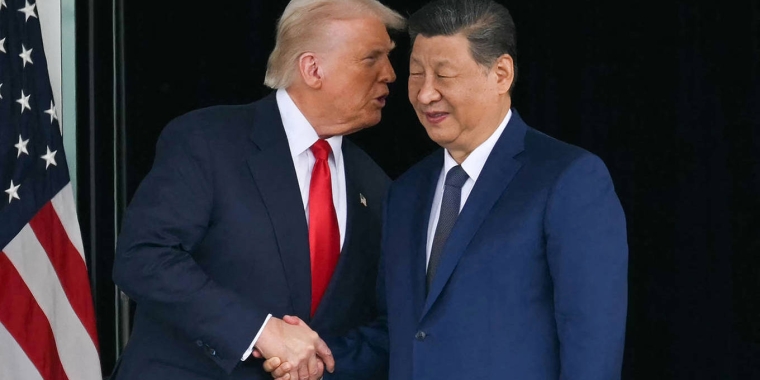
Amid these failures, Trump has set his sights on stabilising relations and building rapport with China, America’s most formidable strategic competitor. That has meant bending over backward to preserve his upcoming summit with Chinese President Xi Jinping, currently scheduled for May 14–15. After postponing the meeting once already due to complications from his war of choice, Trump is so desperate to cut a deal with his “good friend” that he recently turned over a drug smuggler and trafficker to China as a demonstration of good faith. Others claim the summit timeline has been extended to enable Trump to travel triumphantly to Beijing after having declared victory over Iran.
Whatever the reason, America will be at a distinct disadvantage at the summit. Trump needs a win more than Xi does. The Chinese leader is perfectly content to sit back and watch his American counterpart debase himself.
A deeper perspective can be found in the counsel of Sun Tzu, ancient China’s renowned warrior-philosopher. In The Art of War, he stressed that, “When your strategy is deep and far-reaching … you can win before you even fight.” That certainly applies to Xi and his willingness to observe, rather than counter, his adversary. It also applies to Trump and his lack of forethought in declaring a false trade emergency and waging an illegal war.
Iran, for its part, understands the importance of strategy. Despite suffering leadership decapitation and significant damage from the US-Israeli air campaign, Iran maintains a major strategic advantage with its chokehold on the Strait of Hormuz. The real question is why the US did not figure this out.
Look no further than the new National Security Strategy released by the Trump administration late last year. The word “Iran” appeared only three times in the 29-page document. Of course, Trump’s short-sighted fixation on the tactics of obliteration may also have had something to do with it. But why didn’t Trump think strategically before he acted impulsively?
The answer can be found in Sun Tzu’s emphasis on the importance of advice. Trump acts on the basis of personal whim. He wants to be surrounded by sycophants, rather than honest brokers who speak truth to power. Scornful of experts, Trump has stated that the war will end when “I feel it, feel it in my bones.” Sun Tzu, arguing for discipline and reason, wrote, “Assess the advantages in taking advice, then structure your forces accordingly … strategically, based on what is advantageous.”
A deal-focused Donald Trump does not have a strategic bone in his body. He emphasises the number of wars he has allegedly ended (ten, according to his latest tally), tariff revenue (purportedly from abroad), and exaggerated amounts of investment committed by foreign countries to rebuild US capacity. Never mind that these claims are all fictitious—they are now deeply ingrained in the gospel of MAGA and its leader.
By contrast, Xi represents a tradition, dating back to Sun Tzu, that elevates strategy to the highest order. While that does not always work out perfectly for China—I have my own concerns about the efficacy of the current economic rebalancing strategy—the Chinese leadership deserves enormous credit for the value it places on strategic thinking.
The May summit between Xi and Trump is shaping up to be an historic mismatch between a strategist taking the long view and a false prophet proclaiming his supposed successes. Trump, as always, will spin a tale of lies and distortion, underscoring the contrast between The Art of the Deal and The Art of War. Sun Tzu’s perspective would insist that “The one with many strategic factors in his favor wins.”
For two consecutive years, Trump has made massive, illegal policy blunders. I am already worrying about 2027. By that point, if current polling is any indication, Trump’s MAGA faction will have lost control of at least one house of Congress, and American-style autocracy will hopefully be in decline. But an unpopular, angry, and vindictive president will be licking his wounds, intent on retaliating ahead of the 2028 election cycle.
This is not a risk to take lightly. It will be up to a new congressional leadership to right the course for the US. Sun Tzu gets the final word on that possibility: “Leadership is a matter of intelligence, trustworthiness, humaneness, courage, and sternness.”
*Stephen S. Roach, a faculty member at Yale University and former chairman of Morgan Stanley Asia, is the author of Unbalanced: The Codependency of America and China (Yale University Press, 2014) and Accidental Conflict: America, China, and the Clash of False Narratives (Yale University Press, 2022). Copyright: Project Syndicate, 2026, published here with permission.
We welcome your comments below. If you are not already registered, please register to comment
Remember we welcome robust, respectful and insightful debate. We don't welcome abusive or defamatory comments and will de-register those repeatedly making such comments. Our current comment policy is here.