By Stephen Bartos*
This year’s Australian federal government budget combines fiscal policy – taxes and spending – with a heavy focus on better regulation.
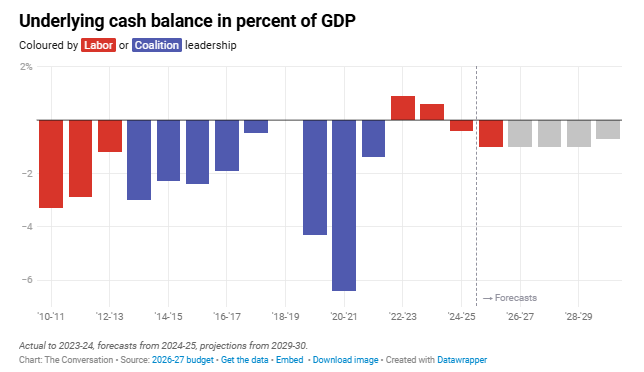
The budget deficit has fallen slightly from the mid-year update in December, to A$31.5 billion, but the budget remains firmly in deficit for the foreseeable future.
Tax reform
There are important reforms to capital gains tax, negative gearing and trusts. While the reforms are significant, the timing is cautious.
The capital gains tax discount – which currently halves the tax on gains made from buying and later selling assets – has made housing less affordable. Pre-budget rumours correctly predicted the time was ripe for this Howard-era policy to be reformed.
The discount will be abolished, replaced by an inflation adjustment for assets held for more than 12 months, with a 30% minimum tax on net capital gains. Changes will only apply to capital gains arising on or after July 1 2027, more than a year away.
The government will also limit negative gearing for residential property to new builds. This, too, will take effect from July 1 2027. The delayed start to the measures means revenue gains only kick in from 2028-29. But they are large, starting at $1.35 billion, rising to $2.28 billion the year after.
In the long term, these changes will help make housing more affordable and the budget more sustainable.
When asked in his budget lockup media conference whether this was a broken promise, Treasurer Jim Chalmers said not acting would have been easy – “easy but wrong”. Reforms will help housing access, particularly for young people. “I acknowledge this is a controversial change,” he said.
A raft of changes
Even larger in budget impact, but more delayed, are changes to trusts. A minimum 30% tax on discretionary trusts is being introduced from July 1 2028. The long transition period is for “small businesses and others that wish to restructure”.
Exceptions include superannuation funds, disability trusts, deceased estates and charitable trusts. Even so the measure is estimated to raise some $4.47 billion in 2029-30.
There is a raft of other measures to cut taxes, mostly small in budget impact and aimed at helping business. They include extending the instant asset write-off for small business, tax refunds on previous losses for small start-up companies, and expanded venture capital tax incentives.
For individuals there is a tax cut, the “Working Australians Tax Offset”, of up to $250 a year. The budget also re-announces a measure from the mid-year budget update, which allows instant tax deductions for expenses up to $1,000 for work-related expenses.
The fringe benefits tax deduction for electric vehicles is being reduced – another tax change with a long phase-in period. It starts small, in fact costing the budget $10 million in the first year, but grows to improve revenue by $1.57 billion in 2029-30.
Spending cuts
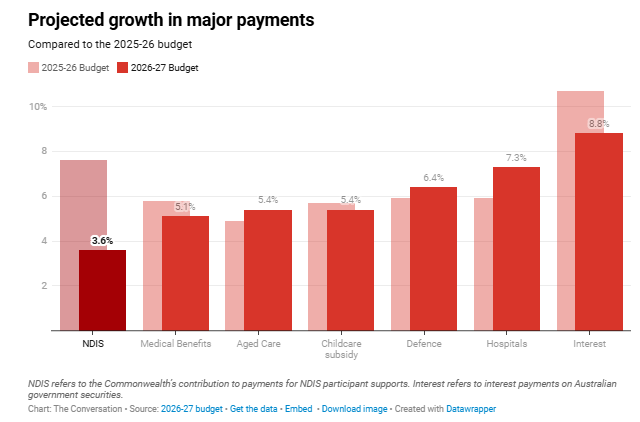
There are previously announced savings in the National Disability Insurance Scheme ($23.9 billion compared with the mid-year update, and $37.8 billion after a recent blowout in estimated costs).
Funds are also shifted between different agencies in government. There are spending increases in portfolios such as defence and social security, cuts in others like climate change and agriculture. Much of the growth in program spending was foreshadowed before the budget, such as more funding for Medicare and responses to the Bondi attack.
Regulatory reform
Past budgets have been mostly about tax and spending. This budget also includes a sweeping package of regulatory reform.
Some of this is in a “productivity package” that includes abolishing nuisance tariffs, faster environmental approvals, streamlining border biosecurity, and making it easier for businesses to engage with government.
A risk for the federal government is many of the elements of the package rely on the states and territories – including reform to the national electricity market, harmonising retail tenancy regulation, and simplifying building regulation.
While this is all highly desirable for improved productivity, history tells us states and territories can hold the Commonwealth hostage. They can demand additional payments or other policy concessions before they act on reforms. It is a risk.
The government has also released a list of 14 legislative reforms to reduce regulation on businesses and households. They are wide-ranging and diverse, from higher reporting thresholds for large companies, through reducing barriers to small bank mergers, to reducing bereavement costs for families.
Better regulation is closely aligned to the productivity agenda. In addition to the reforms aimed at reducing the burden of regulation the government has promised further reviews aimed at better regulation.
It also promises, under the heading “single national market” a set of clear and consistent rules across federal and state governments. Again, progress will depend on the cooperation of other jurisdictions, which is not guaranteed.
In summary, the budget is workable. It includes valuable tax reforms, wide-ranging spending well-targeted to areas of need, and a more comprehensive regulatory reform than in most budgets.
However, there are significant risks. The NDIS savings estimates rely on compliance working. The economic forecasts assume global oil prices start to fall from mid-2026 (just weeks away). The regulatory reform agenda relies on state and territory cooperation.
As the treasurer said in his budget speech: we live in a time of “extreme uncertainty”.

*Stephen Bartos, Professor of Economics, University of Canberra.
This article is republished from The Conversation under a Creative Commons license. Read the original article.
We welcome your comments below. If you are not already registered, please register to comment
Remember we welcome robust, respectful and insightful debate. We don't welcome abusive or defamatory comments and will de-register those repeatedly making such comments. Our current comment policy is here.