
by Anna Whyte and Mandy Te
This election marks a pivotal point in the future of New Zealand, NZ First leader Winston Peters contends, as the country closes in on election day - November 7.
National has just undergone two leadership confidence votes in the space of a few months, and now is faced with whether it can turn its bruising period around to reconnect with voters. Meanwhile the cost of living remains front of mind for voters, but with limited funds for big party promises, the political landscape for spending is tough.
Interest.co.nz asks political commentators what they think National needs to do and whether parties are giving voters hope this election.
National’s election campaign
A major party leader surviving two votes of confidence is something former Minister Peter Dunne can't recall during his 33 years in Parliament.
There were various rumblings during the time of David Lange.
"In the end it was pretty clear that the caucus was becoming more and more dissatisfied and less united, and he chose to resign, but I've never experienced a situation where two formal confidence votes have been held in such a short period of time in the lead up to an election."
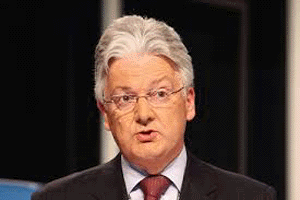
The situation feels damaging, and National needs to do something big, and get some big results, Dunne said.
While time is of the essence, Dunne said National needed to concentrate on their successes, "ironically, this comes down to people like Erica Stanford in education, some of the infrastructure stuff that Chris Bishop has done."
"You get a sense at the moment... it's a bit like a repeating record, really. They're just saying the same old thing, and it's not resonating with people."
"The other thing they've got to do is put the blowtorch much more strongly onto Labour... contrasting Labour's record with National's record, because a lot of people still have reservations about Labour's time in government and National needs to do a much better job reminding people of the things they didn't like three years ago."
National sitting in judgment
Political commentator and former Labour staffer Esther Robinson said National cannot rerun its 2023 campaign.
"At the last election, voters were principally judging Labour’s record. This time, they will be judging National’s."
"National’s campaign therefore needs to move from talking about Labour, to demonstrating why a second term would leave households and business materially better off. This is a hard sell as relief won’t be felt before the election," Robinson said.
"In effect, National is asking voters to bank a recovery they have not yet experienced and trust that it will reach them during another three years in government."
Owner of Curia Market Research and former National staffer David Farrar does not think National needed to drastically change its planned 2026 election campaign, despite this week's confidence vote on Christopher Luxon's leadership.
"Look, this is messy, no one in National would have wanted this. But actually, after the last time it happened, Luxon had a very good two-three months, he was sharp on message."
"They've still got some important laws to pass through the House. Tying into the cost of living, one of those is the rate caps legislation, and Labour have yet to come out with a position on it," said Farrar.
"National would probably be hoping Labour votes against it, because that's going to give them a great whacking stick about 'Labour's voted to allow 20% rates increases', in the future."

Farrar said National needed to remind the public about work done on law and order. "Likewise, on education, they've got a good story to tell about the changes Erica [Stanford] has made."
Dunne, Robinson and Farrar all were of the view the possibility of National going for a third potential leadership change before the election was very low.
"I think the masochism is not that high," Farrar said. "Like, if you're into that, go find the dominatrix to whip you."
The environment
The cost of living is still top of mind for New Zealanders - power prices are high, food prices are high and petrol continues to fluctuate.
"The ingredients for change politics are certainly present, but under MMP dissatisfaction can fragment across several parties rather than produce a straightforward change of government," Robinson said.
Farrar said in his polls the cost of living was still the biggest issue, and was polling three times higher than the second biggest issue for New Zealanders.
"That's not far off what it was when inflation was 7/8% - before inflation got out of control under the previous government, it was only 2%. So we're definitely not back to the days where inflation, cost of living isn't a factor."
He expected quite a few election policies on the cost of living - with a caveat that the country has "very little money."
"We're in deficit, and it would look very irresponsible for any large-scale tax cuts, welfare entitlements."
Any hope for voters?
Farrar said normally what parties would be doing would be looking how to increase incomes, lower tax and increase working for families.
"What you're probably more likely to see is people doing, I call it 'hopeful' rather than 'hope' - "which is, we're going to do something to the supermarkets, we're going to do something to the power companies, which which is going to reduce the cost of power and food."
Robinson said the political landscape remains open for a party to connect with a message of hope for households.
"The missing bridge is between easing the pressure of next month’s power bill and New Zealand’s prosperity over the next decade," she said.
"Voters don’t just want hope as a slogan. Parties need to acknowledge how difficult things are, offer a believable pathway to improvement and be backed by a plan that withstands scrutiny."
Dunne also did not think any political party had hit the nail on the head when it came to delivering the public a message of hope.
"In previous elections parties have been able to do it because they've been able to paint a picture of what they're trying to achieve, whereas that's missing in this case," said Dunne.
"You've got the Labour Party that seems scared to say anything in case it upsets people, and the National Party that doesn't really quite know what it stands for. It's a pretty dissatisfying situation."
But there's still a lot that could still happen before the election, Dunne said.
There were question marks over what the Greens will do, "are they just going to go along for the ride an risk being jilted by Labour in favour of Opportunity?"
"And the Opportunity Party have still got the big challenge. My gut feeling is they may have peaked too soon," Dunne said.
"There's so many uncertainties. Who knows what Trump will do in the meantime that could completely change the game."
We welcome your comments below. If you are not already registered, please register to comment
Remember we welcome robust, respectful and insightful debate. We don't welcome abusive or defamatory comments and will de-register those repeatedly making such comments. Our current comment policy is here.