
Food prices jumped 4.5% in the 12 months to February, driven by higher prices for meat, poultry and fish.
On Tuesday, Statistics NZ released its latest Selected Price Indexes (SPI) figures. This is a monthly series that features about 47% of the contributors to the quarterly Consumers Price Index (CPI) - New Zealand's official measure of inflation.
The SPI includes monthly data on things like food, alcoholic beverages and tobacco, rental housing, utilities, transport and accommodation services.
Outside of the food prices, the latest data shows a 12.8% monthly hike in domestic airfares - and, notably, this happened ahead of the big volatility in oil prices due to the conflict in the Middle East.
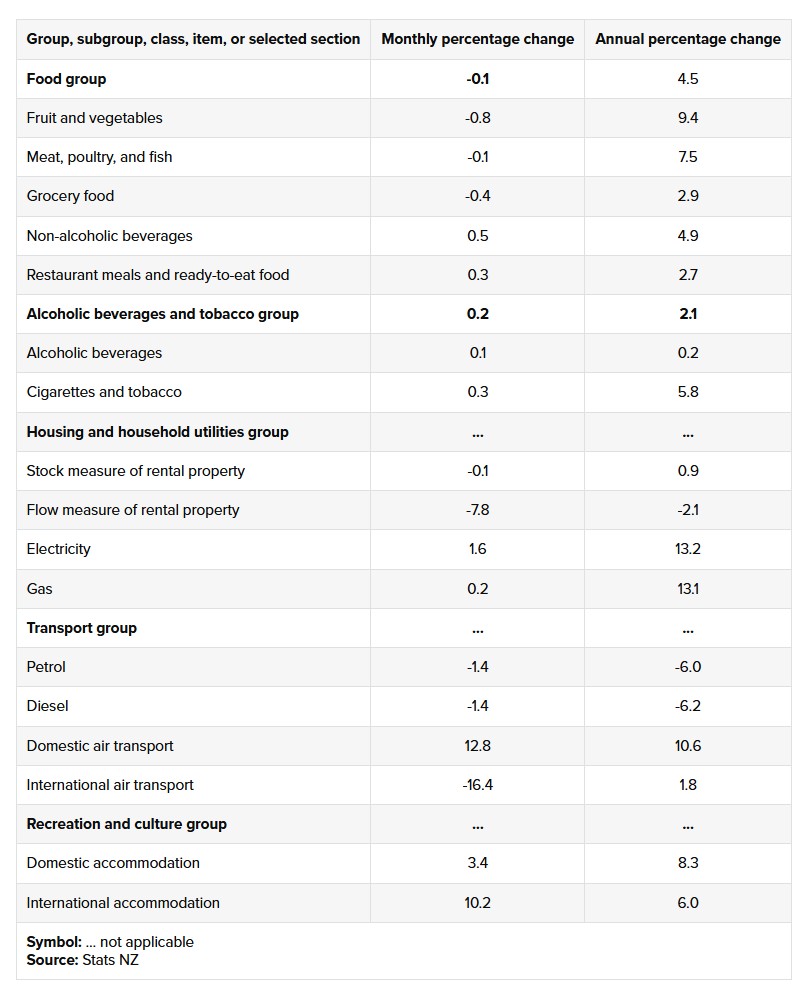
The latest data shows higher prices for the meat, poultry and fish group went up 7.5% and contributed most to the annual increase in food prices. This was followed by fruits and vegetables which increased 9.4% annually.
Compared with January, monthly food prices fell 0.1% with the grocery food group contributing the most to this decrease.
In January, SPI figures showed a monthly rise in food prices of 2.1% - driving the annual rate of food price inflation as of January to 4.2%.
Initially January's SPI figures were reported as the highest monthly rise in food prices in four years at 2.5% and the annual rate of food price inflation in January was initially thought to be 4.6%. Ahead of the latest SPI release on Tuesday, Stats NZ said this mistake was due to human error as the calculations did not include all the supermarket data for January.
The data agency apologised for the error and said the issue does not impact the quarterly CPI.
Food prices make up about 18.5% of the CPI and rent now makes up just over 11% of the CPI so the SPI is a good early guide to what inflation is doing.
As of the December quarter the CPI was recording an annual rate of inflation of 3.1%, which is outside the 1% to 3% target the Reserve Bank (RBNZ) has.
Price for beef mince goes up
The average price for beef mince was $24.46 per kilogram - up 23.2% annually. Previously beef mince was $19.86 per kilogram.
Statistics New Zealand prices and deflators spokesperson Nicola Growden said "the average price per kilogram of beef mince is now $4.60 more than the same period in 2025".
"This is the largest annual price increase in beef mince prices since the series began in June 2006."
Alongside this, beef sirloin steak was $44.71 per kilogram - up 21.5% annually. Previously it was $36.80.
Fresh eggs were an average price of $8.77 per dozen, decreasing 6.2% annually. They were previously sitting at around $9.35 per dozen.
Olive oil was down 22.1% - going from an average price of $22.63 to $17.62.
A block of chocolate was, on average, $6.88 per 250 grams. This was up 20.3% annually - jumping from $5.72.
Cheap as chips
"Kiwis may have seen cheaper prices for some snacks, with the cost of potato crisps, sweets, and chocolate biscuits decreasing over the last 12 months," Growden said.
The average price for potato crisps was $2.14 per 150 grams. This is down 3.2% annually and was previously $2.21 per 150 grams.
Monthly food prices fall by 0.1%
Compared with January, February saw a monthly food price decrease of 0.1%, with the grocery food group contributing the most to the fall, due to a 0.4% dip.
This was followed by fruit and vegetables which was down 0.8%. Meat, poultry and fish was down 0.1%.
But higher prices were recorded for restaurant meals and ready-to-eat food, which saw a 0.3% jump. This was followed by the non-alcoholic beverages group which was up 0.5%
Food prices index
Select chart tabs
Life is like a box of chocolates
Boxed chocolates went from $12.55 to $8.73 per 250 grams - a decrease of 30.4% monthly
"Boxed chocolates were $3.82 cheaper this month than January 2026. There is often a price decrease in February that coincides with Valentine's Day," Growden said.
Chocolate blocks were an average price of $6.88 per 250 grams from $6.46 - this is a 6.5% monthly jump.
Soft drinks went from $3.30 per 1.5 litres to an average price of $3.52. This was a monthly percentage increase of 6.7%.
Apples were down 20.7% monthly - going from an average price of $6.32 per 250 grams to $5.01.
Rent, electricity and gas
Electricity saw an annual increase of 13.2% while gas saw a jump of 13.1%.
The stock measure of rental property went up 0.9% in the 12 months to February.
Airfares rise
Petrol decreased 6% annually and diesel also saw a 6.2% dip.
When it came to domestic air transport, there was an annual 10.6% decrease while international air transport was up 1.8% annually.
Growden said: "This is the largest annual increase in domestic airfares in a February month since 2023."
Alongside this, domestic accommodation jumped 8.3% while international accommodation increased 6%.
Here is the detailed SPI information for February as supplied by Statistics New Zealand:
We welcome your comments below. If you are not already registered, please register to comment
Remember we welcome robust, respectful and insightful debate. We don't welcome abusive or defamatory comments and will de-register those repeatedly making such comments. Our current comment policy is here.