
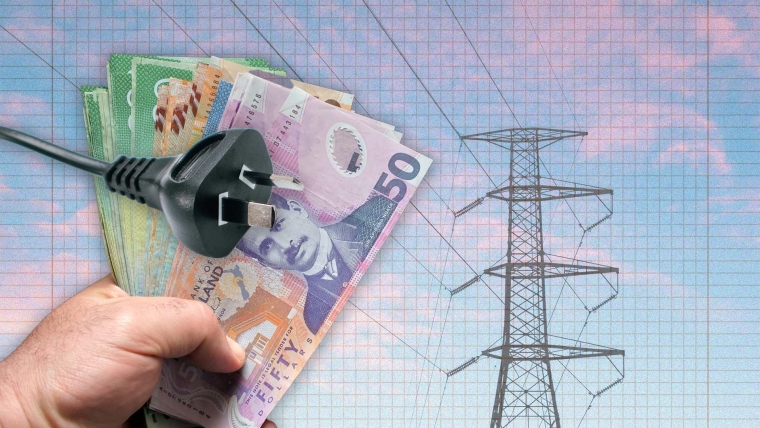
Household electricity costs have risen by around 177% since reforms in 1999 to New Zealand’s electricity industry, a consumer advocacy group says. That’s nearly twice the rate of inflation.
“Even when wage growth is factored in, electricity is now approximately 65% more expensive in real terms. Low-income families have been hit the hardest and are spending an average of 7.5% of their incomes on electricity,” Consumer NZ said.
In its recently released report called Power. At what cost?, the organisation found a quarter of households had trouble paying their bills in the last year, a 5% jump from the previous year.
Of those surveyed, 32% had managed to pay their power bills by cutting back on essentials, while 41% of respondents went without heating to save money.
The pressure to pay power bills wasn’t just impacting those on lower incomes.
According to an Electricity Authority survey: “Across middle-income households, around half describe their bill as at best somewhat affordable. Even among the highest earners (over $150,000), 30% still describe their bill as only somewhat affordable.”
In its report, Consumer NZ said: “For years, we’ve told New Zealanders they can manage their power costs by using less electricity, switching retailers or choosing a better power plan. These actions still help some households, but individual behaviour can only achieve so much.”
The report pointed to four things Consumer NZ believes had led to high power bills:
- Four big power companies - Contact, Genesis, Mercury and Meridian - control most of the retail market and own the generation assets, which gives them advantages that smaller retailers and generators don’t have.
- Power prices don’t always reflect real costs.
- New Zealand hasn’t invested enough in homegrown energy. Consumer NZ said the country needs more renewable energy and dry-year energy capacity.
- Short-term politics and policy uncertainty have prevented the development of a long-term, national energy strategy.
The big four power generator-retailers are Meridian Energy, Contact Energy, Genesis Energy, and Mercury Energy. Currently, the Government owns a 51% stake in Meridian, Genesis and Mercury. Contact is one of the country's largest share market listed companies.
Consumer NZ also pointed to increased lines charges, the removal of a price cap and regional disparity in pricing as other factors contributing to high power bills.
“Household-level behavioural change cannot fix a market that is structurally failing consumers. A family cannot budget its way out of a pricing system that keeps wholesale prices high. A household in debt cannot always switch to the cheapest deal," Consumer NZ said.
“And no consumer can solve a lack of investment in new generation or dry-year resilience on their own.”
Consumer NZ said the current system was working for the gentailers and the market was failing consumers.
“The solutions are not simple, but the direction is clear. New Zealand needs to: end the dominance of the big four power companies, make power prices reflect the real cost of generation, invest in more homegrown energy, [and] set a long-term plan together.”
“New Zealand can continue to patch over the problems in the energy sector, or it can redesign the electricity system around customers,” Consumer NZ said.
“Aotearoa is at a pivotal moment where we can choose to transition to a resilient energy future and bring down power bills for the benefit of all New Zealanders.”
‘Consumers are protected from the fluctuations of the wholesale market through smoothed plans’
Bridget Abernethy, chief executive for the Electricity Retailers' and Generators' Association of New Zealand (ERGANZ), said: “Meeting New Zealand’s growing electricity demand with affordable and renewable energy requires investment.”
“We've seen a renewables boom in recent years - Transpower says 17 new projects are now being connected to the national grid, adding more than 3000 MW (megawatts) of new capacity across wind, solar, geothermal, and grid-scale batteries.”
“In addition, ERGANZ members have $10 billion of planned investment in new generation projects such as geothermal, wind, and solar over the next ten years,” Abernethy said.
“This significantly exceeds historic build rates, and as a result, we’ve recently seen some of the lowest winter wholesale prices in over a decade - forward prices have also fallen. This level of investment into new generation will help deliver a strong supply of affordable electricity for consumers in the long term.”
“At the same time, the four gentailers’ investment in Huntly Firming Options will ensure back-up supply is available when intermittent renewable generation falls short,” Abernethy said.
ERGANZ’s members include Contact, Genesis, Mercury, Meridian and Nova Energy.
Abernethy said electricity price increases were driven by a range of factors including lines charges and transmission costs to upgrade infrastructure to cater for increased demand, retail and generation costs.
“Consumers are protected from the fluctuations of the wholesale market through smoothed plans.
“None of the major reviews of the electricity sector over the past two decades have found that breaking up generator-retailers would lower prices for consumers.”
Energy and politics
Asked how he felt the energy market was doing for consumers, Energy Minister Simeon Brown, on Thursday, said "what we've seen is wholesale prices have dropped significantly since we announced earlier this year the LNG (liquefied natural gas) importation terminal".
“As we deal with the dry-year risk, that is making wholesale prices drop significantly,” Brown said, but what the Government wanted to see was those prices being passed onto consumers.
Breaking up the big power gentailers into separate generators and retailers has been a political topic.
Prime Minister and National leader Christopher Luxon previously told RNZ in March that National wouldn’t be campaigning on breaking up the gentailers. “Our view is that splitting up the gentailers would drive a lot of uncertainty in the energy sector when we need a lot of certainty right now.”
NZ First leader Winston Peters, in his State of the Nation speech in March, announced that his party was proposing to split the big power gentailer companies up “so they could no longer control both the power and price.”
The Green Party has a Member’s Bill from MP Scott Willis sitting in the biscuit tin that aims to separate the generators and retailers.
Meanwhile Labour leader Chis Hipkins said last week that his party had more energy policy to come that was focused on the market and the need to reform the market.
“The market's clearly not operating as it should. It's not giving New Zealand the power prices that we should be able to have, given the abundance of renewable energy that we've got."
ACT isn’t open to separating the gentailers with leader David Seymour saying last week; "if you look at the last three or four years, yes the energy price has gone up, but actually the transmission costs have gone up as much as the price of the actual electricity."
Seymour said ACT would be putting out policy on how to get transmission costs down "because that's what's been hurting people, or at least [it's] about half the problem."

We welcome your comments below. If you are not already registered, please register to comment
Remember we welcome robust, respectful and insightful debate. We don't welcome abusive or defamatory comments and will de-register those repeatedly making such comments. Our current comment policy is here.