
By Chris Trotter*
How on earth did New Zealand’s supermarkets become the catalyst for draconian state interventionism?
While the Greens’ veering sharply in the direction of that Old Time Socialist Religion might have been anticipated, few would have predicted the National Party slipstreaming them quite so blatantly. The upshot of the largest conservative party’s sudden conversion to the doctrines of “Comrade State” has been to make the Labour Party (which once favoured the nationalisation of all farmland!) look like the soul of moderation.
Truly, the 2026 General Election grows weirder with every passing day.
Perhaps the weirdest aspect of this “Crush the Profiteering Supermarkets!” sentiment currently gripping our major political parties is its sheer economic insouciance. It would be interesting to discover which National Party MPs, interviewed privately and with full name suppression guaranteed, would ‘fess up to the news media that they are absolutely confident that the logic of the marketplace can be resisted with enduring success by the intervention of politicians.
My prediction would be: “Not many, if any.”
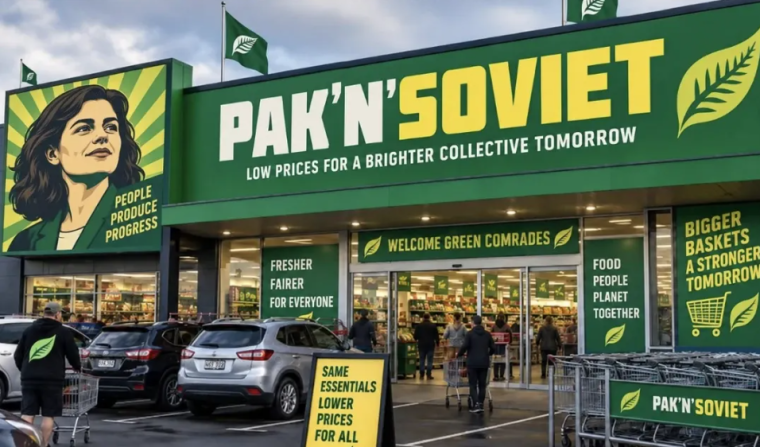
Even among the Greens there must surely be a handful of MPs who are less than certain that nationalising a swathe of private enterprises and setting-up a state-owned supermarket chain will end happily. It requires a tremendous leap of faith (and an almost total ignorance of modern history) to believe that such a supermarket chain could thrive, even in circumstances where all private competition had been abolished. The proposition that that a state-owned “KiwiMart” could successfully compete against two, strong, privately-owned supermarket chains, while worthy of Soviet Russia circa 1926, seems ludicrously heroic in the New Zealand of 2026.
Labour, bless it, still carries sufficient neoliberal antibodies in its bloodstream to resist the temptation of reverting to the economics of Harry Holland (he of land nationalisation fame). Its “solution” to the supermarkets’ alleged profiteering is to:
- Make price gouging illegal, so big companies can no longer rip you off
- Make sure smaller supermarkets can access products at the same wholesale prices as the big players, breaking the big two’s grip on the market
- End the unfair contracts that stop local stores like Four Square cutting their prices
- Stop the giants cutting off supply to smaller supermarkets the moment they start winning customers
- Ban the junk fees they squeeze out of our farmers and food producers
So, when it comes to channelling the spirits of the market-tamers of yesteryear, Chris Hipkins would appear to be inspired less by Lenin than he is by Teddy Roosevelt. Even so, the measures he has announced hardly seem attuned to the prime objective of all private enterprises – i.e. the maximisation of profit.
Nor, strangely, do they show any appreciation of the role played by supermarkets in keeping modern capitalist societies even vaguely affordable.
Without the sheer scale of the big supermarket chains; without their overwhelming market power; the price of the ordinary working family’s basic necessities would be much higher. While abjuring the drama of nationalisation and mandatory divestment, Labour’s policies are every bit as hostile to the market’s implacable calculation of profit and loss.
If voters wish to see “price-gouging” in operation, then I suggest they visit their local dairy or superette. Not that any sensible politician would move against the pricing regime of corner-store retailers. If these hardy shopkeepers didn’t “gouge” they’d go broke. People patronise them on account of their convenience, not for their competitive prices!
Passing laws and/or imposing regulations to equalise the market strength of retailers large and small is equally Quixotic. The profound inequality of market participants is critical to the supermarkets’ profitability. Without it, the savings flowing from their savagely enforced wholesale pricing regime would not be there to pass on to their customers.
Stripped of its monopsonic advantage, the supermarket duopoly would soon fall prey to the avaricious instincts common to every small farmer since Adam was chucked out of Eden. Their incomes would rise, but so, too, would the price of food on the supermarkets’ shelves. The small farmers would praise the market-defying politicians, the workers would curse them.
Perhaps the strangest aspect of Labour’s policy is its firm intent to rid the sector of unequal and unfair contracts, and to prohibit the duopoly’s ruthless deployment of its market power by means of profoundly distorting interventions.
To conceive of such a policy is to betray a completely inadequate understanding of capitalist dynamics. Fairness and equitable treatment are antithetical to capitalist enterprise. Always, the imperative is to absorb and/or eliminate the competition. Monopoly isn’t an aberrant market phenomenon, it is a profoundly rational economic goal.
What the Greens, Labour, and now even National, do not seem to have grasped is that New Zealand’s supermarket duopoly has always been a self-defensive public relations exercise. For many years now the two dominant players used it to protect themselves from the political intervention which an undisguised monopoly would inevitably have prompted. Woolworths and Foodstuffs are competitors, not collaborators. That is their story, and they are sticking to it.
Were KiwiMart to become a reality it would not be long before Chloe Swarbrick and her comrades were forced to accept that you cannot serve God and Mammon.
To provide the voters with more affordable food, along with all the other products essential to a Kiwi household, the state would have to undercut, by a discernible margin, the prices of its private competitors. All other things being equal, this would require KiwiMart’s owners (that would be us) to subsidise a fair number of the items in the average Kiwi shopping basket.
How could the private supermarkets compete? Simple answer: they couldn’t. If they attempted to do so without access to the state subsidisation enjoyed by their publicly-owned competitor, then in very short order they’d go broke. Mammon would drag them under.
In a democracy, unfairness on this scale would be very hard to sell. It would be interpreted by capitalists large and small as a direct threat to their survival and they would deploy all their resources to removing any government reckless enough to let it happen. Responding to such pressure, the guilty government would almost certainly extend the subsidies advantaging KiwiMart to the now struggling private supermarkets.
Good news for consumers. Bad news for taxpayers. Absolutely bloody brilliant news for supermarkets – public and private.
Some might describe all this as ruinous socialism. Others will doubtless characterise it as manifesting kindness in an unkind world. But what nobody should be permitted to get away with calling it, under any circumstances, is capitalism.
*Chris Trotter has been writing and commenting professionally about New Zealand politics for more than 30 years. He writes a weekly column for interest.co.nz. His work may also be found at http//:bowalleyroad.blogspot.com.
We welcome your comments below. If you are not already registered, please register to comment
Remember we welcome robust, respectful and insightful debate. We don't welcome abusive or defamatory comments and will de-register those repeatedly making such comments. Our current comment policy is here.