

In the course of an interesting discussion regarding the importance of dairy to the New Zealand economy, tourism was raised and quickly put to one side, the logic being that if the outflow of money taken by Kiwis going offshore was deducted from the total then the total financial benefit to the economy would pale into insignificance.
As someone involved in ‘hospitality’ I can vouch for the impact both international and domestic tourism has had on our turnover and the border lockdowns certainly made themselves felt, as have the staged openings. Domestic tourism spending was certainly useful and kept us in business but still didn’t make up for what was lost by the absence of the internationals.
So, given this as a backdrop I thought I would do some digging and look at the pre-Covid numbers both in and out of the country and try and ascertain how the balance stood and see if my numbers and impressions married to the stats. Looking at the year ending March 2020 (only a minor disruption by Covid at that stage although the cruise boats absence was already being felt) total tourism spending was nearly $42 bln of which the GST content paid was $3.88 bln so the total sector is certainly important to the government coffers.
Of the $42 bln total, the split between international tourism and domestic tourism is large with domestic making the greater slice at $24.3 bln (58%) and international $17.7 bln (42%). The difference I found a little surprising perhaps the internationals are more ‘visible’ than domestics hence the impression there are more of them.
A graph made up of Stats NZ data provides an interesting comparison with the three columns from 2018, 2019 and 2020. (Different sources provide slightly different numbers but relativity similar).
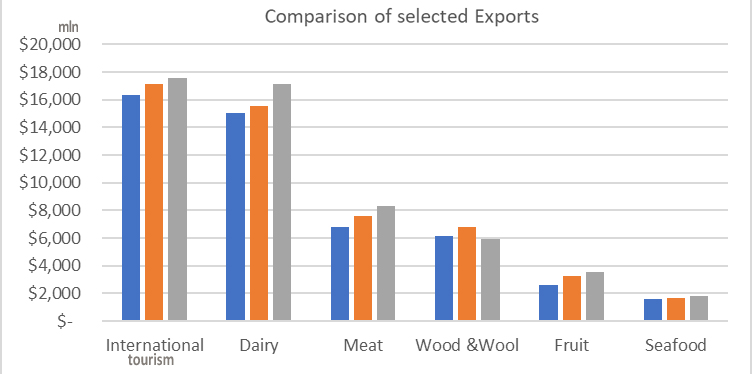
The next question is whether or not Kiwi’s going offshore should be deducted from the ‘financial benefits’ of the international tourists. I have doubts as to the relevancy as money coming in is still money coming in. However, so long as the imported costs to dairy is also deducted to achieve a net benefit then perhaps there is some use in the exercise.
The number of Kiwis returning from overseas trips was a tad over 3 mln in 2018 and not far behind the number of international visitors at roughly 4 mln so a net benefit to internationals but the balance between inwards and outwards not so different.
The outflow of money required to directly support dairy is difficult to calculate but fertiliser is a major obvious one, as is PKE. Fertiliser has been estimated to be around 5% -10% of the milk price, expensive, but it is not going to threaten overall profitability (yet).
Other things which may be required to build infrastructure and to operate on an ongoing basis could equally be applied to both the dairy and tourism sectors so shouldn’t be seen as a factor in my view.
So, based on the above, once the borders are fully open international tourism may not be a stand-alone substitute for dairy, but it is very important to the New Zealand economy.
The 225,000 people directly employed in tourism versus the 50,000 directly employed in dairy attests to that.
And, as stated earlier, I believe that the argument that outgoing Kiwis need to be deducted is a flawed argument as (assuming borders are open) they are going to be going anyway. Whether New Zealand can find anything else as profitable and with the same international competitive advantages (although both sectors appear to be losing these advantages) is unlikely, especially in any timely fashion.
So, it is a matter of improving the benefits of both sectors to make them more sustainable.
However, we shouldn’t be too quick to right off invisible incomes (and outcomes). The Swiss economy has one of the highest rates of GDP in the world based upon it (actually second in 2021) and 74% of that was generated by the service sector and physical exports 24% so there are precedents. New Zealand even had aspirations in that area once, they probably went with the sale of the banks offshore.
We welcome your comments below. If you are not already registered, please register to comment
Remember we welcome robust, respectful and insightful debate. We don't welcome abusive or defamatory comments and will de-register those repeatedly making such comments. Our current comment policy is here.